
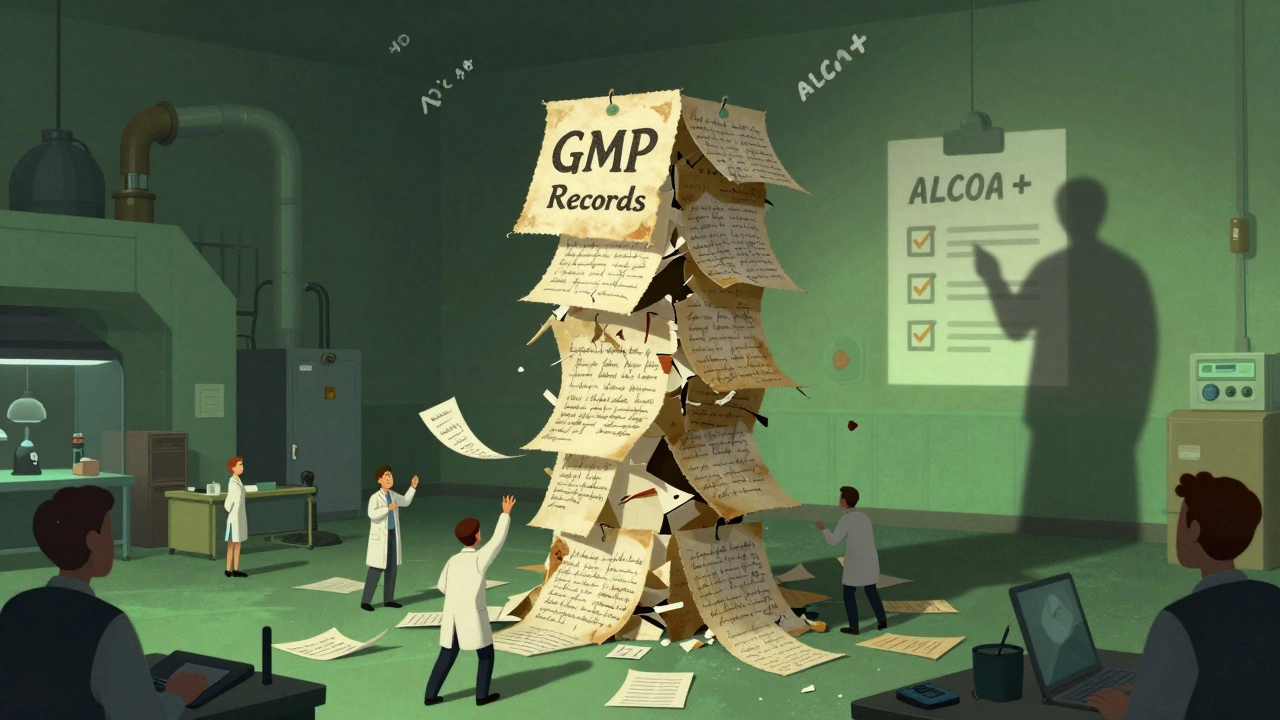
When you’re running a manufacturing line, every batch matters. One missing signature, one unrecorded temperature spike, one handwritten note that fades over time - and suddenly, you’re facing a regulatory warning, a product recall, or worse. In manufacturing - especially for pharmaceuticals, medical devices, and food - documentation isn’t paperwork. It’s your legal shield, your quality backbone, and your only proof that you did things right.
Why Documentation Isn’t Optional
In 2022, a single unrecorded temperature excursion during warehouse transfer led to a $15 million product recall. That wasn’t a glitch. That was a documentation failure. The FDA, EU regulators, and other global authorities don’t inspect your machines or your floors first. They start with your records. If your paperwork is messy, incomplete, or late, they assume your processes are too. Good Manufacturing Practices (GMP) aren’t suggestions. They’re laws. Backed by the 1937 Elixir Sulfanilamide tragedy - where 107 people died from a toxic solvent - modern GMP rules were built on one principle: if it wasn’t written down, it didn’t happen. Today, that means every step, every measurement, every decision must be recorded. And not just recorded - recorded correctly.What Counts as Documentation?
There are two kinds of records you need: procedural documents and compliance records. Procedural documents are your instruction manuals. These include:- Standard Operating Procedures (SOPs) - written in clear, active voice. No jargon. No "as appropriate." If it says "mix for 10 minutes," it means exactly 10 minutes.
- Testing methods - validated according to ICH Q2(R1). If you’re testing purity, you must prove your test actually works.
- Material specifications - like "moisture content: 3.5% ± 0.2% w/w." Vague? That’s a red flag.
- Bills of materials - each ingredient must have a unique ID. No "similar substance" allowed.
- Atttributable - who did it? Name, date, signature.
- Legible - readable. No pencil. No faded ink. No blurry scans.
- Contemporaneous - written at the time. Not at the end of the shift. Not the next day. Within 24 hours, max.
- Original - the first data captured. Not a copy. Not a transcription.
- Accurate - no guessing. No rounding unless approved.
- + Complete, Consistent, Enduring, Available - all data must be whole, match across records, last for years, and be easy to find.
Electronic Systems: The New Normal
Paper records are fading. Most manufacturers now use electronic quality management systems (eQMS). But you can’t just switch to Excel and call it done. Your system must be validated under GAMP 5 guidelines. That means:- 150+ test cases covering data security, access controls, and audit trails.
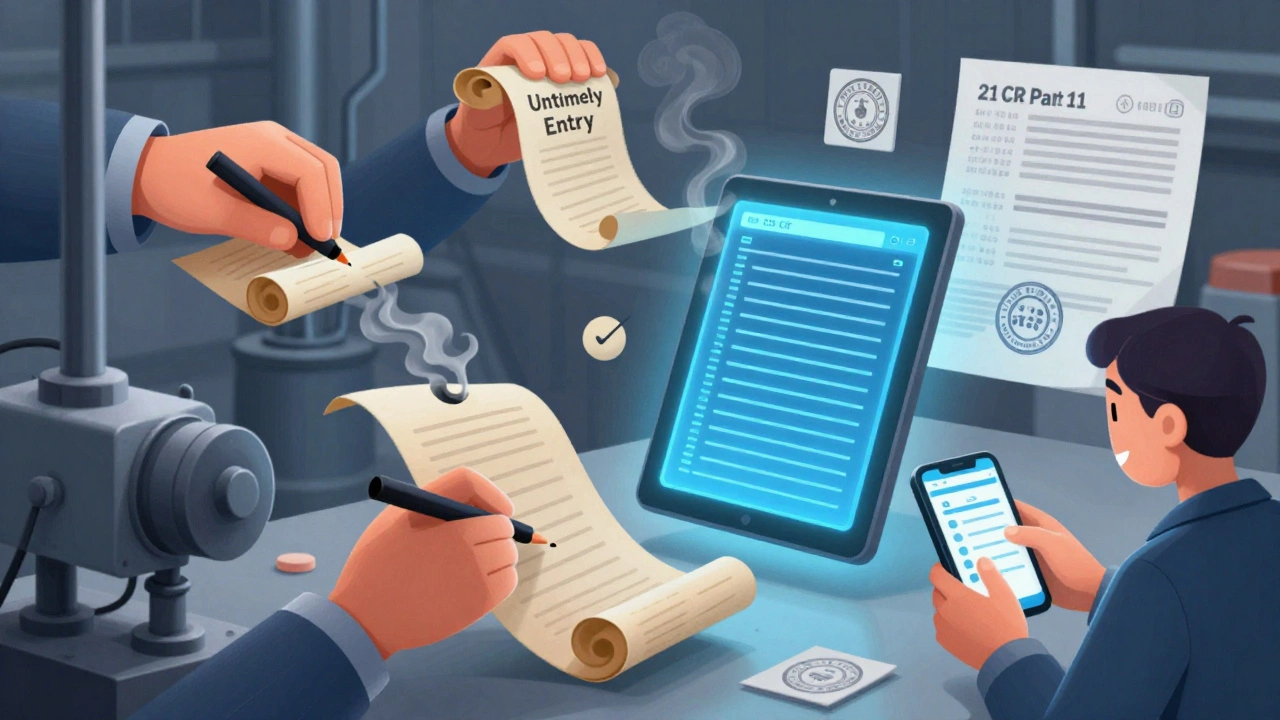
- Electronic signatures that meet 21 CFR Part 11 - not just a typed name, but verified identity with audit logs.
- Audit trails that record every change: who changed it, when, why, and what it was before.
- Data retention for at least 1 year after product expiration - or 3 years after distribution.
Regional Differences That Trip Up Global Manufacturers
You think rules are the same everywhere? Think again. - The FDA requires every calculation to be checked by a second person. The EU lets you use automated verification. - Japan demands all documentation be in Japanese for local approvals. - Medical devices under ISO 13485 need traceability matrices linking every design spec to a test result. The FDA doesn’t require that. - The EU’s Medical Device Regulation (MDR) forces you to document clinical literature searches. The FDA doesn’t. A 2022 study by Emergo by UL found manufacturers juggling U.S. and EU rules spent 37% longer on approvals - and $2.1 million a year just to reconcile paperwork.What Gets You in Trouble
FDA warning letters don’t come from bad machines. They come from bad records. The top three documentation failures in 2022:- Incomplete batch records - 32% of citations. Missing start/end times? Equipment ID? Environmental data? That’s a red flag.
- Inadequate investigation documentation - 27%. If a batch fails, you must prove you looked into why. Not just "it was out of spec." Why? How? What did you do?
- Untimely record completion - 21%. Writing records the next day? That’s not contemporaneous. That’s falsification.
How to Get It Right
There’s no magic software. No shortcut. But there are proven practices:- Write SOPs at an 8th-grade reading level. If your line worker can’t understand it, they won’t follow it.
- Use the "four-eyes principle" - critical records reviewed by two people. One writes, one checks.
- Appoint "documentation champions" in each department. Not QA. The person who actually runs the machine.
- Follow the "5C" rule: Clear, Concise, Complete, Correct, Compliant.

The Cost of Getting It Wrong
A single recall costs $10 million on average, according to Stericycle. Regulatory fines? They’re just the start. Lost trust? Unquantifiable. The global GMP documentation software market is projected to hit $5.1 billion by 2027. Why? Because regulators are watching closer than ever. FDA inspections jumped 44% from 2019 to 2022. And 41% of all Form 483 observations were about documentation.What’s Changing in 2025
The rules are tightening: - The EU’s 2024 update to EudraLex will require risk-based documentation - you must document your own risk assessments for every critical record. - The FDA’s 2023 draft guidance says hybrid paper-electronic systems must have audit trails with at least 1,000 characters per entry. - AI tools are starting to auto-generate batch records from machine data. Early adopters say it cuts documentation time by 45%. But regulators haven’t approved them yet. The message is clear: documentation isn’t a cost center. It’s your quality infrastructure. Ignore it, and you’re not just risking compliance - you’re risking your business.Final Thought
You don’t need perfect documentation. You need consistent, truthful, timely documentation. One line written right today prevents a million-dollar mistake tomorrow. Start with your worst record. Fix it. Then fix the next. And the next. That’s how you build a culture where quality isn’t checked - it’s built in.What happens if I don’t follow GMP documentation rules?
Failure to comply can trigger FDA Form 483 observations, warning letters, product recalls, or even import bans. The average recall costs $10 million, and regulators are increasing inspections. In 2022, 41% of all FDA observations were related to documentation failures. Beyond fines, you lose customer trust and market access.
Can I use handwritten records in manufacturing?
Yes - but only if they meet ALCOA+ standards. Handwritten records must be legible, dated, signed, and created at the time of the activity. Pencil is not allowed. Faded ink or smudged entries are non-compliant. Most manufacturers now use electronic systems because they reduce errors and make audits easier.
How long do I need to keep manufacturing records?
Minimum retention is one year beyond the product’s expiration date. For some products, especially medical devices, regulations require retention for three years after the product is distributed. Always check your region’s rules - the EU and FDA have slight variations, and some countries require longer.
Do I need to validate my electronic documentation system?
Yes. Under GAMP 5 and 21 CFR Part 11, any electronic system used for regulated records must be validated. This includes testing for data integrity, access controls, audit trails, and recovery procedures. Validation isn’t a one-time task - it must be maintained with each system update.
What’s the difference between SOPs and batch records?
SOPs tell you how to do something - like "how to clean a mixer." Batch records are the actual proof that you did it - like "Mixer #3 cleaned on April 5, 2025, by Jane Doe, verified by John Smith." SOPs are instructions. Batch records are your audit trail.
Can AI help with documentation in manufacturing?
Yes - but cautiously. AI tools can auto-generate batch records from machine data, reducing manual entry by up to 45%. However, regulators haven’t fully accepted AI-generated documentation yet. You still need human oversight, audit trails, and validation. Think of AI as a helper, not a replacement.
Why do some companies struggle with documentation even after spending millions?
Because they treat documentation as a compliance task, not a quality culture. The biggest failures happen when QA owns it alone. Success comes when every operator, engineer, and supervisor sees documentation as part of their job - not an extra burden. Training, clear language, and leadership buy-in matter more than software.
What’s the most common mistake in manufacturing documentation?
Waiting until the end of the shift to fill out records. If you write it after the fact, it’s not contemporaneous. Regulators see that as falsification. The fix? Use real-time digital checklists on tablets or mobile devices at the point of work.




11 Comments
Man, I used to think documentation was just busywork until I saw a batch get pulled because someone used pencil on a log. Now I make sure every signature is crisp and every timestamp is right on the dot. It’s not glamorous, but it’s what keeps the lights on.
/p>Also, no more backfilling. I learned that the hard way.
Documentation is the silent guardian of product safety. Without it, even the best processes become invisible to regulators and patients alike.
/p>Consistency over perfection.
Okay but like… why do we still care about ALCOA+? That’s so 2010. I saw a startup using AI to auto-write batch logs from IoT sensors and it was wild. Like, the machine just knew when the mixer started and stopped. No humans needed. Why are we still fighting over pencil vs pen?? 😤
/p>Let me tell you something - I used to be the guy who hated paperwork. Thought it was a waste of time. Then I watched a coworker get let go because a temperature log was missing by 4 hours. That’s not just a mistake. That’s a career killer.
/p>Now I’m the guy who checks everyone’s logs before shift change. Not because QA told me to. Because I care. And if you’re not doing it for the company, do it for the person next to you who’s trying to feed their kid.
It’s not about compliance. It’s about conscience.
Handwritten logs are fine if you’re in a small lab with one shift and a printer that works. But in a 24/7 plant with 150 people? You’re asking for chaos. I’ve seen logs so blurry you could barely tell if it was 37.1 or 37.7. That’s not documentation, that’s Russian roulette.
/p>Switch to tablets. Even if it’s just a cheap Android with a locked-down app. The ROI is insane. We cut errors by 60% in 3 months. And yes, I typo’d that. But you get the point.
It’s funny how something so boring - filling out forms - ends up being the most powerful thing in manufacturing. It’s not about avoiding fines. It’s about knowing you did your part. That someone didn’t get sick because you wrote down the right temp. That’s the real win.
/p>And yeah, AI might help someday. But until then, we’re still humans writing for humans. Make it count.
Love this breakdown. I’ve been pushing for the four-eyes rule in my team and people were resistant. Now they get it after that one FDA visit. Just glad we’re all on the same page now.
/p>OMG YES to the AI thing!! 🤖🔥 I’m using ChatGPT to draft SOPs and it’s actually decent. Just gotta clean it up and add the 5C stuff. Regulators will catch up eventually. Until then, we’re basically living in the future and they’re still using fax machines 😂
/p>One thing missing from this post: the role of leadership. You can have the best eQMS, the most trained staff, and flawless SOPs - but if the plant manager doesn’t walk the floor and ask, ‘Show me your last batch record,’ nothing sticks.
/p>Documentation culture starts at the top. Not QA. Not IT. The person who signs the paycheck.
So we spend millions on software to avoid getting fined for not writing things down… while the actual people who do the work are still using clipboards taped to a forklift. The irony is thicker than a batch of contaminated syrup.
/p>Canada’s rules are way less insane, btw. Just saying.
Real talk: the biggest barrier to good documentation isn’t tech or training - it’s time. Operators are stretched thin. If you add documentation as an extra task, it gets skipped. But if you bake it into the workflow - like a digital checklist that pops up when the machine starts - it becomes part of the rhythm.
/p>We did this at my last job. No one even noticed it was ‘documentation’ anymore. They just called it ‘doing the job right.’ That’s the goal.
Also, audit trails must be tamper-proof. Not just ‘password protected.’ I’ve seen logs edited after the fact with admin rights. That’s not compliance. That’s fraud.
And yes, I’ve seen the 41% stat. It’s not a bug. It’s a culture failure. Fix the culture, not the form.