

DAPT Bleeding Risk Calculator
This calculator estimates your bleeding risk using the PRECISE-DAPT score. Enter your clinical information to receive personalized recommendations for dual antiplatelet therapy duration.
Your Bleeding Risk Score:
Key Takeaways
Low risk: 0-1 point (Standard duration: 6-12 months)
Medium risk: 2-4 points (Consider 3-6 months)
High risk: 5-6 points (1-3 months DAPT, then aspirin alone)
After a heart stent procedure, most patients are put on dual antiplatelet therapy - a combo of aspirin and another drug like clopidogrel, prasugrel, or ticagrelor. It’s meant to stop blood clots from forming inside the stent. But there’s a trade-off: while it saves lives by preventing heart attacks, it also raises the risk of bleeding. For many, this isn’t just a medical statistic - it’s nosebleeds that won’t stop, bruising from a light bump, or scary episodes of vomiting blood. Managing these side effects isn’t about stopping the meds cold. It’s about balancing risk, timing, and personal health history.
Why DAPT Is Necessary - And Why It’s Risky
Dual antiplatelet therapy (DAPT) works by blocking two different pathways that make platelets sticky. Aspirin shuts down one pathway; the P2Y12 inhibitor (like clopidogrel or ticagrelor) shuts down another. Together, they’re far more effective than either drug alone at preventing clots after a stent is placed. Landmark studies like CURE and PLATO showed DAPT cuts heart attacks and stent clots by 15-30%. But that same power increases the chance of major bleeding by 1-2% over a year. That might sound small, but for someone with a history of ulcers, kidney disease, or older age, it’s a real threat.
Not all DAPT regimens are the same. Ticagrelor and prasugrel are stronger and faster-acting than clopidogrel. That means better protection against clots - but also higher bleeding risk. The TRITON-TIMI 38 trial found ticagrelor caused 27% more major bleeding than clopidogrel. Meanwhile, clopidogrel has lower bleeding rates but is less effective in some patients, especially those with genetic variations that make it harder to activate the drug.
Who’s at Highest Risk for Bleeding?
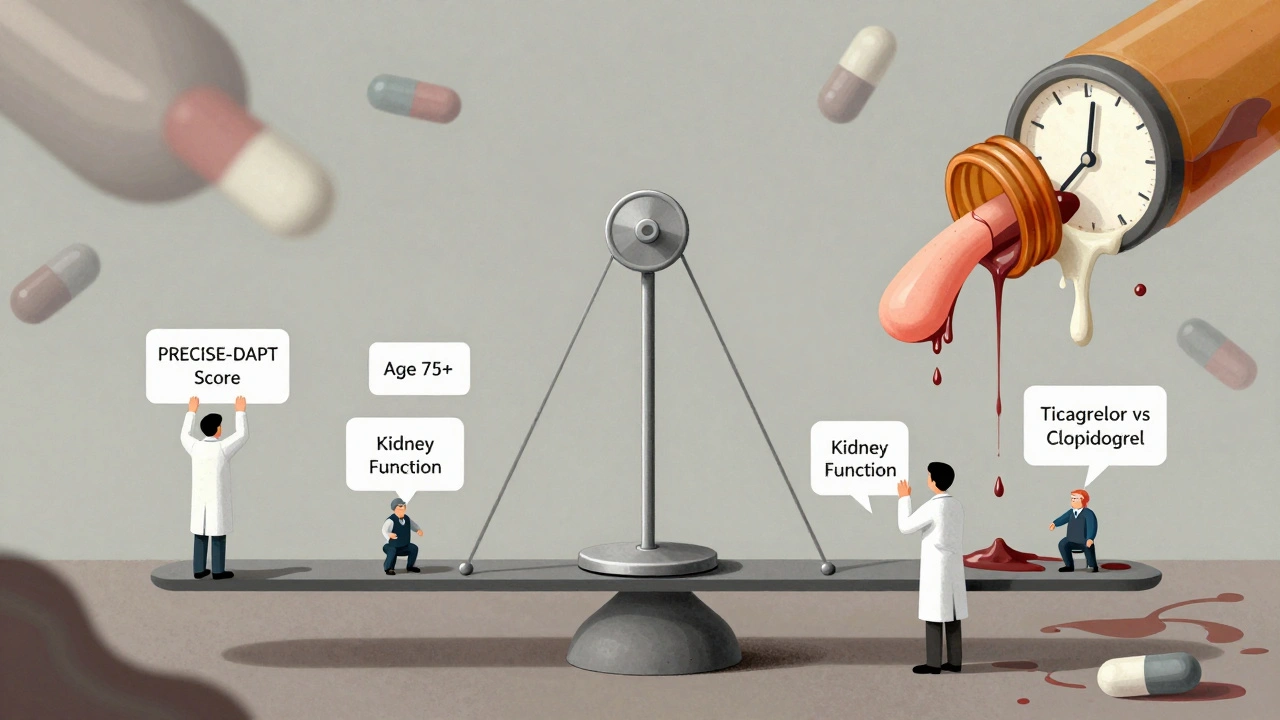
Doctors don’t treat everyone the same. A 78-year-old with kidney trouble, a history of stomach bleeding, and on blood thinners for atrial fibrillation is in a completely different risk category than a 52-year-old with no prior bleeding and healthy kidneys. The PRECISE-DAPT score helps sort this out. If your score is 25 or higher, you’re classified as high bleeding risk (HBR). That’s not a guess - it’s based on real data showing you have a 4% or higher chance of serious bleeding in the first year.
Key factors that bump up your score:
- Age 75 or older
- History of gastrointestinal or brain bleeding
- Low hemoglobin (anemia)
- Creatinine clearance under 60 mL/min (sign of kidney issues)
- Platelet count under 100,000
- Taking anticoagulants like warfarin or apixaban
One study found that 45% of PCI patients in Europe now qualify as HBR - up from just 15% in 2017. That means nearly half of people getting stents today need a smarter, safer DAPT plan.
Shorter DAPT Isn’t Risky - If Done Right
For years, the standard was 12 months of DAPT after a stent. But newer trials have flipped that idea. The MASTER DAPT trial (2022) followed 7,500 HBR patients. Half got the usual 12 months of DAPT. The other half got just one month of DAPT, then switched to aspirin alone. At two years, the short-course group had 6.9% fewer major bleeds - with no increase in heart attacks or death. That’s huge. Another trial, Onyx ONE, showed similar results: 1 month of DAPT followed by aspirin alone was safer without sacrificing protection.
So if you’re high risk, your doctor might recommend stopping the second antiplatelet drug after 30 days - not because the stent is safe, but because the bleeding risk outweighs the benefit after that point. This isn’t cutting corners. It’s precision medicine.
De-Escalation: Switching to a Safer Drug
What if you’re not high risk, but you’re already bleeding? Maybe you’ve had a few nosebleeds, or your gums bleed when you brush. You don’t want to stop DAPT entirely - you’re still at risk for a clot. But you might not need the strongest drug anymore.
The TALOS-AMI trial (2022) tested switching from ticagrelor to clopidogrel after just one month. Patients who made the switch had 2.1% fewer major bleeds over six months - and the same number of heart attacks. That’s a win. It’s not about reducing the dose. It’s about changing the drug to something less aggressive but still effective. Many cardiologists now use this strategy as a first-line move for patients with minor bleeding.
De-escalation works best when done early - between 1 and 3 months after the procedure. Waiting too long increases the chance of bleeding getting worse. And switching too late defeats the purpose.
What to Do If You Start Bleeding
Minor bleeding is common. A cut that takes longer to stop, a nosebleed that lasts 10 minutes, or spotting when you’re on your period - these are often called “nuisance bleeding.” But they matter. In the TALOS-AMI trial, 15% of patients had this kind of bleeding within the first month. And 32% of those patients stopped taking their medication because they were scared. That’s dangerous. Stopping DAPT early doubles or triples your risk of a deadly stent clot.
Here’s what to do:
- Don’t stop your meds - call your cardiologist or pharmacist instead.
- Track it. Note when it happened, how long it lasted, and whether you needed medical help.
- Don’t assume it’s harmless. Even small bleeds can signal bigger problems if they keep happening.
- Ask about de-escalation. If you’re on ticagrelor or prasugrel and bleeding, ask if switching to clopidogrel is an option.
For serious bleeding - vomiting blood, passing black tar-like stools, sudden dizziness, or bleeding that won’t stop - go to the ER immediately. Don’t wait. But even then, don’t assume you’ll need to stop DAPT forever. The Cleveland Clinic’s protocol says: if you’ve had a stent in the last 3 months, restart DAPT as soon as you’re stable. The risk of a clot is higher than the risk of another bleed.
What You Can Do at Home
You can’t control your kidney function or your age. But you can control some daily habits:
- Avoid NSAIDs. Ibuprofen, naproxen, and even high-dose aspirin for headaches can increase bleeding risk. Use acetaminophen (paracetamol) instead.
- Be gentle with your gums. Use a soft toothbrush. Don’t floss too hard. Ask your dentist you’re on DAPT - they may adjust your cleaning routine.
- Watch your alcohol. More than one drink a day increases bleeding risk, especially if you have liver issues.
- Use an electric razor. Less chance of nicks than a blade.
- Don’t take herbal supplements. Ginkgo, garlic, fish oil, and ginger can thin your blood. Tell your doctor about everything you take - even “natural” stuff.
And if you’re on clopidogrel, don’t take omeprazole (Prilosec) for heartburn. It blocks the enzyme your body needs to activate clopidogrel. Pantoprazole or famotidine are safer alternatives.

When to Stop DAPT - And When Not To
Some patients ask: “Can I just stop after 6 months?” The answer depends on your risk. For standard-risk patients, stopping before 6 months increases stent clot risk by 2-3 times. That’s not worth it. But for HBR patients, stopping at 1-3 months is now backed by solid evidence.
Here’s the rule of thumb:
- Standard risk - stay on DAPT for at least 6 months. Most doctors recommend 12.
- High bleeding risk - 1-3 months of DAPT, then switch to aspirin alone.
- Any bleeding - don’t stop. Talk to your doctor about switching to clopidogrel.
- Need surgery - don’t stop DAPT unless your surgeon and cardiologist agree. For minor procedures like dental work or colonoscopies, you usually keep going.
There’s no one-size-fits-all. Your plan should be based on your PRECISE-DAPT score, your age, your kidney function, and whether you’ve bled before.
The Future: Personalized DAPT Is Here
Doctors aren’t guessing anymore. Tools like the PRECISE-DAPT score and trials like MASTER DAPT and TALOS-AMI have made it possible to tailor treatment. The NIH is now funding the DAPT-PLUS registry, tracking 15,000 patients to build AI models that predict bleeding risk using lab results, genetics, and even lifestyle data.
By 2028, experts predict 90% of stent patients will get a personalized DAPT plan - not just “12 months for everyone.” That means fewer bleeds, fewer heart attacks, and better quality of life. One study found patients who switched to clopidogrel after bleeding reported a 15-point improvement in their daily functioning and mood.
And yes - we still don’t have a pill that can reverse ticagrelor or prasugrel. Unlike blood thinners like warfarin or dabigatran, there’s no antidote. That’s why prevention and smart switching matter more than ever.
Can I take ibuprofen while on dual antiplatelet therapy?
No. Ibuprofen and other NSAIDs increase bleeding risk and can interfere with aspirin’s effect on platelets. Use acetaminophen (paracetamol) for pain or fever instead. Always check with your doctor before taking any new medication, even over-the-counter ones.
How long should I stay on DAPT after a heart stent?
It depends on your bleeding risk. If you’re low risk, 6-12 months is standard. If you’re high bleeding risk (age 75+, history of bleeding, kidney issues), 1-3 months of DAPT followed by aspirin alone is now recommended and proven safe. Your doctor will use your PRECISE-DAPT score to decide.
Is clopidogrel safer than ticagrelor?
Yes, clopidogrel causes fewer major bleeds - about 30-40% less than ticagrelor. But it’s also less effective at preventing heart attacks in some people. For those with minor bleeding or high bleeding risk, switching from ticagrelor to clopidogrel after 1-3 months reduces bleeding without raising heart attack risk.
I had a nosebleed - should I stop my meds?
No. Minor bleeding like nosebleeds, bruising, or gum bleeding is common and doesn’t mean you need to stop DAPT. But it does mean you should talk to your doctor. You might benefit from switching from a stronger drug like ticagrelor to clopidogrel. Stopping DAPT increases your risk of a deadly stent clot by 2-3 times.
Can I have dental work while on DAPT?
Yes. Routine dental cleanings, fillings, and even tooth extractions can be done safely while on DAPT. You don’t need to stop your meds. The bleeding risk is low, and the risk of a clot from stopping DAPT is much higher. Always tell your dentist you’re on dual antiplatelet therapy.
What’s the best way to reduce bleeding risk on DAPT?
Use the shortest effective DAPT duration for your risk level, switch from ticagrelor or prasugrel to clopidogrel if bleeding occurs, avoid NSAIDs and alcohol, use an electric razor, and skip herbal supplements like garlic or fish oil. Regular follow-ups with your cardiologist and using the PRECISE-DAPT score help personalize your plan.
Final Thought: It’s Not All or Nothing
DAPT isn’t a one-size-fits-all prescription. It’s a tool - powerful, but dangerous if misused. The goal isn’t to avoid bleeding at all costs. It’s to avoid both bleeding and clotting. That’s why smart, guided changes - like switching drugs or shortening the course - are better than stopping everything. If you’re bleeding, talk to your doctor. Don’t panic. Don’t quit. Adjust. You’re not broken. You’re just being treated with the best tools we have - and those tools are getting smarter every year.





8 Comments
This is all just Big Pharma’s way to keep us hooked on pills-why not just eat more garlic and call it a day? 😏
/p>I’ve been on DAPT for 18 months after my stent, and yes-I’ve had a few nosebleeds. But I didn’t stop. I talked to my cardiologist, switched to clopidogrel, and now I’m fine. Don’t panic. Don’t quit. Adjust. This post? Spot on. You’re not broken-you’re being treated with the best tools we have. Thank you for writing this.
/p>It’s fascinating how medicine has shifted from one-size-fits-all to personalized pathways-like we’re finally treating people, not just conditions. DAPT isn’t a binary choice between bleeding and clotting; it’s a dance between risk and resilience. And yet… we still don’t have an antidote for ticagrelor. That feels like a moral gap in our progress. Are we optimizing for data, or for human experience? Maybe both. But we must remember: behind every score is a person who just wants to brush their teeth without bleeding.
/p>Let’s be clear: the MASTER DAPT trial was methodologically robust, with a pre-specified primary endpoint, intention-to-treat analysis, and adjudicated bleeding events via ARC criteria. Meanwhile, the TALOS-AMI cohort was adequately powered for non-inferiority with a margin of 2.5%. Those who advocate for ‘just stop the meds’ are either misinformed or dangerously misrepresenting the evidence. Clopidogrel is not a ‘safer’ drug per se-it’s a *less potent* one. And potency matters when you’re dealing with a bioengineered coronary scaffold. Also: NSAIDs? Absolutely contraindicated. Acetaminophen is your friend. And yes, omeprazole inhibits CYP2C19-so if you’re on clopidogrel and taking Prilosec, you’re essentially taking a placebo. This isn’t opinion. This is pharmacokinetics.
/p>Real talk: if you’re bleeding, don’t panic. Just switch. That’s it. 💆♀️
/p>I had a stent last year and was terrified of bleeding-I’d get a paper cut and think I was dying. But after switching from ticagrelor to clopidogrel, everything changed. My gums stopped bleeding, my bruises faded faster, and I actually slept again. I didn’t stop the meds. I just made them work better for me. If you’re scared, talk to your doctor. You’re not alone. And you’re not weak for needing to adjust.
/p>The data supporting shortened DAPT in high-risk patients is compelling and aligns with evolving clinical guidelines. The key is risk stratification using validated tools like PRECISE-DAPT. Implementation remains inconsistent across institutions, but the trend is clear: individualized therapy improves outcomes. Further research into genetic polymorphisms and real-world adherence patterns will refine this further.
/p>Wait… if they’re pushing shorter DAPT durations, who’s really benefiting? Hospitals? Pharma? The FDA? I’ve read that the NIH is funding AI models to predict bleeding risk… but what if the AI is trained on data from patients who were pressured to stop meds early? What if this is just a cover for cost-cutting? And why is there no antidote? Because they don’t want you to be able to reverse it. They want you dependent. I know people who had strokes after switching. They were told it was ‘safe.’ But I’ve seen the records. It’s not about science-it’s about control. 🕵️♀️💊 #DAPTisAManipulation
/p>