

The U.S. Food and Drug Administration (FDA) keeps one of the largest public databases of drug safety reports in the world. If you’ve ever wondered how regulators spot rare side effects after a medication hits the market, the answer starts with the FAERS database-the FDA Adverse Event Reporting System. It’s not a secret system. It’s not locked behind paywalls. It’s free, public, and updated every quarter. But knowing where to look and how to read the data is where most people get stuck.
What Is FAERS and Why Does It Matter?
FAERS stands for the FDA Adverse Event Reporting System. It’s a database that collects reports of harmful reactions linked to prescription drugs, over-the-counter medicines, vaccines, and biologics after they’ve been approved and sold to the public. Think of it as a national early warning system. Clinical trials can’t catch every possible side effect-they involve thousands, not millions, of people. FAERS fills that gap by gathering real-world reports from doctors, pharmacists, patients, and drug manufacturers. As of late 2023, FAERS held over 30 million reports. Around 2 million new ones are added every year. That’s a lot of data. But here’s the catch: not every report means a drug caused the problem. A person might have taken a painkiller and then had a heart attack. The drug wasn’t necessarily to blame. FAERS doesn’t prove cause-and-effect. It flags patterns that need deeper study.Who Reports to FAERS?
Reports come from two main sources. About 75% come from pharmaceutical companies. By law, they’re required to submit any adverse event they learn about-whether from a doctor, a patient, or their own clinical trials. The other 25% come directly from healthcare providers and the public through the MedWatch program. You don’t need to be a doctor to file a report. If you or a loved one had an unexpected reaction to a medication, you can report it yourself on the FDA’s website. Each report includes basic details: age, gender, the drug(s) taken, the adverse event (like liver damage, dizziness, or rash), and the outcome (recovered, hospitalized, died). These events are coded using MedDRA, a standardized medical terminology system. That’s where things get tricky. “Nausea” and “vomiting” might be separate codes. If you don’t know how MedDRA works, you might miss important connections.How to Access FAERS Data-Three Ways
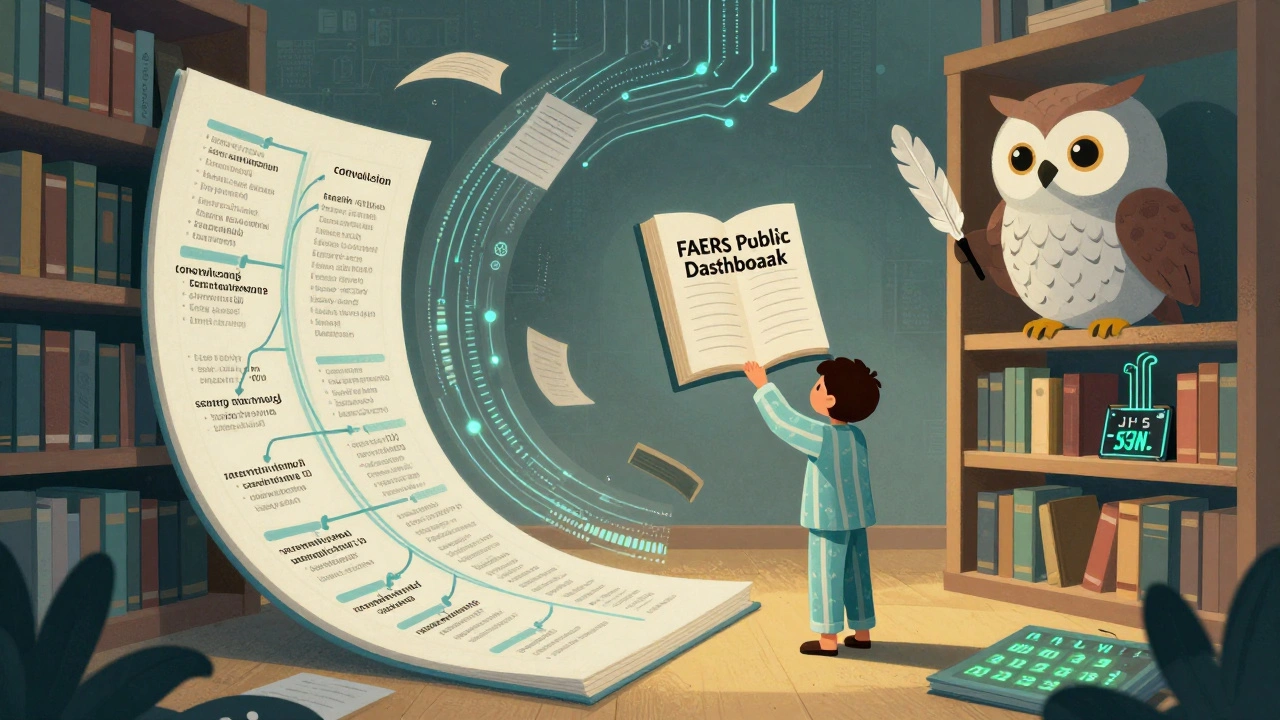
You don’t need special clearance to use FAERS. The FDA gives you three ways in:- FAERS Public Dashboard-This is the easiest entry point. No coding, no downloads. Just go to the FDA’s website, pick a drug, choose an adverse event, and see how often they’ve been reported together over time. You can filter by age, gender, or year. It’s great for spotting trends. If you’re a patient, a student, or a journalist, this is where you start.
- Quarterly Data Extracts-These are raw files (ASCII or XML) you can download. Each file is 1 to 5 gigabytes. You’ll need software like R, Python, or Excel to open them. These are for researchers who want to run their own analyses. But be warned: the data isn’t cleaned up. Missing fields, typos, duplicate entries-they’re all in there. You have to clean it yourself.
- OpenFDA API-If you’re a developer, this is your best bet. OpenFDA lets you pull FAERS data as JSON through a simple web request. You can build tools, apps, or dashboards that query the database automatically. It’s fast, structured, and updated quarterly. But again, you need programming skills to use it effectively.
The Public Dashboard is the most user-friendly. But if you want to dig deeper, the raw data is where the real discoveries happen.
What You Can-and Can’t-Learn From FAERS
Let’s say you’re looking at a new diabetes drug and notice a spike in reports of “pancreatitis.” The dashboard shows 120 cases in the last year. That sounds alarming. But here’s what you can’t tell from FAERS alone:- How many people took the drug? Without knowing the total number of users, you can’t calculate the actual risk.
- Were other drugs involved? Many patients take multiple medications. Was it the diabetes drug, or the blood pressure pill they were also on?
- Were the reports accurate? Some people report side effects that aren’t medically confirmed. Others don’t report at all.
Dr. Robert Ball from the FDA says FAERS data mining “generates hypotheses, not conclusions.” That’s the key. FAERS doesn’t say a drug is dangerous. It says, “Hey, this combination shows up more than we’d expect. Let’s look closer.”
That’s why FAERS is so powerful. In 2022, a patient advocacy group used FAERS to find a rare interaction between a common antidepressant and a diabetes medication. The reaction affected about 1 in 10,000 users. That’s too rare to catch in a trial. But in FAERS, it stood out. The FDA reviewed the data, confirmed the risk, and updated the drug label.
Common Mistakes People Make
Even experienced users trip up. Here are the top three errors:- Assuming correlation = causation-Just because a headache was reported after taking a drug doesn’t mean the drug caused it. Headaches are common. Many people get them anyway.
- Ignoring MedDRA hierarchies-“Seizure” and “convulsion” are separate codes. If you search only for “seizure,” you’ll miss half the cases. You need to understand the broader categories.
- Not checking the date range-Some reports are old. A spike in 2023 might be due to a new reporting trend, not a new safety issue. Always compare time periods.
Also, don’t rely on the dashboard alone for serious research. It’s great for exploration, but it doesn’t let you compare multiple drugs side-by-side or filter by complex combinations. That’s where the raw data comes in.
How to Learn the System
If you’re new to FAERS, start with the Public Dashboard. Spend an hour exploring. Search for a drug you know. Look at the top 5 adverse events. See how they’ve changed over the last five years. Then, read the FDA’s official guide, “FAERS Essentials.” It’s free, and it explains MedDRA, reporting biases, and how to interpret results. For those ready to work with raw data, the FDA offers free quarterly webinars. Attendance is around 250-300 people per session. You’ll learn how to parse XML files, handle missing data, and avoid common statistical traps. Many universities now include FAERS in their pharmacy or public health courses.How FAERS Compares to Other Systems
The European Medicines Agency (EMA) has EudraVigilance, which holds similar data-but you can’t access individual reports publicly. Only qualified researchers can request access. The World Health Organization’s VigiBase has data from 130 countries, but it’s not as easy to search. FAERS stands out because it gives you direct, free access to a massive, structured dataset. Commercial tools like Oracle Argus or ArisGlobal offer more advanced analytics, but they cost tens of thousands of dollars a year. FAERS is the only system that gives researchers, students, and patient advocates the same tools as big pharma-without the price tag.
What’s Coming Next
The FDA is working on improvements. By late 2024, they plan to release a new API that lets you query the dashboard’s analysis tools directly-no downloads needed. In 2025, they’re adding natural language processing so you can type in plain English like “What drugs cause liver damage in elderly women?” and get results. They’re also testing ways to link FAERS data with electronic health records and insurance claims. That could finally solve the biggest problem: not knowing how many people took a drug. If they succeed, FAERS could move from “signal detection” to “risk quantification.”Final Thoughts
FAERS isn’t perfect. It’s messy, incomplete, and full of noise. But it’s the most transparent pharmacovigilance system in the world. It empowers patients to question drug safety. It lets researchers find hidden risks. It holds drug companies accountable. You don’t need to be a statistician to use it. Start with the dashboard. Learn how to ask better questions. And remember: FAERS doesn’t give you answers. It gives you clues. The rest is up to you.Is the FDA FAERS database free to use?
Yes, the FAERS database is completely free for anyone to access. The FDA provides a public dashboard for basic searches, downloadable quarterly data files, and an open API-all at no cost. You don’t need to pay for a subscription or sign a licensing agreement to use it.
Can I report a side effect I experienced to FAERS?
Yes, you can report adverse events directly through the FDA’s MedWatch program. Whether you’re a patient, caregiver, or healthcare provider, you can submit a report online, by mail, or by phone. The FDA encourages public reports because they often capture real-world experiences that professionals miss. Your report helps improve drug safety for everyone.
Do I need to be a programmer to use FAERS data?
No, you don’t. The FAERS Public Dashboard is designed for non-technical users. You can search, filter, and visualize data with just a web browser. But if you want to analyze raw data files (like the quarterly XML or ASCII downloads), you’ll need basic programming skills in R, Python, or similar tools. Many universities and libraries offer free workshops to help you get started.
Why do some adverse event reports seem inaccurate?
FAERS accepts all reports without verifying medical accuracy. Some reports are incomplete, misclassified, or based on anecdotal experiences. Others are duplicates or contain typos. That’s why experts emphasize that FAERS identifies patterns-not proof. The system is designed to flag potential issues for further study, not to confirm them. Always look at the bigger picture across multiple reports and time periods.
How often is FAERS data updated?
FAERS data is updated quarterly-every three months. The FDA releases new data files and refreshes the Public Dashboard in March, June, September, and December. If you’re using the data for research, always note the data cut-off date. Reports from January 2025 won’t appear until the June 2025 release.
Can FAERS data be used to prove a drug is unsafe?
No, FAERS data alone cannot prove a drug is unsafe. It shows associations, not causation. A rise in reports doesn’t mean the drug caused the problem. Regulatory agencies use FAERS to generate hypotheses, then investigate further with controlled studies, medical records, or lab data. Only after multiple lines of evidence do they take action like updating labels or issuing warnings.
What’s the difference between FAERS and the OpenFDA API?
FAERS is the database itself. OpenFDA is a tool that gives you programmatic access to FAERS data in a structured JSON format. Think of FAERS as the library, and OpenFDA as the digital catalog system. The dashboard is for browsing. OpenFDA is for building apps, automating searches, or pulling data into other systems. Both use the same underlying data, but OpenFDA is meant for developers.
How long does it take for a report to appear in FAERS?
It can take 3 to 12 months for a report to appear in the public database. Pharmaceutical companies must submit reports within 15 days for serious events and 90 days for non-serious ones. But it takes time to process, de-identify, and code the data before it’s released publicly. The FDA releases data quarterly, so reports from January might not show up until the next March update.




15 Comments
Man, I just spent an hour playing with the FAERS dashboard last night after my mom had a weird reaction to her new blood pressure med. Didn't know you could filter by age and gender-so cool! Found three other people reporting the same thing. Felt weird being a layperson digging into this stuff, but honestly? It made me feel less alone. The FDA didn’t make this hard on purpose. They just want us to care enough to look.
/p>Also, shoutout to the person who mentioned MedDRA hierarchies. I totally missed that ‘dizziness’ and ‘lightheadedness’ are separate codes. Rookie mistake. Now I’m hooked.
PS: If you’re scared of coding? Don’t be. Start with the dashboard. You don’t need to be a wizard to see patterns. Just curious enough to ask ‘why?’
The systematic transparency of the FAERS database represents a paradigmatic advancement in post-marketing pharmacovigilance. Unlike proprietary systems maintained by commercial entities, the open accessibility of this dataset enables reproducible research, democratizes safety surveillance, and enhances public trust in regulatory institutions. The inclusion of structured MedDRA coding ensures inter-rater reliability, while the quarterly data refreshes maintain temporal validity. However, one must exercise rigorous epistemological caution when interpreting association data as causal evidence, as confounding variables-polypharmacy, comorbidities, and reporting bias-are pervasive. The FDA’s forthcoming NLP integration may significantly mitigate these limitations by enabling semantic query resolution beyond keyword matching. This is not merely a database; it is an epistemic infrastructure for public health.
/p>we’re all just ghosts in the machine…
/p>data points in a giant spreadsheet…
but when your grandma’s name shows up in FAERS…
it stops being data.
it becomes a story.
❤️
This is the stuff that actually saves lives. No cap./p>
I’ve been staring at this database for 18 months. 30 million reports. And not one of them mentions how the FDA ignores 80% of the reports from people who aren’t doctors. They only listen when Big Pharma says ‘hey, something’s weird.’ Meanwhile, my cousin died from a reaction that was reported twice and buried in the system. This isn’t transparency. It’s theater.
/p>Why are we even talking about this? The FDA’s a joke. Every time a drug kills someone, they say ‘it’s not proven’-but if you’re dead, does it matter? We need to ban these drugs the second someone dies, not wait for 500 reports. This ‘hypothesis generation’ nonsense is just corporate cover. America deserves better.
/p>It’s funny how people treat FAERS like a crystal ball. It’s not. It’s a messy notebook someone dropped in the rain. You can still read some of it, but you have to know what you’re looking for. I’ve used it in my public health class for years. The biggest takeaway? People report what they understand. If you don’t know ‘hepatotoxicity,’ you say ‘my liver hurts.’ That’s why the dashboard filters are useless without context. Read the FDA’s guide. It’s free. And it’s the only thing that keeps you from jumping to wild conclusions.
/p>As someone who’s worked in pharmacovigilance for over 15 years, I can tell you FAERS is the most underappreciated tool in medicine. I’ve seen patients use it to spot side effects their doctors missed. I’ve seen students publish papers from it. I’ve even seen a nurse in rural Kansas flag a dangerous interaction between two OTC meds that led to a safety alert.
/p>Yes, it’s noisy. Yes, it’s incomplete. But it’s the only system where a 72-year-old grandmother can change the course of drug safety just by clicking ‘submit.’ That’s power. And we should be teaching this in high school.
Start with the dashboard. Don’t overthink it. Just ask: ‘What’s happening?’ The data will answer you-if you’re patient enough to listen.
The beauty of FAERS lies in its humility. It doesn’t claim to know the truth. It simply says: ‘Here’s what people are experiencing.’ That’s radical in a world obsessed with certainty. I’ve used it to compare antidepressants for my research, and what struck me most wasn’t the numbers-it was the stories behind them. One report said, ‘I felt like my brain was melting.’ Another: ‘My son stopped talking after this pill.’
/p>These aren’t data points. They’re human cries. And the fact that we can hear them, without a paywall or a PhD, is a quiet revolution. We owe it to ourselves to learn how to listen properly.
My mom’s on six meds. I started using FAERS last year to check if any of them might mess with each other. Found one combo that had 17 reports of confusion in people over 70. Took it to her doctor. They changed her script. She’s been clearer-headed since.
/p>Don’t let the ‘it’s not proven’ stuff scare you off. If something feels off, check FAERS. It’s not magic, but it’s the closest thing we have to a truth detector for drugs after they hit the shelves. And yeah, you don’t need to be a nerd to use it. Just care enough to look.
Oh wow. So we’re supposed to be impressed that the FDA… lets us look at their messy spreadsheet? 🙄
/p>Let me guess-the next step is ‘please like this post’ so they can fund the ‘FAERS for Dummies’ webinar?
Real revolutionary. Next they’ll open the White House to tourists.
Everyone talks about coding and APIs. But the real magic is in the dashboard. You don’t need to be smart. You just need to be brave enough to ask questions. I showed my 16-year-old niece how to search for her ADHD med. She found 300 reports of sleep problems. She told her doctor. They lowered the dose.
/p>This isn’t about being a tech genius. It’s about being a human being who cares. That’s all it takes.
And yes, I know I spelled ‘med’ wrong. But you got the point.
FAERS is a joke. I tried to search for ‘anxiety’ and got 500k results. Half of them were people who just said ‘I’m stressed.’ That’s not science, that’s spam. And the FDA doesn’t even clean it up. Why should I trust this? They’re just hiding behind ‘we’re transparent’ so they don’t get sued. Real helpful.
/p>Canada’s EudraVigilance system is far more rigorous. We don’t let just anyone submit reports. You need credentials. You need training. You need to understand medical terminology. This open-for-all approach? It’s chaos. And it makes real researchers’ jobs harder. The FDA is sacrificing quality for optics.
/p>Just found out my anxiety med has a weird link to heart palpitations in women over 50. Took me 10 mins on the dashboard. I’m telling my mom. She’s on it. 🙌
/p>Also, I typed ‘heart thump’ instead of ‘palpitations’ and it still found it. So the AI’s kinda smart??
FAERS = free superpower. Use it. Share it. Don’t be scared.