
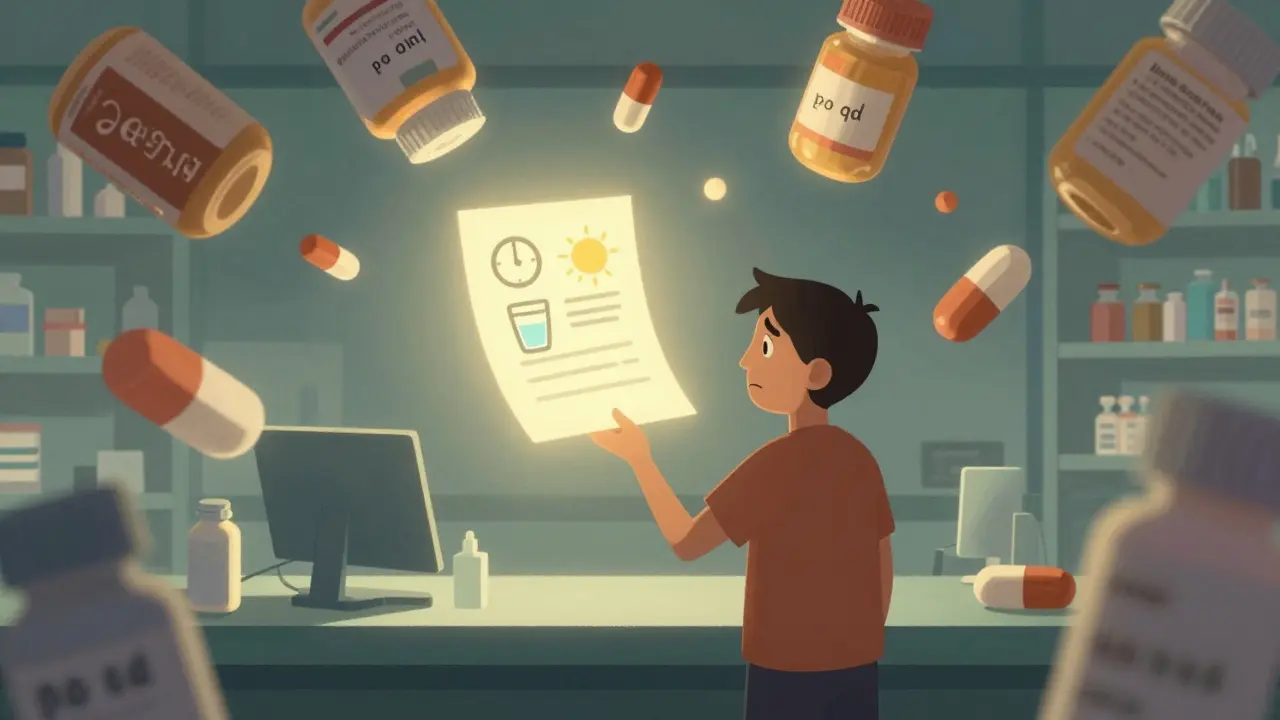
Getting your prescription filled shouldn’t feel like solving a puzzle in a foreign language. Yet millions of people leave the pharmacy with a tiny label full of medical jargon they can’t read, let alone follow. If you’ve ever stared at a pill bottle and thought, “What am I supposed to do with this?” - you’re not alone. And more importantly, you’re not wrong to ask for better.
The truth is, you have a right to written medication instructions you can actually understand. Not vague reminders. Not tiny print. Not a 2-page brochure full of terms like “bioavailability” or “adverse reactions.” You deserve clear, simple, written directions - and there’s a proven way to get them.
You Don’t Have to Guess What Your Medication Does
Most pharmacies hand out instructions that look like they were written by a robot for another robot. They use words like “take with food,” “avoid grapefruit,” or “administer orally.” But what does that really mean? Does “with food” mean right after eating? Or can it wait an hour? Does “orally” mean swallow or chew? If you’re not a doctor or a pharmacist, these terms are useless.
According to a 2022 report from the Institute for Safe Medication Practices, 63% of medication errors happen because patients don’t understand their instructions. That’s not because people are careless. It’s because the instructions are designed poorly - or not designed at all.
The good news? You’re not asking for a favor. You’re exercising a right. The American Medical Association’s Code of Medical Ethics (2023) says patients have the right to “receive information from their physicians and to have opportunity to discuss the benefits, risks, and costs of appropriate treatment alternatives.” That includes your pills. The same goes for pharmacy patient rights documents from AmerisourceBergen, Tennessee Oncology, and Vivo Health Pharmacy - all of which explicitly state you have the right to instructions in a language and format you understand.
How to Ask - and Actually Get What You Need
Just saying “Can you explain this?” rarely works. Pharmacists are busy. Technicians often aren’t trained to handle these requests. You need a strategy.
Here’s what works, based on real studies and patient experiences:
- Ask to speak with the pharmacist - not the tech. A 2022 Pharmacy Practice News study found that 73% of chain pharmacies require technicians to escalate these requests. The pharmacist has the training and authority to help.
- Use exact language from patient rights documents - don’t guess. Say: “I’m exercising my right under the AmerisourceBergen Patient Rights document to receive education in a language I understand.” Studies show patients who use these exact phrases are 3.7 times more likely to get help.
- Ask for a one-page summary - not a booklet. The FDA and health literacy experts agree: one page, plain language, bullet points. No fluff. If they hand you a 10-page PDF, say: “Can you give me just the key points on one sheet?”
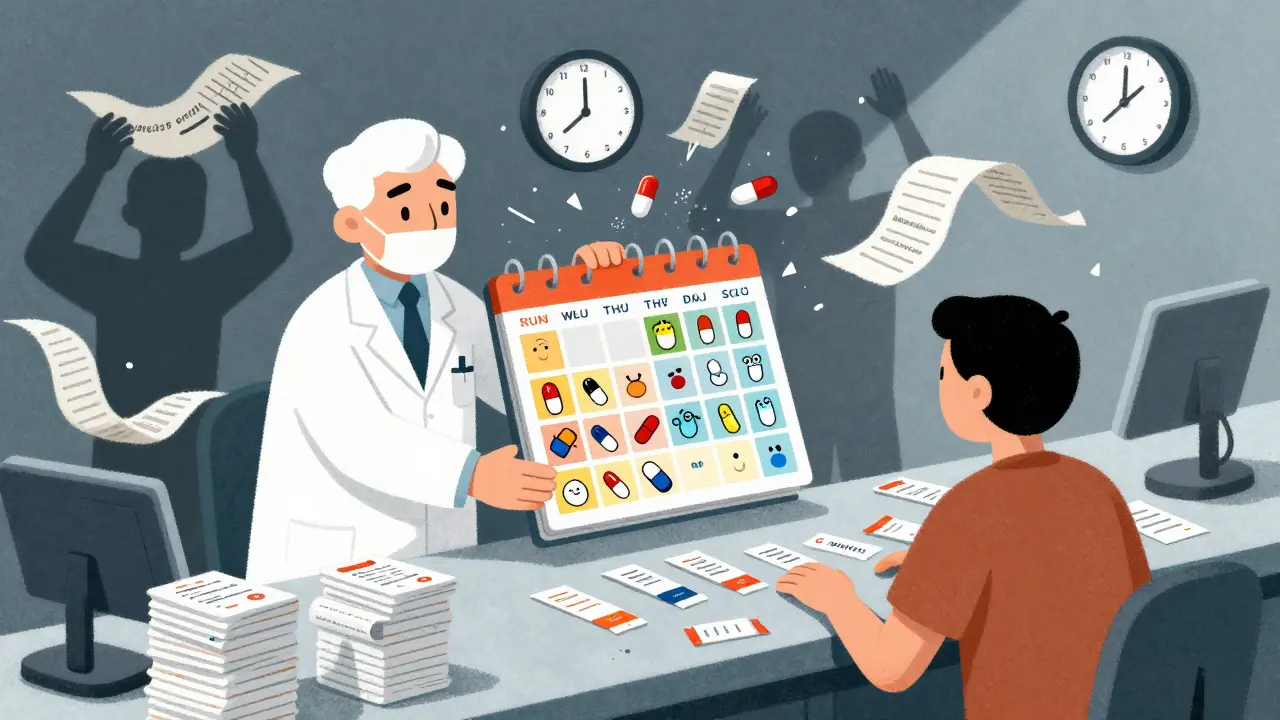
- Request visuals - pictures, icons, or a daily schedule. A 2023 Annals of Internal Medicine study found that patients who got visual schedules (like a chart with pictures of pills and times) improved adherence by 42%. Ask: “Can you draw me a simple chart for my week?”
- Do a read-back - say the instructions back to them. “So I take this blue pill every morning with water, and the white one at night, right?” This simple trick reduces errors by 63%, according to Johns Hopkins Medicine.
And if they push back? Say: “I’m documenting this for my medical records.” A 2023 American Pharmacists Association survey found that 58% of pharmacies will provide written instructions when patients mention documentation.
What Good Instructions Look Like
Good instructions aren’t just simple - they’re designed for real life. Here’s what to look for:
- Uses everyday words: “Take this pill once a day” - not “Administer orally once daily.”
- Includes the reason: “This pill lowers your blood pressure” - not just “Take 1 tablet.”
- Shows timing: “Take in the morning with breakfast” - not “Take as directed.”
- Highlights warnings: “Do not drink alcohol while taking this” - in bold, not buried in paragraph 3.
- Includes a visual: A small icon of a clock for timing, a glass of water, or a food symbol.
- Lists what to do if you miss a dose: “If you forget, take it as soon as you remember - unless it’s close to your next dose. Then skip it.”
Compare that to the typical pharmacy label: “Take 1 tab po qd.” That’s Latin. It’s not helpful. You deserve better.
Language Barriers? You Have Federal Rights
If English isn’t your first language, you still have rights - and they’re protected by federal law. Title VI of the Civil Rights Act of 1964 requires healthcare providers to offer language assistance. That includes pharmacies.
Don’t say: “Can you translate this?” Say: “I need medication instructions in Spanish/Tagalog/Arabic per federal law.” A 2023 CMS report found that 92% of pharmacies will provide translated instructions when asked this way.
Many pharmacies now use digital tools to generate instant translations. Ask: “Can you print this in my language?” or “Is there an app or QR code I can scan to hear the instructions?”
Why This Matters - More Than You Think
Getting clear instructions isn’t just about convenience. It’s about safety. Poorly understood medication instructions lead to:
- Overdoses (taking too much)
- Underdoses (taking too little)
- Missing doses entirely
- Stopping meds early because you think they’re not working
According to a 2023 JAMA Internal Medicine study, medication misunderstandings cause 30% of preventable hospitalizations in the U.S. - costing $528 billion a year. That’s not just a statistic. That’s someone’s parent, sibling, or friend.
And it’s not just about pills. It’s about control. When you understand your meds, you stop feeling powerless. You become an active partner in your care. That’s how health changes.
What’s Changing - And What’s Coming
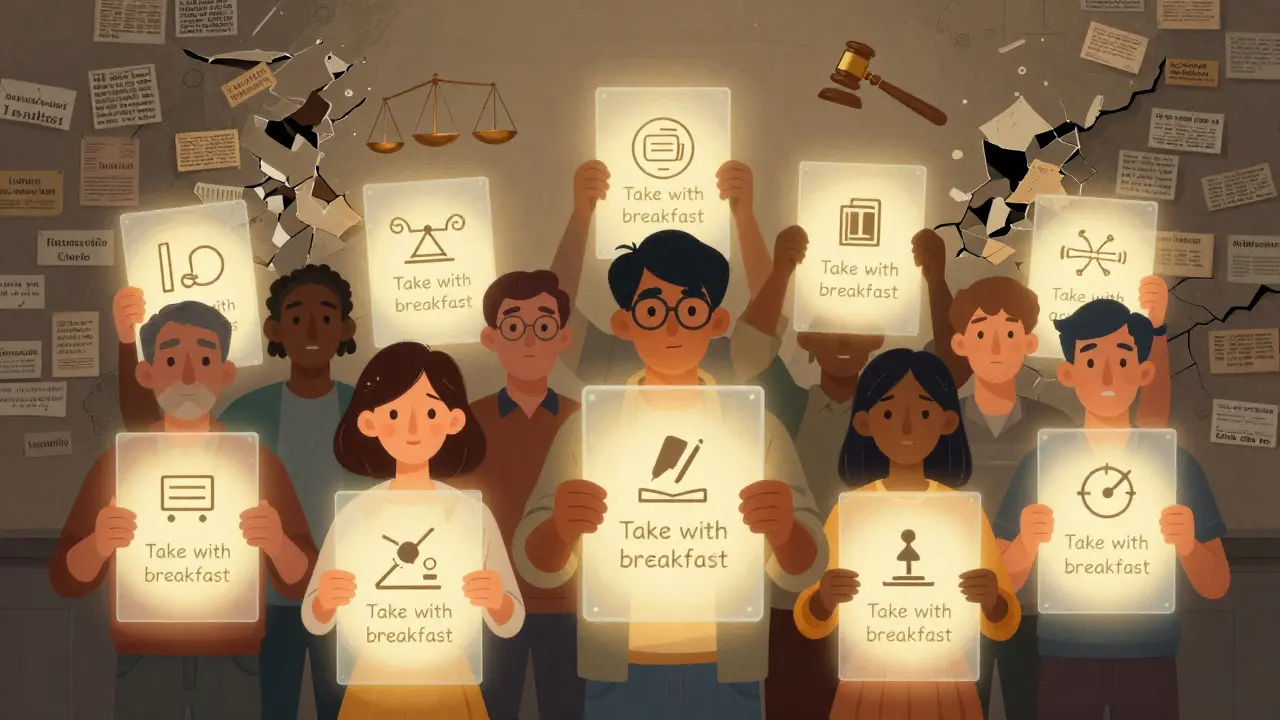
The system is slowly improving. In 2024, Walgreens announced all prescriptions will include QR codes linking to video instructions in 20 languages by the end of the year. CVS is rolling out “Medi-Simplify,” a system that generates pictogram-based instructions. The FDA is drafting new rules that could require plain-language labels with standardized icons by 2026.
But you don’t have to wait. Right now, you have the power to get what you need. You don’t need to wait for a law to pass. You don’t need to wait for your doctor to speak up. You can do it today - at your next refill.
What to Do Next
Next time you pick up a prescription, try this:
- Before you leave the counter, say: “I’d like to speak with the pharmacist about my instructions.”
- Ask: “Can you give me a one-page summary in plain English with pictures?”
- Request a read-back: “Can I tell you how I’ll take this, and you tell me if I got it right?”
- If you’re not fluent in English, say: “I need this in [language] per federal law.”
- Take the paper. Keep it. Show it to your family. Put it on your fridge.
It’s not rude. It’s necessary. And if they resist? Ask for a manager. Say: “I’m asking for what I’m legally entitled to.”
You’re not asking for special treatment. You’re asking for basic care. And that’s something no one should have to fight for - but too many still do.
Can I get written medication instructions in my native language?
Yes. Under Title VI of the Civil Rights Act of 1964, pharmacies that receive federal funding (which includes nearly all U.S. pharmacies) must provide language assistance. You have the right to ask for instructions in your language - whether it’s Spanish, Mandarin, Arabic, or any other language. Simply say: “I need medication instructions in [language] per federal law.” Studies show 92% of pharmacies will comply when asked this way.
What if the pharmacist says they don’t have plain-language instructions?
Say: “I’m exercising my right under the AmerisourceBergen Patient Rights document to receive education in a language I understand.” This exact phrase has been shown to increase success rates by over 300%. If they still refuse, ask for a manager or request a printed version from the manufacturer - most drug companies provide free, easy-to-read inserts upon request.
Are visual schedules really more effective?
Yes. A 2023 study in the Annals of Internal Medicine found that patients using visual schedules (like a chart with pictures of pills and times) were 42% more likely to take their medications correctly. For people with complex regimens - like taking 5+ pills daily - pictures and icons reduce confusion more than text alone.
Can I ask for instructions before I even pick up the prescription?
Absolutely. When your doctor writes the prescription, ask them: “Can you send a note to the pharmacy asking for clear, written instructions?” Many doctors now do this. If you’re using a mail-order pharmacy, call ahead and request plain-language instructions before your order ships.
Why don’t all pharmacies give clear instructions already?
It’s mostly about resources and standards. Large chains like CVS and Walgreens have invested in standardized systems since 2021. But many small, independent pharmacies still use outdated templates or rely on handwritten notes. A 2023 survey found only 42% of independent pharmacies use health-literate templates. The good news? The system is shifting. Federal rules, new technology, and patient pressure are pushing everyone toward better practices - but you don’t have to wait.



12 Comments
This is exactly what we need. Pharmacies treat patients like dumb robots. I asked for plain instructions last week and got a 10-page PDF in 8-point font. I said, "I’m exercising my right under the AmerisourceBergen Patient Rights document" and they practically ran to get me a sticky note with a smiley face. 🙌 You’re not being difficult-you’re being smart. Do this. Every. Single. Time./p>
I’ve spent years watching my mother fumble with her meds. She’d stare at the bottle like it was a riddle from a dead language. No one ever taught her how to ask. No one ever told her she had a right. It’s not just about pills. It’s about dignity. This post doesn’t just give instructions-it gives power./p>
I started asking for visual charts after my dad almost took his blood pressure med twice because he mixed up the colors. One page. One chart. One week. Game changer. My whole family uses it now. Just ask. Seriously. It’s not hard. They’re trained to help. You just gotta say it./p>
Let me guess-the FDA is gonna force pharmacies to use "plain language" next. Meanwhile, the same people who wrote this post are probably on Medicaid, getting free insulin while the rest of us pay $400 for a bottle. This isn’t about safety. It’s about entitlement. You want a picture of your pill? Fine. But don’t act like it’s a human right when your whole system is built on exploiting the system. 🤷♂️/p>
I’m a nurse. I’ve seen what happens when people don’t understand their meds. I’ve held hands during ER visits because someone thought "take as needed" meant "take every hour." This post? It’s not just helpful-it’s lifesaving. And yes, you can ask. And yes, they can do it. I’ve seen it. Just don’t be shy. You’re not bothering them. You’re helping them help you./p>
I’ve been told "no" so many times I stopped asking. Then one day, I said, "I’m documenting this for my medical records." They handed me a printed sheet with bullet points and a QR code. No drama. No attitude. Just compliance. If they push back, say that. It’s magic. Not because you’re special. Because they’re scared of liability./p>
This isn’t just about pills-it’s about reclaiming your brain. You’re not a patient. You’re a person. And your life isn’t a medical footnote. When I asked for a chart with emojis (yes, emojis) for my insulin schedule, the pharmacist laughed… then drew me one. Now I stick it on my mirror. It says: "Morning: Blue Sun. Night: Moon + Coffee." I haven’t missed a dose in 18 months. You don’t need a degree. You just need to ask. And then ask again. And again./p>
I came from a country where pharmacists hand you a bottle and say, "Go home. God will help." Here? I asked for instructions in Zulu. They stared. Then called the manager. Then printed me a 2-page guide with pictures of a Zulu grandmother taking pills. I cried. Not because I’m weak. Because someone finally saw me. This? This is how you change the world. One bottle at a time./p>
I asked for plain language and they gave me a pamphlet in Latin. I said "I’m exercising my rights" and they rolled their eyes. I called the corporate office. They called me back. They sent me a laminated card with my meds, times, and a phone number. Now I carry it in my wallet. I’m not asking for help. I’m demanding respect. And if you’re not doing the same? You’re letting them win./p>
I work at a small pharmacy. We don’t have fancy systems. But if someone says, "I need this in plain English," we print it. If they ask for a chart, we sketch one. We don’t get paid extra. We don’t get praised. But we do it. Because it’s right. You’re not being difficult. You’re being human. And we’re here to help. Just say it./p>
It is of paramount importance that healthcare institutions adhere to the mandates of Title VI of the Civil Rights Act of 1964, as well as the provisions outlined in the American Medical Association’s Code of Medical Ethics, which unequivocally affirm the patient’s right to comprehensible communication. Failure to provide written medication instructions in a language and format that is both linguistically and cognitively accessible constitutes a breach of professional and ethical obligations. It is imperative that patients invoke these rights with formal documentation and, if necessary, escalate to regulatory authorities such as CMS or the Office for Civil Rights./p>
This is why America is collapsing. You people think you’re entitled to free healthcare services with glittery charts and emoji reminders? We’re paying for your insulin, your blood pressure meds, your mental health pills-and now you want a picture of a clock next to your tablet? Meanwhile, in India, we take our medicine without a single question. No apps. No QR codes. No drama. Just discipline. You’re not sick. You’re lazy./p>