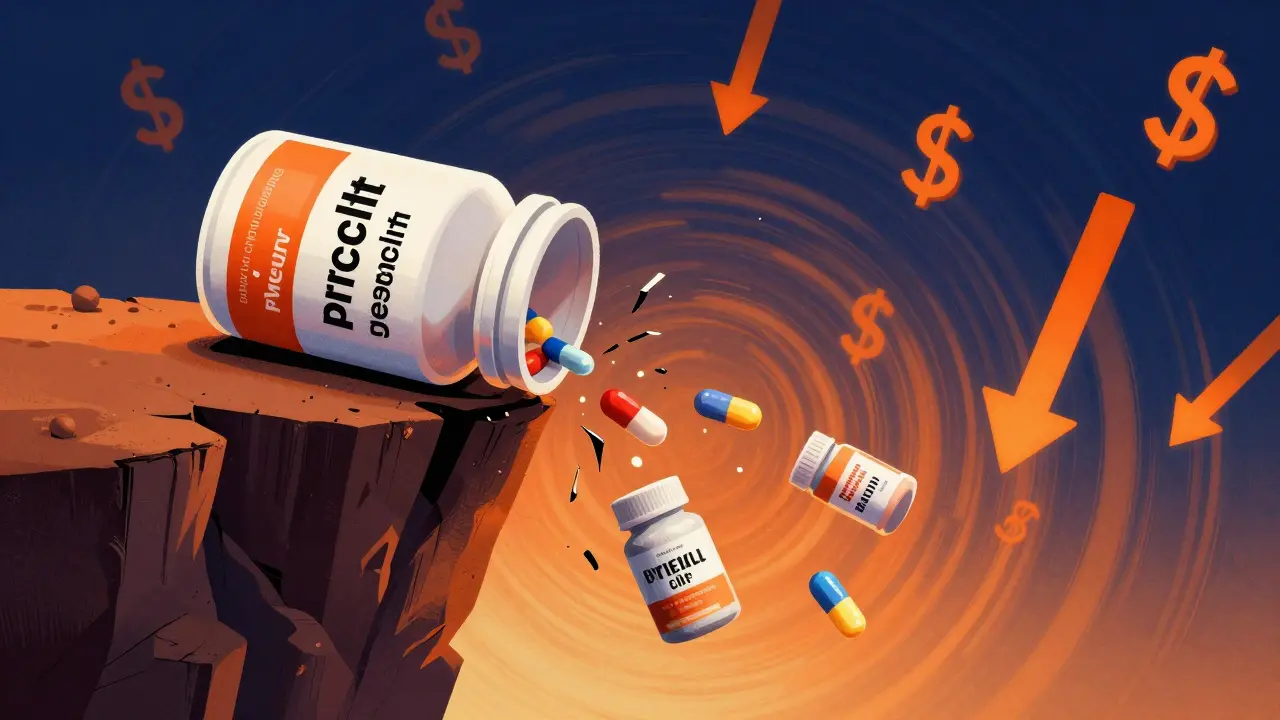
You'd think that more players in a market always mean lower prices. In the world of pharmaceuticals, that logic usually holds-until it doesn't. While the arrival of generic drug competition is the process where non-branded versions of a medication enter the market after patent expiry typically triggers a price crash, adding more competitors doesn't always guarantee a bargain. In some cases, too many rivals can actually lead to a stalemate where prices stop dropping, or worse, start creeping back up.
The Non-Linear Drop: Why the First Few Matter Most
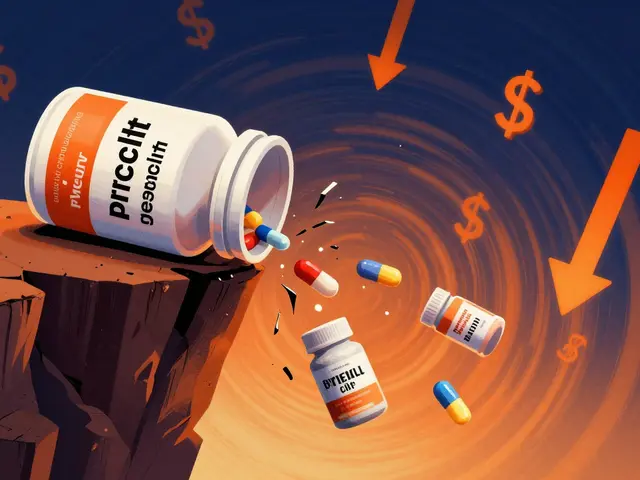
When a brand-name drug loses its patent, the price doesn't slide down a smooth ramp; it drops off a cliff. According to data from the FDA is the Food and Drug Administration, the federal agency responsible for protecting public health by ensuring the safety and efficacy of drugs , the most dramatic savings happen almost immediately. A single generic competitor typically slashes prices by 30% to 39% compared to the original brand. When a second player enters, that drop deepens to around 54%.
But there's a point of diminishing returns. Once you hit six or more competitors, the Average Manufacturer Price (AMP) can plummet by as much as 95%. However, the gap between the first and sixth competitor is huge. This means the biggest "win" for the consumer happens early. If a market stays stuck with only one or two players, the price remains significantly higher than it would be in a truly crowded market.
The Mutual Forbearance Trap
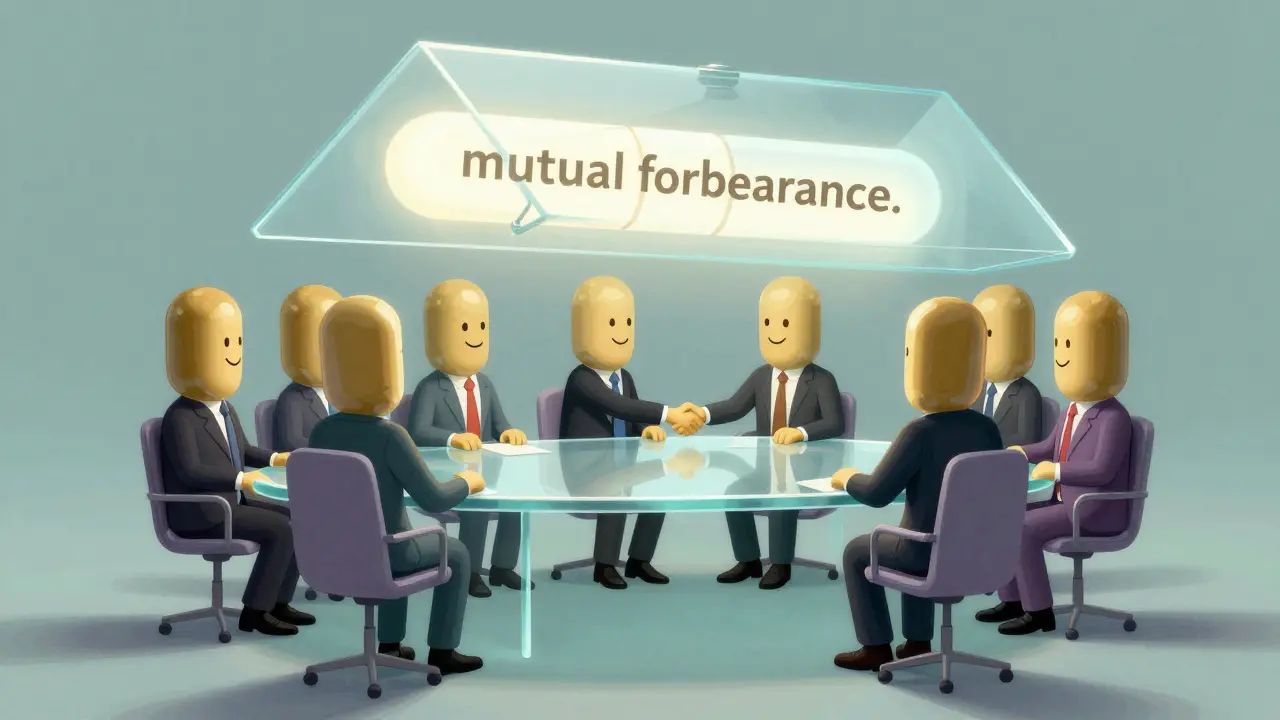
Here is where things get weird. You might expect ten generic companies to fight to the death over a few cents, but sometimes they just... stop. This is called "mutual forbearance." It happens when companies realize that aggressive price wars hurt everyone's bottom line. If they face the same rivals across multiple different drug markets, they develop a silent understanding: "I won't undercut you on this drug if you don't undercut me on that one."
We saw this clearly in Portugal's statin market. Even with regulatory price caps and several generic options, drugs often stayed priced right at the ceiling. The price cap actually acted as a focal point for coordination, making it easy for companies to agree on a high price without ever speaking to each other. In this scenario, more competitors didn't lead to lower prices; it just created a larger club of companies agreeing not to compete.
The Brand-Name Paradox: When Originators Raise Prices
It seems counterintuitive, but brand-name companies sometimes increase their prices after generics hit the market. Why? Because they know they can't compete on price, so they compete on perception. By raising the price, they signal "premium quality" or "superior reliability" to a loyal sliver of the market.
A study in China involving 27 originator drugs highlighted this strange behavior. While most brands lowered prices slightly, some actually increased them by about 0.62%. The brand company essentially accepts a smaller piece of the pie (market share) but makes sure that piece is as expensive as possible. This creates a split market: a cheap generic tier and a high-priced "prestige" brand tier, effectively neutralizing some of the competitive pressure.
| Number of Generic Competitors | Estimated Price Reduction | Market Dynamic |
|---|---|---|
| 1 Competitor | 30% - 39% | Initial shock to brand pricing |
| 2 Competitors | ~54% | Accelerated price erosion |
| 6+ Competitors | Up to 95% | Commoditization / Floor pricing |
Barriers to Entry: The "Complexity Advantage"
Not all generics are created equal. It's one thing to copy a simple pill; it's another to replicate a complex biological delivery system. This is where the "complexity advantage" comes in. For advanced drugs, manufacturers must prove "sameness" across various critical quality attributes. These requirements necessitate expensive bridging studies that smaller firms simply can't afford.
This creates a high-barrier environment. Even if a drug is technically off-patent, the regulatory gauntlet ensures that only the biggest, most technically capable firms can enter. When only three giants are competing instead of thirty small firms, the pricing stays higher because the cost of entry is so steep that no one is willing to risk a price war that might make the entire product line unprofitable.
The PBM Factor and Authorized Generics
In the U.S., you can't talk about pricing without mentioning Pharmacy Benefit Managers is PBMs are third-party administrators of prescription drug programs that negotiate rebates and pricing between insurers and manufacturers (PBMs). These entities control a massive portion of pharmaceutical purchasing-up to 90% in some analyses. Because PBMs negotiate in bulk, the price a brand-name company charges is often less about the number of generic competitors and more about the rebate deal they struck with the PBM.
Then there are Authorized Generics is A generic version of a drug that is marketed by the original brand company or a partner (AGs). If the brand company owns the AG, they can keep the brand price higher. If a third party owns it, the brand price tends to drop further (by about 22% in some cases). This ownership structure determines whether the "competition" is a real fight or just a strategic move to capture two different price points in the same market.

Supply Chain Resilience vs. Price War
While we usually focus on the cost, there is a hidden benefit to having multiple generic competitors: stability. A market with only one generic supplier is a fragile market. If that one factory has a quality failure or a fire, the drug disappears from the shelves.
Data shows that drugs with three or more manufacturers experienced 67% fewer shortages than those with a single-source supplier. So, while a fourth or fifth competitor might not drive the price down much further, they act as a critical insurance policy for public health. The goal isn't just the lowest price, but a price that is low enough to be affordable yet high enough to keep multiple factories running.
The Future: IRA and Complex Biologics
The landscape is shifting again with the Inflation Reduction Act is A 2022 U.S. law that allows Medicare to negotiate prices for certain high-cost brand-name drugs (IRA). By setting "Maximum Fair Prices" (MFPs) for brands, the government might accidentally kill the incentive for generics to enter. Why spend millions developing a generic if the brand version is already capped at a very low price? This could lead to a future where we have fewer generic competitors, potentially risking the supply chain resilience mentioned earlier.
We're also moving into the era of Biosimilars is Almost identical but not exactly the same as a biological medicine, which are much more complex to manufacture than small-molecule drugs . These don't follow the 85% price reduction rule of thumb. Because they are so expensive to develop, the competition looks more like a slow fade than a sudden crash. The traditional model of "more generics = cheaper drugs" is being tested by the sheer complexity of modern medicine.
Does more generic competition always mean lower prices?
Generally, yes, but it follows a non-linear path. The biggest drops happen with the first two competitors. After that, a phenomenon called "mutual forbearance" can occur, where companies stop competing aggressively to avoid hurting their collective profits, keeping prices stable or even high.
What is an Authorized Generic (AG)?
An Authorized Generic is a generic version of a drug marketed by the original brand-name company. This allows the brand owner to capture a share of the generic market and can influence how much the brand price drops when other generics enter.
Why do some brand-name drugs increase in price after generics launch?
This is a strategic move to signal premium quality. By raising the price, the brand owner targets a niche of patients who perceive the more expensive version as being safer or more effective, offsetting the loss in total market share.
How do PBMs affect drug pricing?
Pharmacy Benefit Managers control the bulk of purchasing. Their negotiations for rebates often dictate the actual cost of a drug more than the number of generic competitors on the market, effectively decoupling the list price from the actual transaction price.
What is the risk of having too few generic manufacturers?
The primary risk is supply chain fragility. Drugs with only one or two suppliers are far more likely to experience shortages. Having three or more manufacturers reduces the likelihood of shortages by roughly 67%.