

By the end of 2025, millions of Americans will face a turning point in their health coverage. The Affordable Care Act has kept insurance affordable for many - but the enhanced tax credits that made it possible are set to expire. If nothing changes, the average monthly premium for a Silver plan will jump by over $800. That’s not a guess. It’s from the Kaiser Family Foundation’s latest calculator, updated February 2025.
What the ACA Actually Covers
The Affordable Care Act didn’t just create a new way to buy insurance. It changed what insurance has to include. Every plan sold on the Health Insurance Marketplace must cover ten essential health benefits. That means no more hidden exclusions. No more lifetime caps on care. No more being denied coverage because you had diabetes, cancer, or even a past injury. These benefits are not optional. They include:- Ambulatory patient services (doctor visits)
- Emergency care
- Hospitalization
- Pregnancy, maternity, and newborn care
- Mental health and substance use disorder services
- Prescription drugs
- Rehabilitative and habilitative services
- Laboratory services
- Preventive and wellness services
- Pediatric services, including dental and vision
That last one matters. A lot. Before the ACA, many plans didn’t cover kids’ dental care or vision. Now, they must. If you’re a parent, that’s not a perk - it’s a lifeline.
How Metal Tiers Work - and What They Really Mean
You’ve probably seen Bronze, Silver, Gold, Platinum. They’re not just names. They’re a guarantee of how much the plan pays for your care.- Bronze: Pays 60% of your costs. You pay 40%. Lowest monthly premium, highest out-of-pocket when you need care.
- Silver: Pays 70%. This is the sweet spot for most people because it qualifies for cost-sharing reductions if your income is below 250% of the poverty line.
- Gold: Pays 80%. Higher premiums, but you pay less when you visit the doctor.
- Platinum: Pays 90%. Best for people who need frequent care. Monthly cost is steep, but your copays are tiny.
Here’s the catch: The metal tier doesn’t tell you the full story. A Silver plan from UnitedHealthcare in Texas might have a $50 copay for a specialist, while the same tier from Molina in Florida might charge $120. Networks vary. Always check which doctors and hospitals are in-network before you enroll.
Who Gets Financial Help - and How Much
Premium tax credits are the reason so many people can afford coverage. Before the American Rescue Plan in 2021, only people earning up to 400% of the Federal Poverty Level (FPL) qualified. Now, thanks to the Inflation Reduction Act, that cap is gone - until the end of 2025.Let’s say you’re 40, earn $50,000 a year, and live in Ohio. Without tax credits, a Silver plan costs about $534 a month. With them? $247. That’s more than half off. That’s not a discount. That’s access.
But here’s what’s changing. Starting January 1, 2026, those credits go back to pre-2021 rules. That means:
- People earning over 400% FPL lose all subsidies.
- People near the 400% line could see premiums jump 100% or more.
- Seniors - especially those 60 and older - could face increases up to 192% in some states, according to KFF.
That’s not a small bump. It’s a cliff. And it’s coming fast.
What’s Changing in 2026 - And Why It Matters
The Centers for Medicare & Medicaid Services (CMS) rolled out its 2025 Marketplace Integrity and Affordability Final Rule on November 11, 2025. It sounds bureaucratic. But it’s not.Here’s what actually changed:
- DACA recipients are no longer eligible. Around 550,000 people will lose coverage by 2026. This was a surprise to many enrollees.
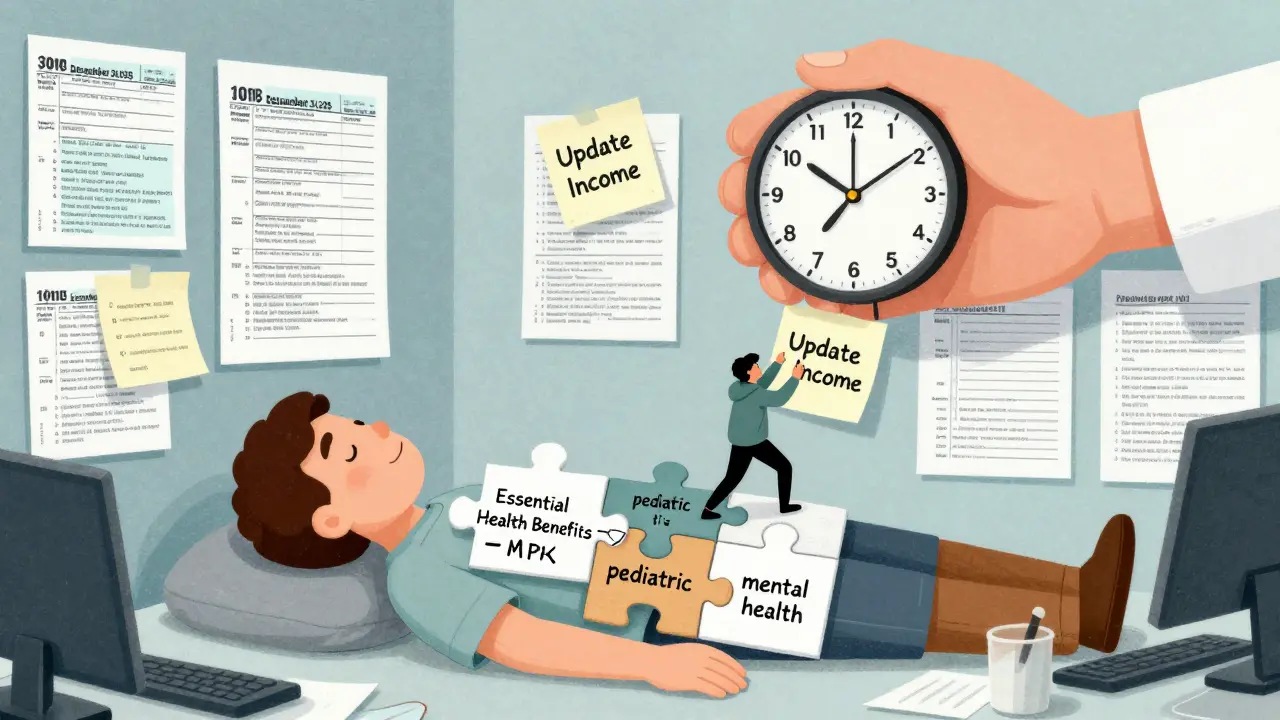
- Income verification is getting stricter. You’ll now need to update your income every quarter starting in 2026. If you’re self-employed or have freelance income, this adds work - but it’s meant to cut down on the $2,800 surprise bills people get when their subsidy doesn’t match their actual income.
- The monthly Special Enrollment Period for low-income people is gone. Before, if you lost a job or had a baby, you could sign up anytime. Now, you only get 60 days after a qualifying life event. That’s a problem for people who don’t know the rules.
And then there’s the big one: the “family glitch” fix. Before 2023, if your employer offered you affordable coverage, your spouse and kids couldn’t get subsidies - even if the family plan cost $1,200 a month. Now, they can. That’s a win. But it only applies if you’re applying through the Marketplace. If your employer’s plan is the only option, you’re still stuck.
Marketplace vs. Medicaid vs. Employer Plans
It’s not just about what the ACA offers. It’s about what it doesn’t cover.If your income is under 138% of the FPL and you live in a state that expanded Medicaid, you’re better off with Medicaid. It has lower premiums, lower copays, and broader coverage. Marketplace plans are for people who earn too much for Medicaid but too little to afford employer insurance.
Compare that to employer plans. They’re often cheaper - but less flexible. If you leave your job, you lose the plan. With a Marketplace plan, you keep it. You can switch plans every year. You can pick your doctor. You can get mental health care without jumping through hoops.
But here’s the trade-off: Marketplace networks are tighter. You might have to drive farther to see your specialist. Your pharmacy might not be in-network. That’s why checking the provider directory before you enroll is not optional. It’s critical.

Real People, Real Stories
Sarah K. from Ohio is a freelance writer. She earns $32,000 a year. In 2024, she got a Silver plan with $0 premium and full cost-sharing reductions. Her copay for a doctor visit? $5. Her annual out-of-pocket maximum? $1,500. She didn’t have to choose between rent and insulin. Then there’s u/ACA_Warrior on Reddit. They lost half their income mid-year. They didn’t update their income on HealthCare.gov because they didn’t know they could. When they filed taxes, they owed $2,800 in repayment. That’s not a mistake. That’s a system flaw.According to CMS’s 2025 survey, 65% of users loved the plan comparison tools. But only 42% understood if they qualified for extra help with copays. That’s a gap. And it’s dangerous.
How to Enroll - And Avoid the Big Mistakes
You don’t need a degree in health policy to sign up. But you do need to be prepared.Here’s what to do:
- Gather documents: Social Security numbers, pay stubs, W-2s, proof of citizenship or immigration status.
- Calculate your income: Use Modified Adjusted Gross Income (MAGI). That’s your income after certain deductions. If you’re self-employed, this is tricky. Use the IRS calculator - don’t guess.
- Compare plans: Don’t just pick the cheapest premium. Look at the deductible, copays, and out-of-pocket maximum. A Bronze plan might look cheap - until you need an MRI.
- Check your network: Go to the insurer’s website. Type in your doctor’s name. If they’re not listed, the plan won’t help you when you need it.
- Enroll before December 15: Coverage starts January 1. Miss it, and you wait until next year - unless you have a qualifying life event.
And if your income changes during the year? Update it on HealthCare.gov immediately. Don’t wait for tax season. That’s how people end up owing thousands.
What Happens If Nothing Changes After 2025?
If Congress does nothing, the ACA Marketplace will shrink. CMS projects a 15-20% drop in enrollment by 2026. States that didn’t expand Medicaid will be hit hardest. In those places, 42% of enrollees will face premium hikes over 150%.Experts warn of a death spiral: fewer healthy people enroll, premiums rise, more people drop out. It’s not speculation. The Urban Institute modeled it. Premiums could jump 25-35% in the first year alone.
The ACA wasn’t perfect. But it gave millions of people something they didn’t have before: security. It let people with chronic illness get care. It let parents cover their kids. It let freelancers breathe.
Now, that security is on the line. Not because the law failed. Because the support that made it work is about to vanish.
Do ACA plans cover pre-existing conditions?
Yes. Since 2014, all Marketplace plans must cover pre-existing conditions. You can’t be denied coverage, charged more, or have benefits limited because of diabetes, cancer, asthma, or any other condition. This is one of the most valued features of the ACA - cited by 92% of enrollees with chronic illnesses in 2025 surveys.
Can I get help paying for my ACA plan?
Yes, if your income is between 100% and 400% of the Federal Poverty Level. You qualify for premium tax credits that lower your monthly bill. If you earn under 250% FPL, you may also get cost-sharing reductions that lower your copays and deductibles. These benefits are set to expire at the end of 2025 unless Congress extends them.
What’s the difference between Bronze and Silver plans?
Bronze plans have lower monthly premiums but higher out-of-pocket costs when you need care - you pay about 40% of expenses. Silver plans cost more each month but cover 70% of your care. If your income is below 250% of the poverty line, Silver plans also come with extra help lowering your copays and deductibles, making them the best value for most people.
Can I switch my ACA plan during the year?
Only if you have a qualifying life event - like losing job-based coverage, getting married, having a baby, or moving to a new state. You can’t just switch because you found a cheaper plan. Outside of open enrollment (November 1 to January 15), your options are limited.
What happens if my income changes after I enroll?
Update your income on HealthCare.gov right away. If you earn more than you reported, your subsidy might shrink - but you won’t owe money until tax time. If you earn less, your subsidy increases, and you’ll pay less going forward. Waiting until tax season can lead to surprise bills - some people owe thousands because they didn’t update their income.






10 Comments
so i just signed up for silver plan n thought i was gettin free stuff but turns out if i go to the doc i pay $80?? what even is this system?? i thought the whole point was to not go broke when i get sick. also typo: 'subsidy dont match' should be 'doesn't' lol/p>
The ACA didn’t create equity-it created a scaffold. A fragile, bureaucratic scaffold held up by tax credits that were never meant to be permanent. What we’re witnessing isn’t a policy failure-it’s the inevitable collapse of a system built on temporary political goodwill. When you make healthcare contingent on congressional whims, you’re not securing access-you’re gambling with lives. And now, the house is collecting its chips./p>
i read this whole thing and still don't know if i should pick bronze or silver. my doctor's in both networks but the silver one has a $2k deductible? that's like buying a car and being told you gotta pay for the gas before you even start driving./p>
Let me tell you something about the family glitch fix-it’s like finally getting a seat at the table only to realize the table’s made of sand and the tide’s coming in. We’ve spent a decade arguing over whether the ACA was a lifeline or a trap, but nobody’s talking about the fact that the system was designed to be confusing on purpose. It’s not a bug, it’s a feature: if you’re educated enough to navigate the paperwork, you get help. If you’re just trying to survive, you get buried under forms, deadlines, and surprise bills that arrive like unpaid rent from a ghost landlord. And now, with income verification every quarter? That’s not oversight. That’s punishment for being poor./p>
The ACA provisions are well-intentioned but require structural reform. Income verification should be automated, not manual. Subsidy expiration is a policy risk./p>
I'm from India and honestly? I'm shocked how much people here take this for granted. Back home, if you have diabetes, you choose between insulin and food. Here, even with all the mess, you still have a shot. Please don't let the noise drown out that truth. 💪❤️/p>
The erosion of the Affordable Care Act’s foundational subsidies constitutes not merely a fiscal recalibration, but an ontological rupture in the social contract between the citizenry and the state. When access to essential medical services becomes contingent upon legislative expediency, the very notion of healthcare as a right is rendered provisional-and thus, inherently unjust./p>
This is all just a liberal scam to get more people on government handouts. Why should I pay for someone else’s diabetes? If you can't afford insurance, get a real job. And DACA recipients? No. We don't owe them anything. America first./p>
I keep seeing people say ‘the ACA is broken’-but what’s broken is the political will to fix it. The system works great if you’re under 250% FPL. The problem isn’t the law. It’s that we keep treating healthcare like a commodity instead of a human right. And now we’re about to yank the rug out from people who’ve been playing by the rules. That’s not policy. That’s cruelty dressed up as fiscal responsibility./p>
My cousin in Texas got kicked off her plan because she forgot to update her income. She had to pay $4k out of pocket for chemo. The system isn’t broken-it’s hostile. Update your info. Always. Don’t wait./p>