
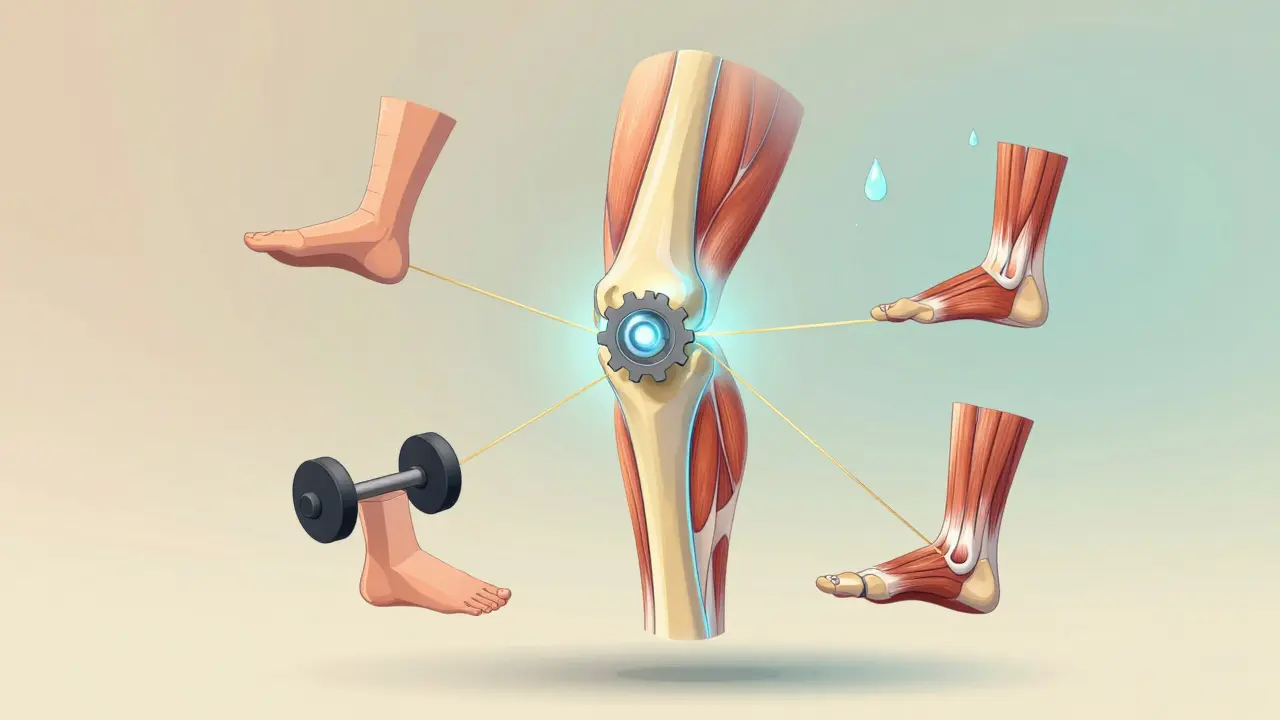
When your knees ache every time you stand up, or your hips stiffen after sitting too long, it’s easy to assume surgery or stronger painkillers are the only answers. But what if the real solution started with moving better - not just taking more pills? Physical therapy for joint disorders isn’t a last resort. It’s often the most effective first step. And it’s backed by hard data: a 2023 review of 127 clinical trials found that structured physical therapy reduces pain by nearly 38% and improves daily function by almost 30% compared to standard care alone.
Why Movement Matters More Than You Think
Joint disorders like osteoarthritis (OA) and rheumatoid arthritis (RA) aren’t just about worn-down cartilage or inflamed tissue. They’re about lost movement. When you stop moving because it hurts, your muscles weaken, your joints stiffen, and your body compensates in ways that make things worse. Physical therapy breaks that cycle. It doesn’t just treat pain - it restores function. The American College of Rheumatology’s 2021 guidelines changed everything. For the first time, they declared exercise a core treatment for RA, not just a nice-to-have. That’s because studies show people who stick with their prescribed movement routines slow joint damage by 23%. That’s not a minor benefit. That’s disease-modifying. And it applies to OA too. A 2023 study in Arthritis & Rheumatology found that physical therapy gave patients with mild-to-moderate hip OA the same level of function as those who had hip replacement surgery - without cutting into their body.Range of Motion: The Foundation of Every Program
You can’t strengthen what you can’t move. That’s why every effective physical therapy plan starts with range of motion (ROM). But not all ROM exercises are created equal. For knee OA, the gold standard is terminal knee extension. This isn’t just bending and straightening your leg. It’s the last 10-15 degrees of straightening - the part you use when standing up from a chair or walking uphill. The protocol? Three sets of 10-15 reps, five days a week, with resistance light enough that pain stays below 3 out of 10 on the pain scale. Add a 2.5kg ankle weight, and many patients report this single exercise makes the biggest difference in daily life. Hip ROM is different. Gentle hip circles, seated marches, and lying leg slides help maintain mobility without stressing the joint. The goal isn’t to force movement - it’s to keep the joint lubricated and the surrounding muscles active. Water therapy works wonders here. The 2022 APTA guidelines recommend water temperatures between 33-36°C (91-97°F) for 30-45 minutes, three times a week. The buoyancy reduces pressure on the joint while letting you move freely.Strengthening: The Real Game-Changer
Once movement is restored, strengthening takes over. This is where most programs fail - too little resistance, too few reps, or skipping progression. For hip OA, the 2025 JOSPT guidelines recommend hip abductor strengthening at 2.5-5.0 kg resistance, three times a week. That’s side-lying leg lifts, clamshells, or band walks. Not just once a week. Not light weights. This level of intensity triggers real muscle adaptation. For RA, the focus is on major muscle groups - quadriceps, glutes, shoulders - at 40-60% of your one-rep max, twice weekly. That means using weights you can lift 10-15 times before fatigue. It’s not about bulk. It’s about endurance and joint stability. Studies show this reduces flare-ups and improves grip strength, balance, and walking speed. The progression is strict: start with isometric holds (muscle contraction without movement) at 20-30% effort in the first two weeks. Then move to dynamic lifts at 60-80% effort after six weeks. Increase resistance by 0.5-1.0 kg weekly. Miss a week? You lose ground. Stick to it? You gain function.
What Works Better Than Surgery (Yes, Really)
Let’s be clear: physical therapy isn’t always the answer. If your joint space is more than 50% gone on an X-ray, exercise alone won’t rebuild cartilage. But for most people - especially those with mild to moderate damage - it outperforms alternatives. Take sacroiliac (SI) joint dysfunction. A 2022 meta-analysis found that physical therapy combined with joint manipulation reduced pain by 68% at 12 months. NSAIDs? Only 32%. The number needed to treat (NNT) was 2.8 - meaning for every three people treated, two avoided major disability. For knee OA, the cost savings are staggering. Medicare data shows patients who do physical therapy before total knee replacement cut their total episode costs by 22%. The APTA’s 2024 analysis found physical therapy saves $7,842 per quality-adjusted life year compared to corticosteroid injections. That’s not just money. It’s less risk, fewer complications, and more years of independence. And here’s the kicker: physical therapy can delay surgery by nearly three years. That’s three years of avoiding hospital stays, recovery time, and implant risks. For someone in their 50s or 60s, that’s a huge advantage.Why So Many People Quit - And How to Stick With It
You’d think with all this evidence, everyone would stick with therapy. But 33% of patients drop out within weeks. Why? Transportation is a big one. Rural patients are 2.4 times more likely to quit because they can’t get to appointments. Pain in the first two weeks is another. Many mistake initial discomfort for failure. But that’s normal. A Reddit survey of 347 people found 41% felt worse before they felt better. Insurance limits are a third. In Australia and the U.S., many plans cap sessions at 10-12. But Medicare data shows 87% of knee OA patients hit their goals by session 12 - if the protocol is followed. That means if your therapist stops at 10 sessions because of insurance, you might not get the full benefit. The fix? Consistency. You need at least 70% adherence to see results. That means showing up, doing the exercises, and tracking progress. Use a simple notebook. Write down your pain level before and after each session. Note what made movement easier. Celebrate small wins - like climbing stairs without holding the rail, or standing up from a chair without using your hands.
What the Experts Say
Dr. Susan Goodman, lead author of the ACR 2021 guidelines, calls exercise “disease-modifying therapy.” She’s not exaggerating. People who stick with their program don’t just feel better - their joints deteriorate slower. Dr. Michael Skolnik from Cleveland Clinic says prehabilitation before joint surgery cuts complications by 31% and shortens hospital stays by 1.8 days. That’s not just comfort - it’s safety. But Dr. Thomas Schnitzer warns: generic exercises fail. A 2022 study found only 12-15% of patients respond to one-size-fits-all routines. The magic happens when therapy is tailored - using tools like the HOOS (Hip Disability and Osteoarthritis Outcome Score) or KOOS (Knee version), with a minimum 8-10 point improvement considered clinically meaningful.The Future Is Personalized - And It’s Here
The 2025 JOSPT Hip Osteoarthritis guideline introduced something new: machine learning. By inputting your HOOS score, BMI, and X-ray severity, algorithms now predict which exercises will work best for you - with 83% accuracy. This isn’t science fiction. It’s clinical reality. Telehealth is expanding too. New billing codes in 2025 let therapists bill for remotely monitored sessions using wearable sensors that track movement accuracy. If your leg lift is off by more than 10 degrees, your app alerts you. No more guessing. Even neuromuscular electrical stimulation (NMES) is gaining traction. A 2024 study from the University of Pittsburgh found adding NMES to exercise boosted strength gains by 41% in knee OA patients at 24 weeks. That’s a game-changer for those who struggle to activate muscles on their own.What You Need to Do Now
If you have joint pain and haven’t tried physical therapy:- Ask your doctor for a referral - don’t wait until it’s “bad enough.”
- Find a therapist with specialized training in musculoskeletal rehab. Look for 120+ hours of advanced training in joint assessment and exercise prescription.
- Insist on a clear plan: ROM first, then strengthening, with measurable goals (e.g., “walk 500 meters without pain by week 6”).
- Track your progress. Pain scales, step counts, chair rises - write them down.
- If insurance limits sessions, push back. Ask if maintenance therapy is covered starting in 2026 - it now is for chronic joint conditions.
Can physical therapy really delay or avoid joint surgery?
Yes - for many people with mild to moderate joint damage. Studies show physical therapy can delay total hip or knee replacement by an average of 2.7 years. In some cases, patients achieve the same level of function as those who had surgery, without the risks or recovery time. However, if joint space narrowing exceeds 50% on X-ray, surgery may still be necessary. Physical therapy is most effective as an early intervention, not a last resort.
How often should I do range of motion and strengthening exercises?
For range of motion, aim for daily movement - even just 10 minutes. For strengthening, most guidelines recommend 3 sessions per week using resistance (e.g., 2.5-5.0 kg for hips, 40-60% one-rep max for major muscles). Consistency matters more than intensity. Missing two days in a row can slow progress. The key is sticking to a routine long enough to see changes - usually 6-8 weeks.
Why do I feel more pain at the start of physical therapy?
It’s common. When you start moving a stiff or weak joint, you’re activating muscles that have been dormant. This can cause temporary soreness - not sharp pain, but a dull ache. That’s normal. Pain should stay below 3/10 during exercise and go away within 24 hours. If pain spikes above 5/10, increases over time, or lasts longer than two days, talk to your therapist. They may need to adjust your program.
Is aquatic therapy better than land-based exercise for joint pain?
It depends. Water therapy is excellent for people with severe pain, balance issues, or obesity because buoyancy reduces joint load by up to 80%. It’s ideal for early-stage rehab. But land-based exercises build strength and coordination better for real-life tasks like walking stairs or standing up. Most effective programs use both: water therapy to start, then transition to land-based as pain and strength improve.
What if my insurance won’t cover enough physical therapy sessions?
Many insurers limit sessions to 10-12, but Medicare data shows 87% of knee OA patients reach their goals by session 12 - if protocols are followed. Ask your therapist to document your progress using validated tools like KOOS or HOOS. If you’re close to your goal, request an extension. In 2026, Medicare will expand coverage for maintenance therapy for chronic joint conditions, so ask if you qualify. Also, check if your plan covers telehealth - remote monitoring may be an affordable alternative.






8 Comments
Physical therapy my ass. I tried this for 6 weeks and my knee felt worse. They had me doing these dumb leg lifts and I ended up paying $400 for someone to tell me to 'move more'. Meanwhile my cousin got a knee replacement and now he’s hiking again. Stop selling snake oil as science.
Also who the hell uses ankle weights? That’s how you blow out your ACL./p>
The data is unequivocal: structured neuromuscular re-education protocols with progressive resistance training demonstrate statistically significant improvements in joint kinematics and functional capacity metrics. For OA patients, adherence to 3x weekly sessions with 40-60% 1RM load yields a 23% reduction in cartilage degradation velocity. Do not confuse transient discomfort with therapeutic failure. Consistency is non-negotiable./p>
I’ve been doing this for 18 months. Started with a cane. Now I hike. The first two weeks felt like my hips were grinding glass. But the pain? It didn’t vanish. It transformed. Into a dull hum. Then a whisper. Then nothing. I stopped counting reps. Started counting steps. 500. Then 1,000. Then 5,000. This isn’t medicine. It’s a rebellion./p>
I’m a PT. Worked in rural Maine for 12 years. The biggest barrier isn’t pain or motivation. It’s transportation. One woman drove 90 miles each way for 11 sessions. Got her insurance to deny #12. She cried in my office. We switched her to home-based NMES + telehealth. She’s walking her dog again. Tech helps. But heart matters more./p>
You got this. I know it hurts. I’ve been there. But every time you do those clamshells? You’re not just strengthening your glutes-you’re stealing back your life. One rep at a time. You’re not failing. You’re becoming./p>
I’ve read the JOSPT 2025 guidelines. The machine learning algorithm they mention? It’s already in use at my clinic. Input your HOOS score, BMI, and X-ray grade. It spits out a custom protocol. We had a 68-year-old man with hip OA. Algorithm said: 8 weeks water therapy, then 3x/week band walks. He hit his goal in 9. No surgery. But here’s the twist-he didn’t believe it would work. We had to send him home with a video of his own movement data. Seeing his own improvement? That’s what stuck./p>
I cried the first time I stood up from my couch without using my hands. I didn’t think it was possible. I thought my body was broken. But movement? Movement is a language. And your joints? They’re trying to talk to you. You just have to learn how to listen. And sometimes, you have to scream through the pain to hear them. I’m not healed. I’m becoming. And I’m so damn proud of myself.
💪❤️/p>
You think this is about therapy? Nah. This is Big Pharma’s cover-up. They don’t want you moving. They want you buying pills. And don’t get me started on the insurance cap. 10 sessions? That’s not enough to heal-it’s enough to make you quit. They’re setting you up to fail so you’ll end up with a $50k implant. And who profits? The same companies that make the meds. Wake up./p>