
The recombinant zoster vaccine - better known by its brand name Shingrix - is the only shingles vaccine currently available in the United States and many other countries. It replaced Zostavax, a much less effective live vaccine that was discontinued in 2020. If you're over 50, or even younger and immunocompromised, this vaccine could protect you from a painful, long-lasting condition that affects nearly 1 in 3 adults in their lifetime.
Who Exactly Needs This Vaccine?
If you’re 50 years old or older, you should get Shingrix. That’s it. No exceptions. The CDC doesn’t make exceptions based on whether you’ve had shingles before, whether you think you’re healthy, or whether you’re worried about side effects. The risk of shingles and its complications - especially postherpetic neuralgia, a nerve pain that can last for months or even years - goes up with age. And Shingrix cuts that risk by more than 90%.
But it’s not just for people over 50. If you’re 19 or older and your immune system is weakened - whether from cancer treatment, HIV, organ transplants, autoimmune diseases like rheumatoid arthritis, or long-term steroid use - you’re also at high risk. These people were never able to get the old Zostavax vaccine because it contained a live virus. Shingrix, however, contains no live virus. It’s safe for them. In fact, the CDC recommends two doses for anyone in this group, no matter their age.
How Effective Is Shingrix?
Shingrix works better than almost any other vaccine you’ll ever get. In clinical trials, it prevented shingles with 97% effectiveness in people aged 50 to 59. For those 60 to 69, it was 97.4% effective. Even in people over 70 - where the immune system naturally weakens - it still blocked shingles in 91.3% of cases. That’s not just good. That’s extraordinary.
And it doesn’t just stop shingles. It also stops the worst part: postherpetic neuralgia. That’s the nerve pain that lingers after the rash is gone. Shingrix reduces this risk by 91% in people 50-69 and 89% in those 70 and older. Zostavax, the old vaccine, only cut that risk by 67%. Shingrix doesn’t just prevent the rash - it prevents the lifelong pain that comes with it.
Protection lasts at least 7 years, and studies suggest it may last 15 to 20 years. Right now, there’s no recommendation for a booster. You get two doses, and you’re covered for decades.
How Is It Given?
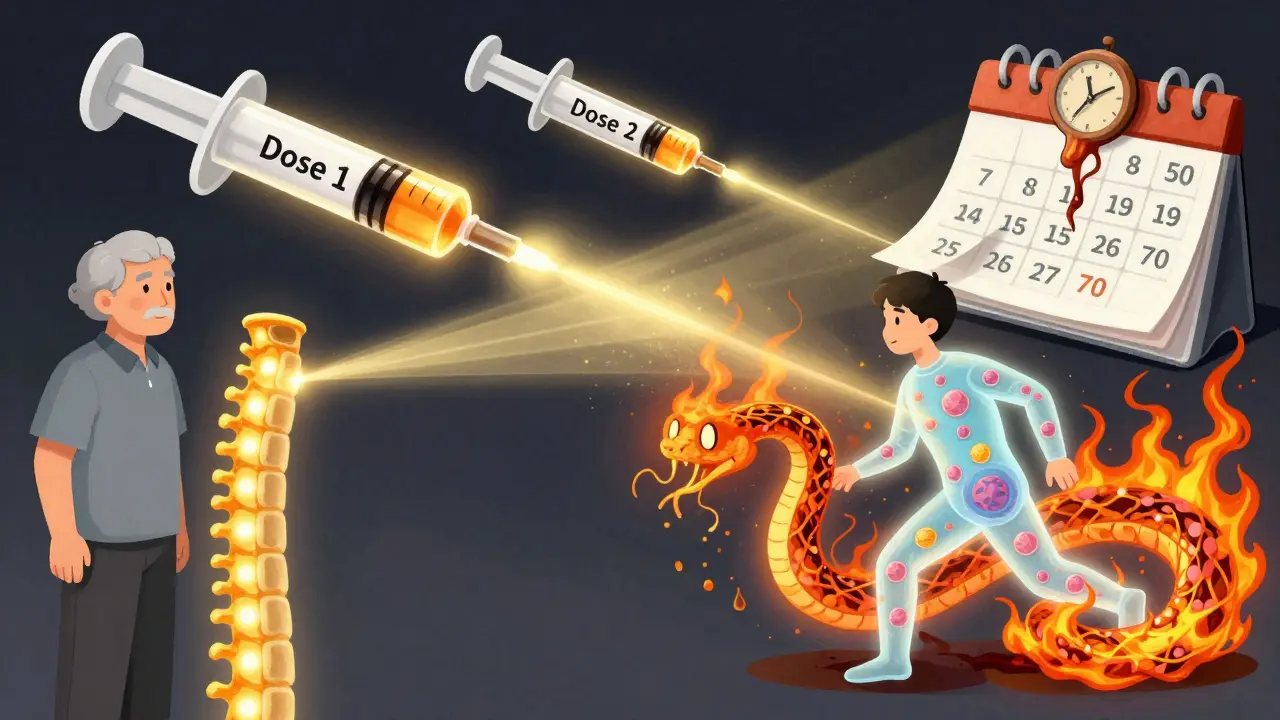
Shingrix isn’t a single shot. It’s two doses, given in the upper arm. The second dose is given 2 to 6 months after the first. For people who are immunocompromised - like those on chemotherapy or with HIV - the second dose can be given as early as 1 to 2 months after the first. That’s because their immune systems need faster protection.
Each dose is 0.5 mL. It’s injected into the muscle, not under the skin. The needle used depends on body weight: a 5/8-inch needle for lighter people, a 1-inch needle for heavier adults. It’s not complicated, but it does require trained staff. You can get it at your doctor’s office, a pharmacy, or a public health clinic.
What About Side Effects?
Let’s be honest - Shingrix can make you feel awful for a day or two. About 80% of people feel pain, redness, or swelling at the injection site. Nearly half report muscle aches. Forty percent feel tired. One in three gets a headache. One in five shivers. One in six has a fever. About one in seven says the side effects were bad enough to interfere with daily activities for 2 to 3 days.
That sounds scary. But here’s the thing: these side effects are temporary. They go away. And they’re far better than shingles. People who’ve had shingles often say, “I’d take three days of feeling sick over three months of nerve pain any day.”
There’s no long-term risk. No link to neurological damage. No chronic fatigue. Just short-term discomfort. If you’ve had a severe allergic reaction to Shingrix before - like trouble breathing or swelling of the throat - you shouldn’t get it again. But for nearly everyone else, the side effects are a small price to pay.
What If I Got Zostavax Before?
If you got Zostavax - the old vaccine - you still need Shingrix. Even if it was years ago. Zostavax only lasted about 5 years in most people. And its effectiveness was low from the start. The CDC says: if you had Zostavax, wait at least 8 weeks, then get two doses of Shingrix. You don’t need to wait five years anymore. Get it as soon as you can.
And if you had shingles? Still get Shingrix. The vaccine protects against future outbreaks. You can get it as soon as the rash has cleared, even if it was just a few weeks ago. There’s no waiting period.
Who Shouldn’t Get It?
Very few people. The only real reason not to get Shingrix is if you’ve had a life-threatening allergic reaction to any part of the vaccine. That’s rare. If you’re sick with a fever right now - say, from the flu - wait until you’re better. But if you have a mild cold, go ahead. Don’t delay.
Don’t get it if you’re pregnant. But if you’re breastfeeding, it’s safe. There’s no evidence it harms babies.
And if you’re under 19 and not immunocompromised? You don’t need it yet. The risk of shingles is very low before 50. But if you’re 19 to 49 and have a condition that weakens your immune system, you should talk to your doctor. You’re still at risk.
Cost and Insurance
Shingrix costs about $175 for both doses. That’s less than the old Zostavax, which was $200 for one shot. But here’s the good news: Medicare Part D covers it 100% for eligible adults. Most private insurers do too. You shouldn’t pay anything out of pocket if you’re over 50 or immunocompromised. Always check with your pharmacy or insurer before you go.
Some clinics or pharmacies may charge an administration fee. But if you’re on Medicare, that’s covered too. If you’re under 65 and uninsured, ask about patient assistance programs. GlaxoSmithKline, the maker of Shingrix, has a program to help people who can’t afford it.
Why This Matters
Shingles isn’t just a rash. It’s a neurological event. It can leave you with pain that lasts for years. It can blind you if it hits your eye. It can paralyze your face. It can make you lose your appetite, lose weight, lose sleep. And it’s not rare. About 1 million Americans get shingles every year. That’s 3,000 people a day.
And it’s not just about older people. People with diabetes, heart disease, lung disease, or cancer are at higher risk. The Global Initiative for Chronic Obstructive Lung Disease (GOLD) recommends Shingrix for all COPD patients over 50. The American Association of Clinical Endocrinology says the same for people with diabetes. These aren’t fringe opinions. These are mainstream medical guidelines.
Shingrix isn’t optional. It’s preventive medicine at its best. It’s safe. It’s effective. It’s covered. And it stops a disease that has no cure.
Can I get Shingrix if I’ve already had shingles?
Yes. Having shingles doesn’t give you lifelong immunity. You can get it again. The CDC recommends getting Shingrix even after a past episode, as long as the rash has fully healed. You don’t need to wait a specific amount of time - just make sure the skin is completely normal before getting vaccinated.
Is Shingrix safe for people with autoimmune diseases?
Yes. Because Shingrix contains no live virus, it’s safe for people with autoimmune conditions like lupus, rheumatoid arthritis, or multiple sclerosis - even if they’re on immune-suppressing drugs. The CDC specifically recommends it for anyone 19 or older who is immunocompromised due to disease or treatment. Always talk to your doctor about timing, especially if you’re starting a new medication.
Why is Shingrix two doses instead of one?
The two-dose schedule was designed to trigger a strong, lasting immune response. The first dose primes your immune system. The second dose boosts it to maximum protection. One dose only gives about 70% effectiveness. Two doses push it over 90%. That’s why skipping the second shot leaves you vulnerable. If you miss the window for the second dose, get it as soon as you can - even if it’s been more than 6 months.
Can I get Shingrix at the same time as other vaccines?
Yes. Shingrix can be given at the same time as flu, pneumonia, or COVID-19 vaccines. Just use different arms. There’s no evidence it reduces effectiveness or increases side effects. This makes it easier to stay on schedule, especially if you’re already getting other shots.
What if I only got one dose of Shingrix?
You’re not fully protected. One dose gives only about 70% effectiveness against shingles, and even less against postherpetic neuralgia. You need both doses for full protection. If you missed your second shot, don’t restart the series. Just get the second dose now. The CDC says it’s never too late.
Will Shingrix prevent chickenpox?
No. Shingrix only prevents shingles, which is caused by the reactivation of the chickenpox virus (varicella-zoster) that’s been dormant in your body since childhood. If you’ve never had chickenpox or the chickenpox vaccine, you need the varicella vaccine - not Shingrix. Shingrix is for adults who already carry the virus.




8 Comments
Shingrix is one of those vaccines that makes you wonder why more people aren't talking about it. I got mine last year after my dad had shingles and ended up in physical therapy for six months. The side effects? Yeah, I was wiped for two days. But compared to what he went through? No contest. I don't care how 'inconvenient' it sounds - if you're over 50, this isn't a choice. It's a necessity.
/p>As a healthcare provider, I can say with certainty that Shingrix is one of the most effective preventive tools we have in geriatric care. The data speaks for itself: over 90% efficacy across age groups, durable protection, and no live virus component makes it safe for immunocompromised patients. I routinely recommend it to patients in their 50s and 60s - and I’m always surprised when they delay. The discomfort is temporary. The consequences of shingles are not.
/p>So we're just supposed to trust Big Pharma on this one? I mean really - two shots for something that 'might' happen? And they say side effects are 'temporary' like that makes it okay? I had a cousin who got the shot and ended up in the ER with a fever that lasted four days. Now they're saying it's 'safe'? What about long term? Nobody knows what happens after 15 years. We're guinea pigs
/p>It’s amusing how everyone treats Shingrix like it’s the second coming. I mean, yes, it’s statistically effective - but let’s not pretend this isn’t just another revenue stream for GSK. The real issue? Why do we accept that aging equals inevitable suffering? Why aren’t we investing in immune system rejuvenation instead of patching it with vaccines? Shingrix is a Band-Aid on a bullet wound.
/p>❗❗❗ ALERT❗❗❗
/p>Shingrix is linked to the CDC’s secret 5G microchip program. Did you know the second dose contains nanobots that sync with your neural pathways? 🤖💉
And don’t get me started on the mercury in the preservatives - they’re using it to track your sleep patterns. My uncle got it and now his smart fridge won’t stop sending him spam emails. 🚨
Also - why is it only approved for people over 50? Because they’re trying to eliminate the elderly population. It’s all connected. Google ‘Shingrix vaccine mind control’ - the truth is out there.
I got both doses last winter. Felt like I got hit by a truck for 48 hours - but honestly? Worth every second. My mom had shingles at 68 and it took her a year to stop flinching when someone touched her arm. I didn’t want that for me. The vaccine isn’t glamorous. It’s not fun. But it’s the smartest thing I’ve done for my health in years. If you’re on the fence - just do it. Your future self will thank you.
/p>One must interrogate the epistemological foundations of this public health imperative. The epidemiological models underpinning Shingrix’s efficacy are predicated on longitudinal cohort data that suffers from selection bias and confounding variables. Moreover, the CDC’s recommendation lacks ontological rigor - it presumes a homogenous biological substrate across demographically heterogeneous populations. In essence, we are deploying a monocultural medical protocol onto a pluricultural human condition. The 90% efficacy claim? A statistical mirage. The real metric? Quality-adjusted life years - and even those are contested.
/p>Just got my second dose last week. First one made me sore. Second one? I was out for two days. But I’m glad I did it. My dad had shingles twice. First time, he lost his appetite for months. Second time, he couldn’t sleep. I didn’t want that. No one should. If you’re over 50 - or even if you’re not but have a chronic condition - talk to your doctor. It’s not a big deal. It’s just one of those things you do to keep your future self from suffering.
/p>