
7 Mar 2026
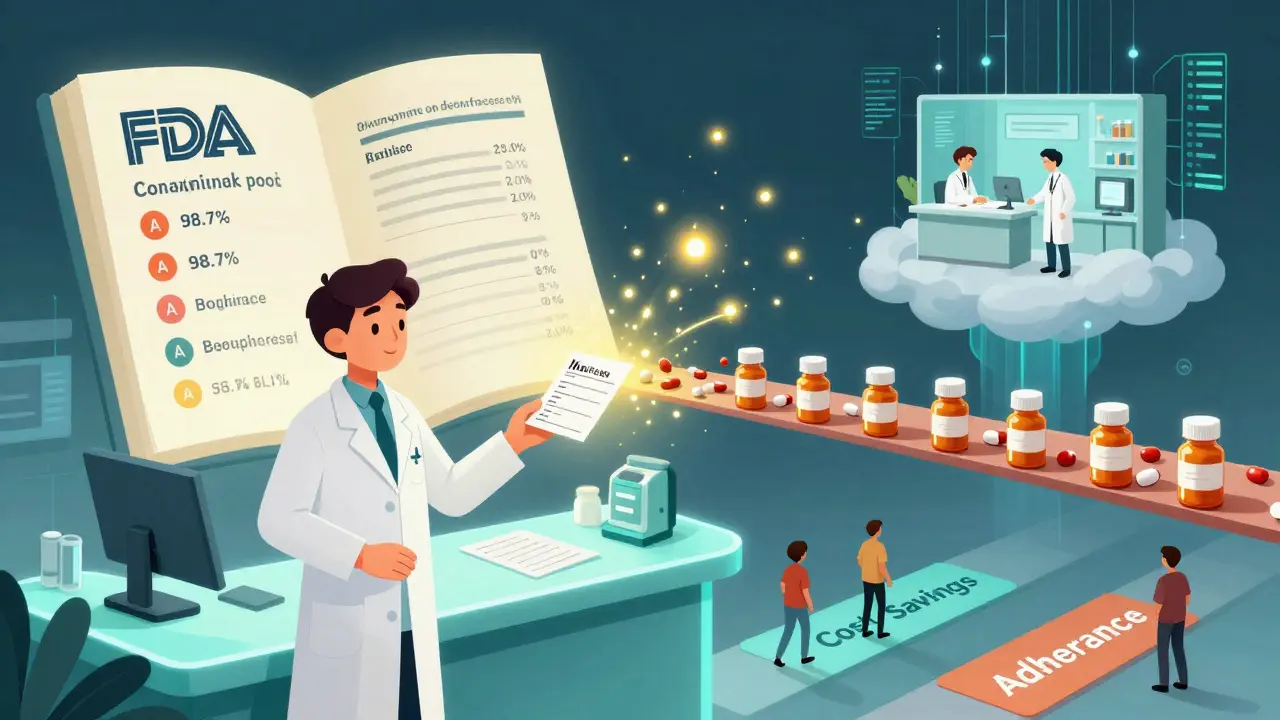
When a pharmacist sees a prescription for a brand-name drug, they don’t just fill it. They look at the cost, the patient’s history, and whether a generic version would work just as well. In many cases, it does. But telling a doctor that isn’t always as simple as checking a box. Communicating with prescribers about generic substitution is one of the most impactful, yet underappreciated, parts of pharmacy practice today. It’s not about pushing cheaper drugs-it’s about making sure patients get the right treatment at the right price, without compromising safety or effectiveness.
Why Generic Substitution Matters
Generic drugs aren’t second-rate. They’re the same active ingredient, in the same strength, and delivered the same way as their brand-name counterparts. The U.S. Food and Drug Administration (FDA) requires them to meet strict bioequivalence standards: the amount of drug absorbed into the bloodstream must fall within 80% to 125% of the brand-name version. In practice, 98.7% of approved generics stay within an even tighter range-95% to 105%. That means the body processes them almost identically. In 2023, 97% of all prescriptions filled in the U.S. were for generics. That’s not just a trend-it’s a savings machine. Generics saved the healthcare system $409 billion that year alone. For patients on long-term medications like statins, blood pressure pills, or diabetes drugs, switching to a generic can cut out-of-pocket costs by 80% or more. But here’s the catch: if the prescriber doesn’t know the substitution happened, or if they have concerns, it can lead to confusion, refill delays, or even unnecessary switching back to expensive brands.When Pharmacists Must Speak Up
Not every prescription is a candidate for automatic substitution. There are clear situations where a pharmacist must reach out to the prescriber before making any changes. Narrow therapeutic index (NTI) drugs are the first red flag. These are medications where even small changes in blood levels can cause serious side effects or treatment failure. Examples include warfarin, levothyroxine, and phenytoin. While the FDA considers many NTI generics equivalent, pharmacists know that some prescribers still prefer to stick with the original brand. A quick call or secure message can prevent a patient from having a stroke or going into thyroid crisis. Excipient allergies are another hidden risk. Generics can use different inactive ingredients-fillers, dyes, preservatives-that might trigger reactions in sensitive patients. About 8.7% of substitution issues stem from these differences. A patient with a documented allergy to lactose or a specific dye? The pharmacist has to check the generic’s ingredients and alert the prescriber if there’s a mismatch. Then there’s the "dispense as written" (DAW) code on prescriptions. About 15.3% of all prescriptions carry this instruction. Often, it’s because the prescriber has seen a bad reaction to a previous generic, or they’re unsure about equivalence. Pharmacists don’t ignore DAW codes-they use them as a trigger to ask: "Why?" A well-informed pharmacist can provide data from the FDA’s Orange Book to show that the generic in question has an "A" rating (therapeutically equivalent), helping to clear up misunderstandings.The Tools Pharmacists Use
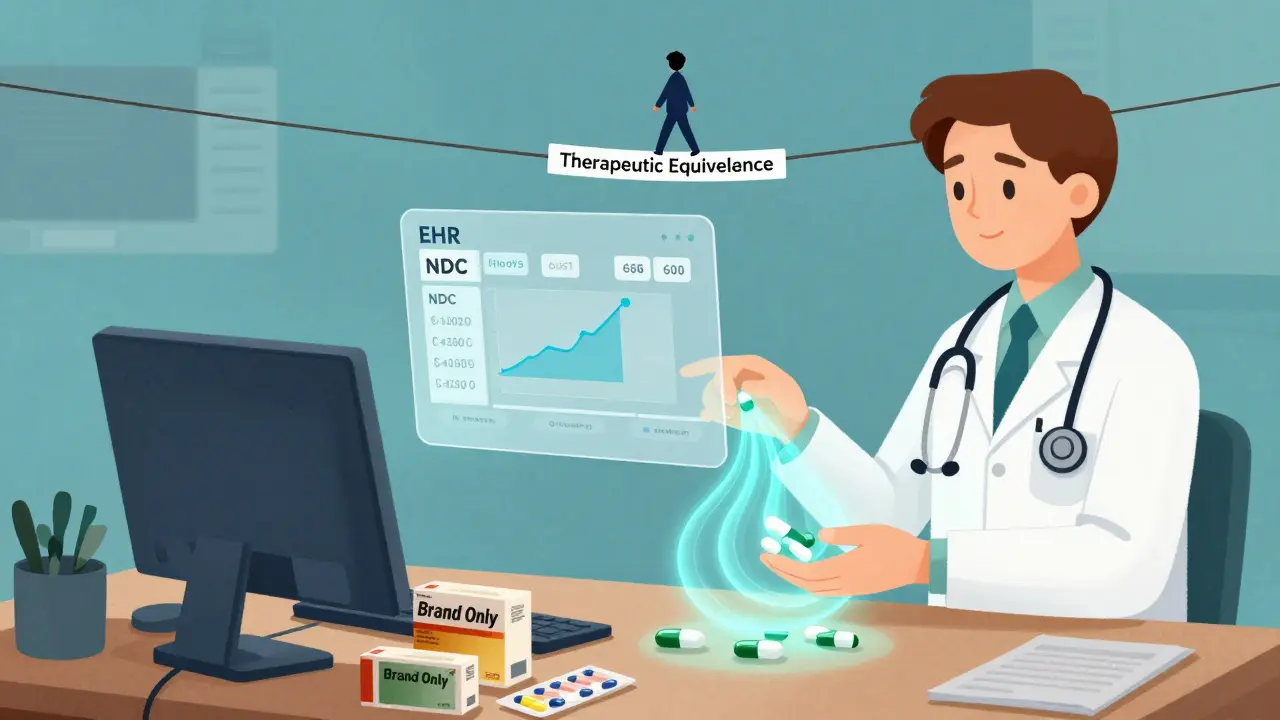
The backbone of all this communication is the FDA’s Orange Book. Officially called Approved Drug Products with Therapeutic Equivalence Evaluations, it’s updated monthly and lists every approved generic, its brand counterpart, and its equivalence rating. "A" means equivalent. "B" means not. Pharmacists rely on this daily. But knowing the rating isn’t enough. The real skill is explaining it. The American Society of Health-System Pharmacists (ASHP) recommends a four-step approach:- Contact the prescriber within 24 hours of receiving the prescription.
- Reference the specific Orange Book rating for the drug.
- Share cost data-average wholesale price differences can be dramatic.
- Document the conversation in the patient’s record.
Barriers Still Exist
Despite the data, resistance remains. A 2023 survey by the National Community Pharmacists Association found that 37.6% of prescribers still worry about generic effectiveness. That number jumps to 42.3% for inhalers and 38.9% for topical creams-products where delivery matters. Why? Some of it’s outdated thinking. Some of it’s lack of exposure. Many doctors trained decades ago, when generics had a reputation for inconsistency. They haven’t seen the data since the FDA tightened standards in the 2000s. Time is another barrier. Pharmacists report having only 2.3 minutes per prescription to verify everything-dosage, interactions, allergies, substitutions. That’s not enough to have deep conversations. And prescribers? A 2023 Medscape report found 62.1% say they simply don’t have time to review substitution requests. The solution? Concise, targeted messaging. A 2021 study showed that when pharmacists included specific bioequivalence numbers-like "AUC ratio of 98.7%"-prescriber acceptance rose by 34.2 percentage points. Facts beat feelings.Documentation Is Non-Negotiable
Every time a pharmacist substitutes a generic-or even just discusses it with a prescriber-it must be documented. The Centers for Medicare & Medicaid Services (CMS) requires this for Part D claims. But it’s not just about compliance. Good documentation prevents errors. Best practices from the American Pharmacists Association and the American Medical Association include recording:- Date and time of communication
- Method used (phone, secure message, EHR)
- Prescriber name and credentials
- Generic product dispensed (including manufacturer and NDC)
- Reason for substitution
- Prescriber’s response or decision



11 Comments
I've been doing this for 20 years and let me tell you, most generics are junk. I've seen patients go into seizures because some no-name company in India decided to use a different filler. The FDA doesn't even test the real-world stuff. It's all just paperwork. And don't get me started on how they 'approve' things now.
Also, why is everyone acting like this is some heroic act? It's just cost-cutting disguised as care. Pharma companies are laughing all the way to the bank./p>
I work in a community pharmacy and I see this every day. A 72-year-old on metformin used to spend $180 a month. Now? $12. She cries when she gets her script. Not because she's grateful for the savings - though she is - but because she finally can afford to eat right, take her blood pressure med, and not skip doses.
It's not about generics being 'just as good.' It's about dignity. When someone can't choose between insulin and groceries, we're failing them. Pharmacists aren't pushing drugs - we're pushing survival./p>
I love this so much 😊 Seriously, y'all don't realize how much work goes into this. I had a guy yesterday come in for his warfarin - brand name. I checked the Orange Book, called his doc, sent the EHR note with the AUC ratio (98.7% btw) and guess what? He switched and saved $200/month. He texted me a selfie with his coffee and a 'thank u' 🙌
Pharmacists are the real MVPs. We're the ones holding the line between science and chaos./p>
I used to think generics were sketchy too. Then my mom got on a bunch of meds after her stroke. We switched her to generics and her co-pays went from $500/month to $45. She's been stable for 2 years now.
Turns out, the science is solid. The FDA doesn't lie. And honestly? If a drug works for 97% of prescriptions, maybe we should stop acting like it's a gamble. Just sayin'./p>
This whole thing is a scam. You think the government cares about patients? Nah. They care about corporate profits. Generics are made in factories where workers don't even have masks. The active ingredient? Sometimes it's 70% of what it should be. You think they test it? They don't. They just stamp 'A' and move on.
And don't even get me started on the EHR systems. They're all rigged. Big Pharma owns them. They're making you think you're saving money while they just reroute the cash. Wake up./p>
Oh wow. A 1500-word essay on how pharmacists are angels. How touching. Let me guess - you're also going to tell me that the Orange Book is written in divine scripture?
Here’s the reality: doctors don’t trust generics because they’ve seen patients crash after switching. Not because they’re 'outdated' - because sometimes, the damn thing doesn’t work. And no, 98.7% doesn’t mean squat when you’re the 1.3% who gets a stroke because your levothyroxine had a 10% variance.
Stop pretending this is about care. It’s about cost-shifting. And you’re the enabler./p>
i heard the orange book is just a list made by people who used to work for pfizer. and the 'a' rating? that's just a joke. my cousin works in a lab and says they test like 2 batches a year. the rest is just paperwork. and the ehr stuff? totally fake. it's all just bots sending messages to each other.
they don't even call anymore. it's all automated. so who's really checking? no one. it's a lie. you're all being played./p>
Let’s be real. This whole ‘pharmacist advocacy’ narrative is just PR fluff. You’re not ‘helping patients’ - you’re pushing generics because your pharmacy gets a bigger margin. You think I don’t know? I’ve seen the spreadsheets. The ‘cost savings’? That’s just the difference between $1.50 and $0.80 per pill. Meanwhile, the patient still pays $40 for the script because insurance won’t cover the rest.
And documenting everything? That’s not safety - that’s liability armor. You’re covering your ass, not saving lives.
Also, AI tools? Please. They’re trained on biased data. They recommend generics based on formulary, not clinical need. You’re automating negligence./p>
In India, we have been using generic medications for decades, and the quality control standards are far more rigorous than many assume. The notion that generics are inferior is a Western myth perpetuated by marketing, not science. Pharmacists here are trained to verify bioequivalence at every step - and patients have better adherence because they can afford treatment.
This article highlights a systemic issue in the U.S., not a failure of generics. The real barrier is not science - it's policy, profit, and perception./p>
I’ve been a pharmacist for 18 years. I’ve seen patients die because they couldn’t afford their meds. I’ve also seen doctors refuse substitution because they ‘remember a bad experience’ from 1998.
What this article doesn’t say - but what I live every day - is that communication isn’t just about sending a message. It’s about building trust. It’s about showing up, even when you have 2.3 minutes. It’s about having the same conversation five times until they finally listen.
This isn’t about data. It’s about persistence. And yes - it’s exhausting. But someone has to do it./p>
So you're telling me a pharmacist can just swap a brand-name drug for a generic and call it a day? What about bioavailability? What about manufacturing variations? You're ignoring the fact that the FDA's equivalence standards are based on healthy young adults - not elderly patients on polypharmacy.
And you're glorifying automation? AI doesn't know if a patient has a rare CYP450 mutation. EHRs don't know if the patient's last refill was 3 months ago because they were in the hospital.
This isn't innovation - it's negligence dressed up as efficiency. You're outsourcing clinical judgment to a spreadsheet. And that's dangerous./p>