
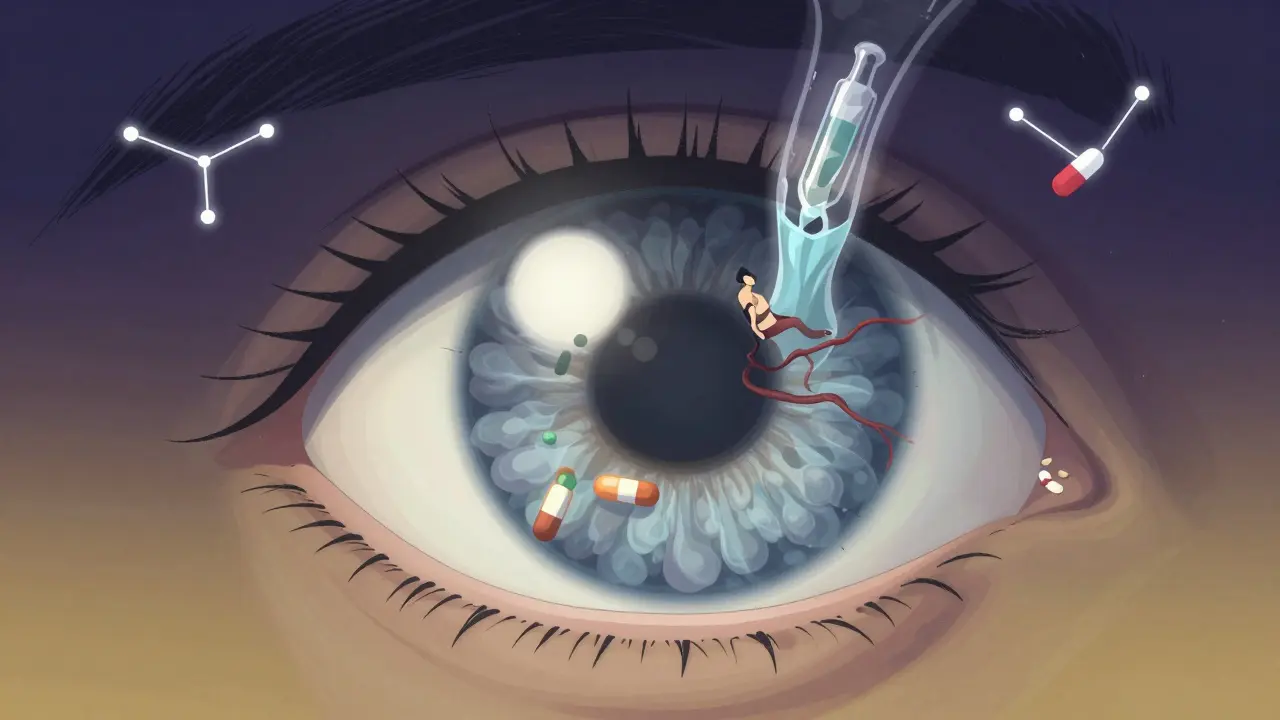
Steroid Eye Risk Calculator
Assess Your Risk
Calculate your personalized risk of steroid-induced eye damage based on your treatment and health history.
Your Risk Assessment
Schedule routine eye exam every 6 months while on steroids.
When you take steroids for asthma, rheumatoid arthritis, or even a bad skin rash, you’re not just fighting inflammation-you’re putting your eyes at risk. Many people don’t realize that the same medicine helping their body can quietly damage their vision. Steroid-induced cataracts and glaucoma aren’t rare side effects. They’re common, predictable, and often preventable-if you know what to watch for.
How Steroids Hurt Your Eyes
Steroids don’t just reduce swelling. They change how your eye works at a molecular level. For cataracts, the steroid molecule binds to proteins in your lens, forming abnormal clumps that cloud your vision. This isn’t the slow fogging of age-related cataracts. Steroid-induced cataracts are posterior subcapsular cataracts-a specific type that forms right behind the lens, right where light enters. They blur your vision fast. People report halos around lights, faded colors, and trouble seeing at night-all before they even notice their vision is changing.
For glaucoma, steroids block the eye’s natural drainage system. Fluid builds up, pressure rises, and the optic nerve slowly dies. Unlike regular glaucoma, which creeps up over years, steroid-induced pressure can spike in weeks. And here’s the scary part: you won’t feel it. Glaucoma doesn’t hurt. No redness, no pain-just a slow narrowing of your side vision until it’s too late.
Who’s Most at Risk?
Not everyone who uses steroids gets eye damage. But some people are far more vulnerable. About 5% of the population has a genetic sensitivity that makes their eye pressure spike dangerously high with even small doses. Another 25-30% show moderate pressure increases. That means nearly one in three people could be at risk.
High-risk groups include:
- People with a family history of glaucoma
- Those already diagnosed with glaucoma
- Patients who’ve had cataract surgery
- People using steroid eye drops for more than two weeks
- Anyone taking oral steroids like prednisone for over a month
One study found that 90% of people with existing glaucoma become steroid responders-meaning their pressure skyrockets with any steroid exposure. And here’s the twist: nearly 35% of steroid-induced glaucoma cases happen in people with no prior eye history. You can be perfectly healthy and still be blindsided.
How Fast Does Damage Happen?
Time matters. A lot.
Steroid eye drops can cause cataracts in as little as two to four weeks. That’s why doctors warn against using them for more than a week without follow-up. Oral steroids take longer-but not much. After four months of daily prednisone, the risk of posterior capsular opacification jumps sharply. Glaucoma can develop in weeks or months, depending on your genetics and dose.
Pressure spikes vary: 66% of users see a rise under 5 mmHg, which may not be dangerous. But 30% see a 6-15 mmHg increase-and 5% go over 15 mmHg. That’s a red flag. Normal eye pressure is 10-21 mmHg. A jump to 30+ mmHg can damage your optic nerve in months.
And here’s the brutal truth: once the nerve is damaged, it doesn’t heal. Even if you stop the steroids, the vision loss stays.
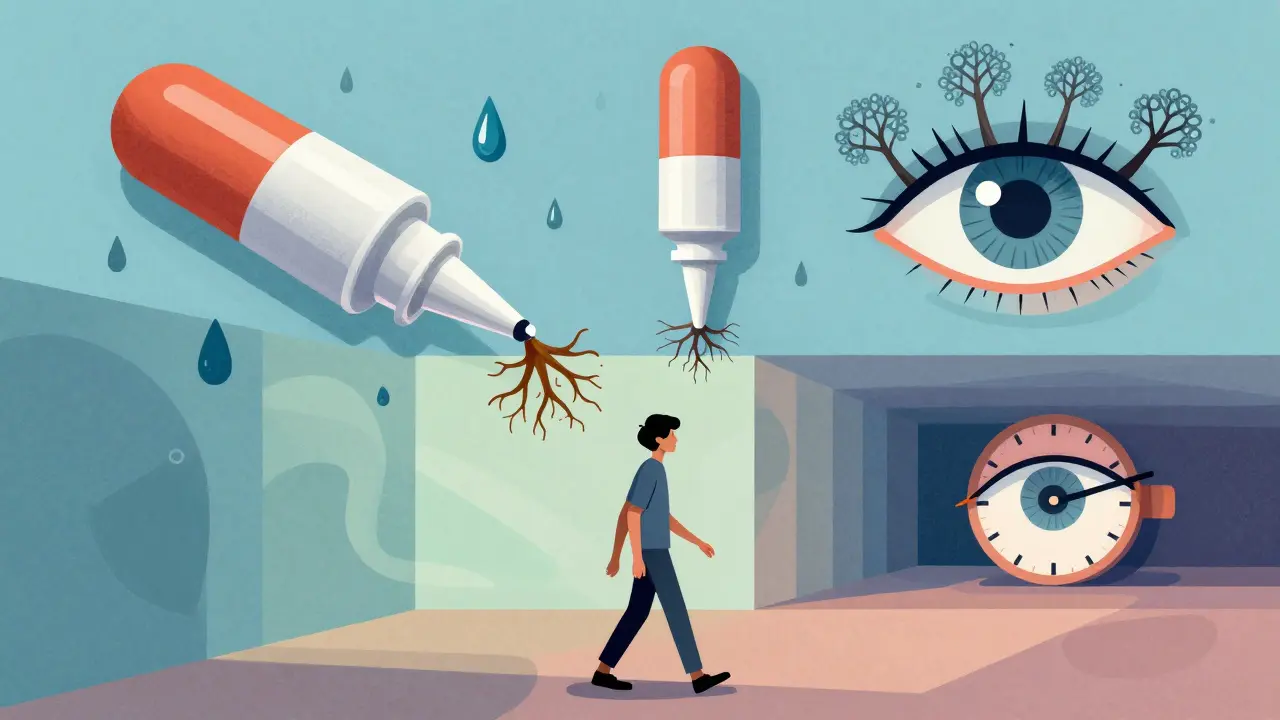
Steroid Eye Drops Are the Biggest Culprit
Not all steroids are equal when it comes to eye risk. Topical drops-used for uveitis, allergies, or post-surgery-deliver the highest concentration directly to the eye. That’s why they cause the fastest damage.
One patient on Healthgrades shared: ‘I used steroid drops for uveitis for six months. My doctor said it was safe. I didn’t know I was losing peripheral vision until I couldn’t see the curb while walking.’
Systemic steroids (pills, shots, inhalers) are slower but still dangerous. A Reddit user wrote: ‘After six months of prednisone for asthma, my eye exam showed 20/80 vision. I had advanced cataracts. No warning.’
Doctors often prescribe steroid drops because they work so well. But they’re not always necessary. Alternatives like loteprednol etabonate are now available-designed to break down faster in the eye and cause less pressure rise. A 2024 JAMA Ophthalmology study showed these newer drops raised pressure in only 8% of users, compared to 30% with traditional steroids.
What You Should Do
If you’re on steroids long-term, here’s your action plan:
- Get a baseline eye exam before starting steroids. Measure your eye pressure and check for early signs of damage.
- Follow up every 2 weeks if you’re using eye drops. Every 4-6 weeks if you’re on pills or inhalers.
- Don’t wait for symptoms. Glaucoma doesn’t hurt. Cataracts don’t always cause blurry vision right away.
- Ask your doctor if you can switch to a lower-risk steroid or use the lowest effective dose.
- Get annual eye exams even after stopping steroids-damage can progress slowly.
The American Academy of Ophthalmology says only 42% of primary care doctors refer patients for eye checks when prescribing long-term steroids. Don’t rely on them to catch it. Be your own advocate.
Early Signs You Can’t Ignore
These aren’t vague complaints. They’re red flags:
- Seeing halos or glare around lights, especially at night
- Colors looking dull or washed out
- Difficulty reading small print or seeing in dim light
- Blurred vision that doesn’t improve with glasses
- Feeling like you’re looking through a tunnel-losing side vision
If you notice any of these while on steroids, see an eye doctor immediately. Don’t wait for your next appointment.
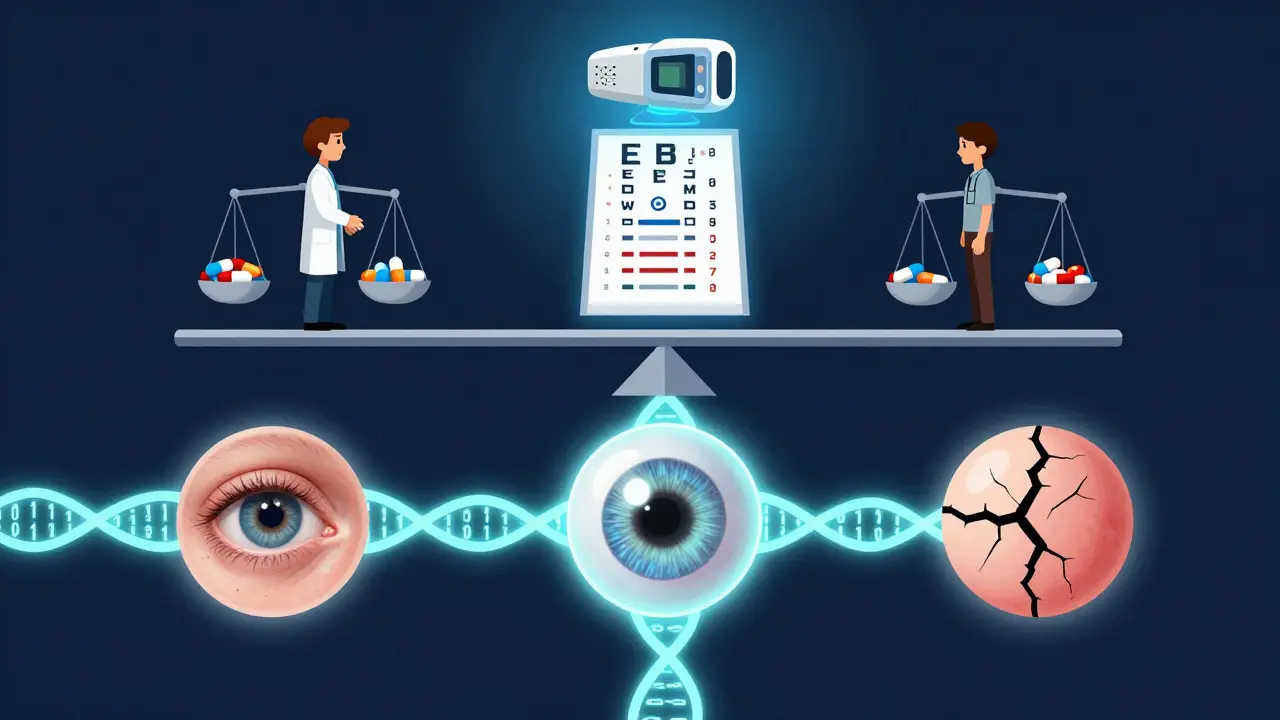
Can It Be Reversed?
Good news: if caught early, steroid-induced glaucoma can be stopped. Once you stop the steroid, eye pressure often drops back to normal. Medications like prostaglandin analogs or beta-blockers can help lower pressure while your eye recovers.
But if pressure stays high for too long, the optic nerve dies. That’s permanent. Cataracts don’t reverse-they get worse. Surgery is the only fix. And while cataract surgery is common, doing it on a steroid-damaged eye is harder. The lens is more fragile. Recovery takes longer. Vision doesn’t always bounce back fully.
The key isn’t cure. It’s prevention.
What’s Changing in 2026?
Technology is catching up. New home IOP monitors let high-risk patients check their eye pressure weekly without leaving the house. A 2024 study in the American Journal of Ophthalmology found a genetic test can predict steroid responsiveness with 85% accuracy. That means in the near future, you might get a blood test before starting steroids-and know your risk before your eyes are affected.
Tele-ophthalmology programs are also expanding. The Veterans Health Administration now monitors over 27,000 steroid users remotely, catching problems early. More clinics are adopting these tools.
But the biggest change? Awareness. More doctors are starting to ask: ‘Are you on steroids?’ before prescribing eye drops. More patients are asking: ‘Could this hurt my eyes?’
Final Thought
Steroids save lives. They control asthma. They calm autoimmune flare-ups. They help skin heal. But they’re not harmless. Their eye risks are real, measurable, and often ignored.
You don’t need to avoid steroids. You just need to know the risks-and act before it’s too late. Get checked. Ask questions. Push for alternatives if you’re on them long-term. Your vision isn’t something you can afford to gamble with.
Can steroid eye drops cause permanent vision loss?
Yes, if used for more than a few weeks without monitoring. Steroid eye drops can cause glaucoma by raising eye pressure. If that pressure stays high for months, it damages the optic nerve permanently. Cataracts from steroids also worsen over time and require surgery. Early detection stops progression-delayed care leads to irreversible loss.
How long before steroids damage your eyes?
It varies. Steroid eye drops can start causing pressure changes in as little as two weeks. Cataracts may form in 2-4 weeks. Oral steroids usually take longer-around 3-4 months of daily use significantly raises risk. But genetics matter. Some people see damage in weeks; others take years. That’s why regular eye checks are critical from day one.
Are there safer steroids for the eyes?
Yes. Newer steroid eye drops like loteprednol etabonate are designed to break down faster in the eye, reducing pressure buildup. Studies show they cause significantly less IOP elevation than older steroids like prednisolone. Talk to your eye doctor about switching if you’re on long-term steroid drops. For systemic use, low-dose or intermittent regimens lower risk.
If I stop steroids, will my eye pressure go back to normal?
In most cases, yes. Steroid-induced high eye pressure usually drops within weeks after stopping the medication. But not always. Some people remain high-pressure responders even after discontinuation. That’s why follow-up checks are essential-sometimes for months after stopping. And if optic nerve damage has already occurred, stopping steroids won’t restore lost vision.
Should I get genetic testing before taking steroids?
It’s not routine yet, but it’s coming. A 2024 study showed a genetic test can predict steroid responsiveness with 85% accuracy. If you have a family history of glaucoma or have had high pressure before, ask your doctor about testing. It’s not widely available, but in clinics with advanced eye care, it’s becoming an option for high-risk patients.
How often should I get my eyes checked if I’m on long-term steroids?
Baseline exam before starting. Then: every 2 weeks if using eye drops, every 4-6 weeks if on oral or inhaled steroids for the first 3 months. After that, if pressure stays normal, every 6 months. If pressure rises, you’ll need monthly checks. Don’t skip these-even if you feel fine. Glaucoma has no symptoms until it’s advanced.

8 Comments
Just got off a 6-month prednisone run for my RA. Didn’t know my eyes were in danger until my optometrist flagged my pressure at 28. Scared the hell out of me. Now I get checked every 4 weeks-no excuses. If you’re on steroids, don’t wait for symptoms. Your vision doesn’t text you a warning.
/p>It’s not just about steroids-it’s about the erosion of medical responsibility. Doctors prescribe like they’re handing out candy. And patients? They swallow it without asking. This isn’t healthcare. It’s negligence dressed in white coats. The system is broken, and your eyes are the collateral damage.
/p>OMG I’m so glad this post exists. I was on steroid drops for uveitis for 3 months and thought I was fine-until I started missing steps on the stairs. Turned out my peripheral vision was gone on the left. I cried in the doctor’s office. But here’s the win-I switched to loteprednol, pressure dropped in 2 weeks, and now I’m on a monitoring schedule. YOU CAN SAVE YOURSELF. Just don’t wait. Go get that baseline now. Seriously. Your future self will thank you.
/p>People today are too lazy to read the damn pamphlet. Steroids? Read the fine print. It’s right there. If you can’t be bothered to know what you’re putting in your body, don’t blame the doctor. Your eyes are your own responsibility. I’ve seen too many people cry after it’s too late. Stop being passive. Start being smart.
/p>Did you know Big Pharma knows exactly how many people will go blind from steroids? They’ve calculated it. That’s why they push the drops so hard. It’s not about healing-it’s about the next surgery, the next lens, the next bill. Your vision is a profit center. And your ignorance? That’s their marketing strategy.
/p>I’m so glad someone finally said this out loud. My mom lost 30% of her vision from steroid eye drops after a corneal scratch. She didn’t know to ask. I’m now pushing every single person I know who’s on any kind of steroid to get an eye exam-even if they feel fine. It’s not scary to get checked. It’s scary to wait.
/p>Back home in Delhi, we call this ‘silent thief of sight’-and it’s true. My uncle took steroids for years for his eczema, never checked his eyes, and woke up one morning seeing double. Surgery fixed the cataracts, but the glaucoma damage? Gone forever. We lost his peripheral vision. He can’t drive anymore. I tell everyone now: if your doctor says ‘it’s safe,’ ask ‘safe for what?’ Eyes don’t lie. They just don’t scream until it’s too late.
/p>Get checked. Period./p>