
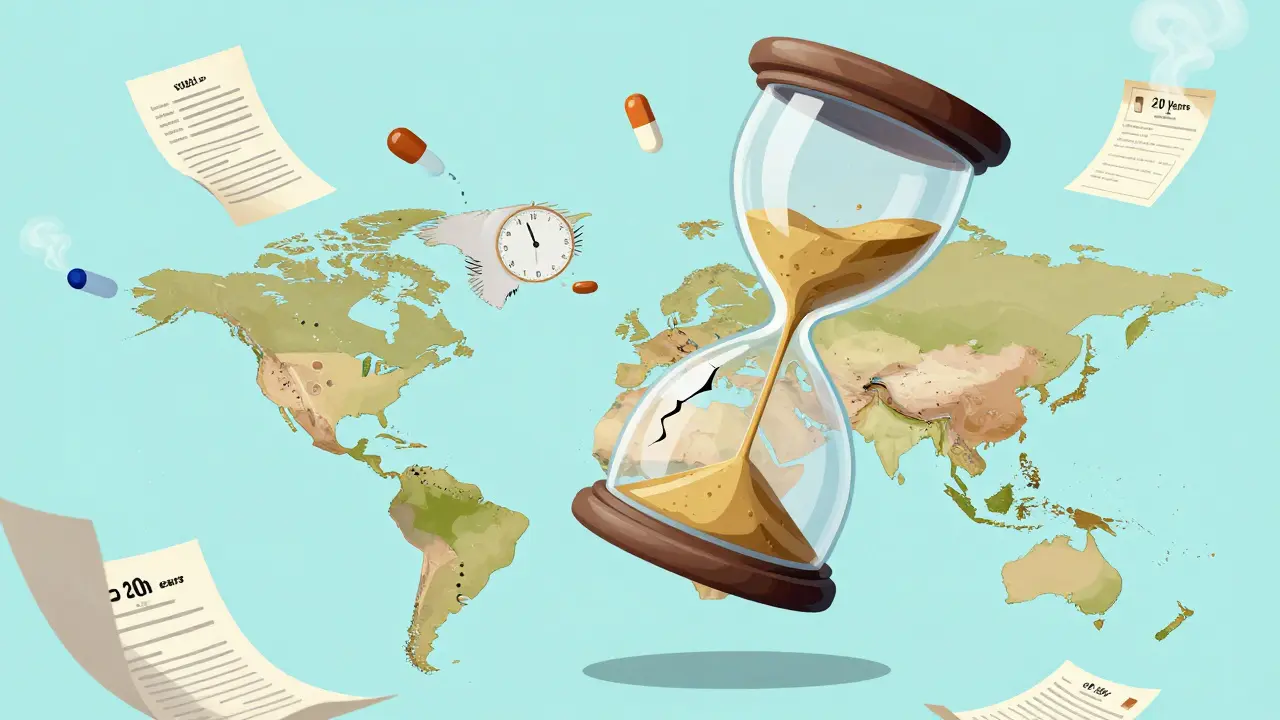
When a company develops a new drug, the patent doesn’t just expire on a single date worldwide. It vanishes at different times in different countries - sometimes years apart. This isn’t a glitch. It’s the system. And for pharmaceutical companies, getting this wrong can mean losing millions in revenue overnight. Understanding how patent expiration works across borders isn’t just legal trivia. It’s a core part of how drugs stay on the market - or don’t.
The 20-Year Rule - And Why It’s Not That Simple
Most people think patents last 20 years. And technically, they’re right. Since 1995, nearly every country that’s part of the World Trade Organization (WTO) has followed the TRIPS Agreement a global treaty that mandates patent protection must last at least 20 years from the filing date. This replaced older systems, like the U.S. rule that gave patents 17 years from the grant date. But the 20-year clock doesn’t start the same way everywhere.
The key is the priority date the date of the first patent application filed anywhere in the world. If a company files in Germany on January 1, 2020, then files in the U.S., Japan, and Brazil six months later, all those patents will expire 20 years from January 1, 2020 - not from when they were filed locally. This is thanks to the Paris Convention an international treaty that lets inventors claim their original filing date in other countries within 12 months. So, even though the patent applications were filed in different places, they’re all tied to that first date.
What Happens After 20 Years? Not Always What You Think
Just because the 20-year term ends doesn’t mean the patent dies instantly. Many countries have rules that can extend it - sometimes significantly.
In the United States the patent term can be extended due to delays caused by the USPTO during examination. The Patent Term Adjustment (PTA) an automatic extension granted when the patent office takes too long to review the application can add hundreds of days. In 2022, the average PTA was 558 days - nearly 1.5 years. For a drug patent filed in 2015, that could mean protection lasting until 2036 instead of 2035.
For pharmaceuticals, there’s another layer: Patent Term Extension (PTE) a legal extension granted to make up for time lost during regulatory approval. The FDA review process can take five to seven years. The U.S. allows up to five years of extension, but only if the patent hasn’t already expired. This is why some blockbuster drugs stay protected well beyond their original 20-year window.
Europe has a similar system called Supplementary Protection Certificates (SPCs) a mechanism that extends patent life by up to five years for drugs. The EU even added a six-month extension if the drug was tested in children. In Japan, patent terms can be extended if the patent office took more than three years to examine the application - or if regulatory approval took over a year.
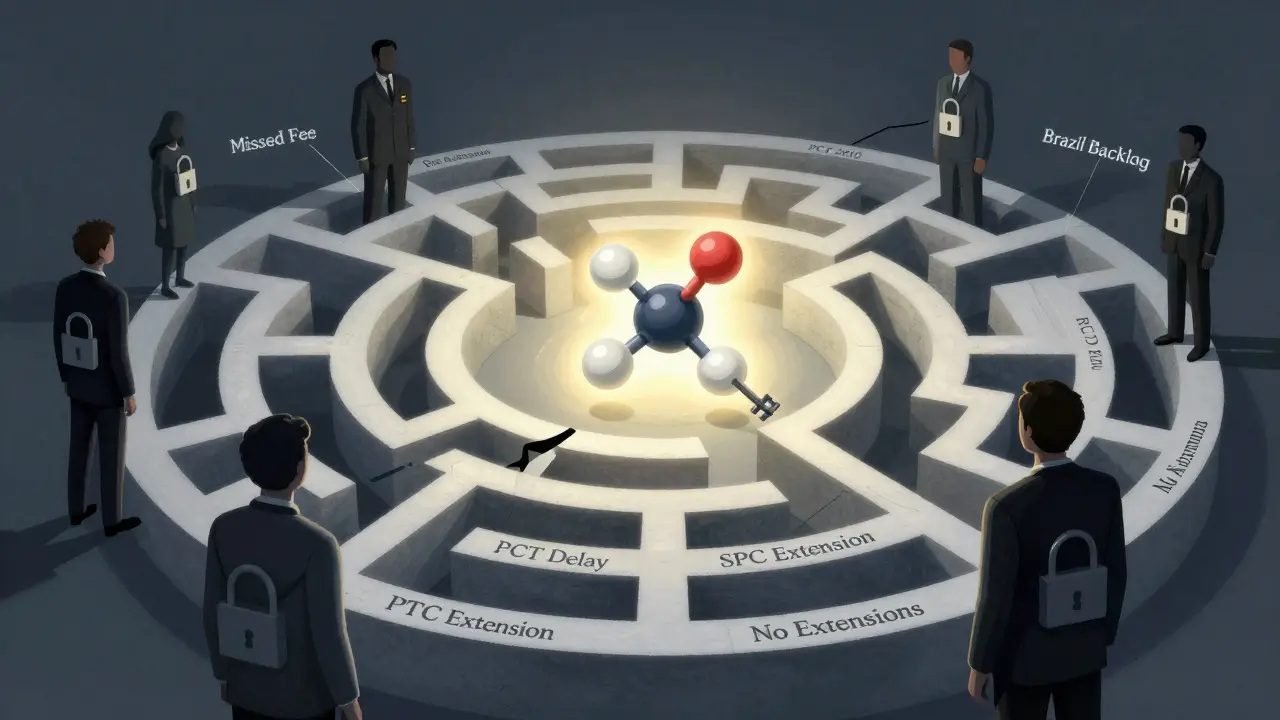
But not all countries do this. India does not allow any patent term extensions, even for drugs. If the 20 years are up, the patent ends - no exceptions. Australia offers extensions for delays by its patent office, but not for regulatory delays. China started allowing term compensation for examination delays in 2021. Brazil still struggles with backlogs, meaning many patents expire before their full 20 years are even served.
The PCT System - A Delayed Entry, Not a Global Patent
Many companies use the Patent Cooperation Treaty (PCT) a system that lets applicants file one international application to preserve rights in over 150 countries. It’s not a patent. It’s a delay tactic.
After filing a PCT application, you have 30 or 31 months (depending on the country) to decide where you want patent protection. During that time, you’re not paying national fees. You’re not dealing with local patent offices. You’re just waiting. This gives companies time to see if the drug actually works in clinical trials before spending $100,000+ in each country.
But here’s the catch: the 20-year term still starts from the original priority date. So if you file a PCT application in 2024 and wait until 2026 to enter the national phase in Germany, your patent still expires in 2044 - not 2046. The PCT doesn’t extend the term. It just delays the costs.
Maintenance Fees - The Silent Killer of Patents
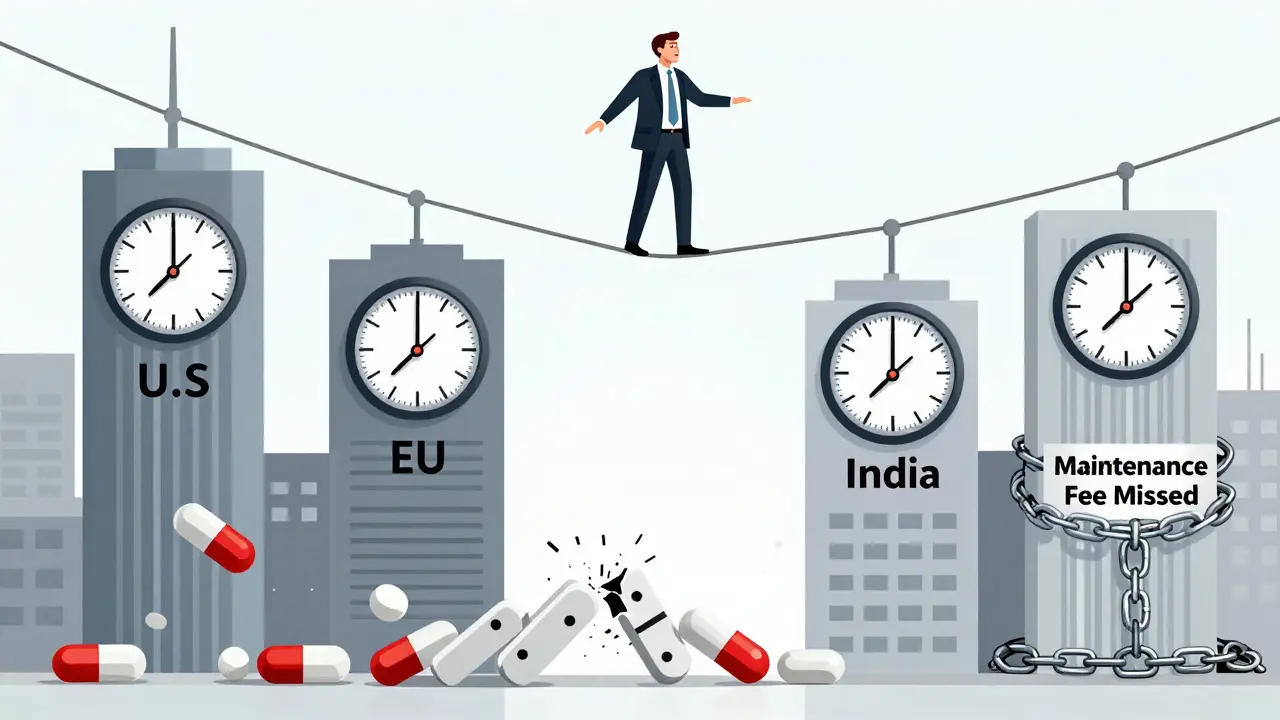
Even if the 20-year clock is ticking, patents can die early if fees aren’t paid. Most countries require maintenance payments at 3.5, 7.5, and 11.5 years after grant. In the U.S., missing one of these payments - even by a day - kills the patent unless you pay a late fee within six months.
But the rules vary wildly. In Switzerland you only pay once, at grant. In Mexico you pay four times: at 5, 10, 15, and 20 years. In Japan you pay annually after year 3. A company might think it’s protected in 15 countries - but if it misses one payment in Brazil, that patent vanishes. No warning. No second chance.
Utility Models - The Short-Term Alternative
Not all patents are created equal. In countries like Germany, China, and Japan you can file a utility model - a simplified patent with a shorter term. These last 6 to 10 years, don’t require substantive examination, and cost far less. They’re often used for mechanical devices or incremental improvements.
But here’s the twist: utility models can’t be filed for pharmaceuticals in most countries. So while a drug company might use them for delivery devices or packaging, the core molecule is still protected by a 20-year patent. Still, if a company relies on a utility model for a key component, and that expires in 7 years, the entire product’s market exclusivity could collapse sooner than expected.
Regional Systems - The EU’s Unitary Patent
In June 2023, the Unitary Patent a single patent valid across 17 EU countries went live. Before this, companies had to validate their European patent individually in each country - a costly, time-consuming process. Now, one patent covers all participating countries with one expiration date: 20 years from the original filing date.
This doesn’t change the term. But it simplifies enforcement. No more chasing infringement in 10 different courts. It also means fewer maintenance fees - just one payment to the European Patent Office instead of dozens.
Why This Matters for Drugs
For pharmaceutical companies, patent expiration isn’t just about legal deadlines. It’s about revenue cliffs. A drug that brings in $2 billion a year can lose 80% of its sales within months of generic entry. That’s why companies track expiration dates across dozens of jurisdictions with software that updates in real time.
Take Pfizer’s Lipitor. In the U.S., its patent expired in 2011 - but due to PTEs and PCT delays, some related patents lasted until 2012. In Europe, SPCs extended protection until 2012 as well. But in India, where no extensions are allowed, generics hit the market in 2010. That meant a massive price drop before the U.S. market even opened up.
Smaller companies don’t have teams of patent lawyers. They rely on databases and legal advisors. Miss one deadline. Forget one maintenance fee. And a patent that was supposed to last until 2030 might vanish in 2027 - with no one noticing until it’s too late.
What’s Changing Now?
Developing countries are catching up. Indonesia raised its patent term from 15 to 20 years in 2016. Vietnam did the same in 2022. Even Brazil, long criticized for its slow patent office, is working to reduce delays so patents don’t expire before they’re even granted.
But tensions remain. The U.S. and EU push for stronger protections. Developing nations argue that long patent terms keep drugs expensive and out of reach. The TRIPS Council at the WTO is still debating whether to allow automatic extensions for regulatory delays in low-income countries. No agreement yet.
One thing is clear: patent expiration is no longer a single date. It’s a patchwork. A web of deadlines, fees, extensions, and legal loopholes. And for anyone relying on patents - whether you’re a startup or a global pharma giant - missing one thread can unravel everything.
Do all countries have the same patent expiration date?
No. While most countries follow the 20-year rule from the filing date, differences in priority claims, patent term adjustments, regulatory delays, and maintenance fees mean the actual expiration date can vary by years between countries. A patent filed in 2020 might expire in 2039 in the U.S. due to extensions, but in 2040 in Europe, and 2041 in Japan - or even 2035 in India if no extensions are granted.
Can a patent expire before 20 years?
Yes. If maintenance fees aren’t paid on time, the patent lapses - even if the 20-year term hasn’t ended. Some countries also have rules that limit patent life if the patent office takes too long to grant it. In Brazil, for example, patent backlogs have caused many patents to expire before their full term due to legal caps on how long protection can last after grant.
What’s the difference between PCT and a real patent?
The PCT is not a patent. It’s a filing system that lets you delay national patent applications for up to 30 or 31 months. After that, you must enter each country individually to get actual patent rights. The PCT preserves your priority date but doesn’t grant any enforceable rights on its own.
Do generic drug makers always wait until the patent expires?
No. Many generics challenge patents before they expire, especially in the U.S. under the Hatch-Waxman Act. The first generic to file a challenge can get 180 days of market exclusivity. This means a patent might still be active, but generic competition can start before the official expiration date.
How do I find out when a patent expires in a specific country?
You need to check the national patent office database for that country. Start with the filing date, then add any extensions (like PTA or SPC), subtract any missed maintenance fees, and account for local rules. Many companies use specialized software like LexisNexis PatentSight or Clarivate PatBase. Free tools like WIPO’s PATENTSCOPE can help, but they don’t show all adjustments.




15 Comments
I never realized how wild the patent game is. One drug, 15 different expiration dates? Crazy. I thought patents were global, but nope - it’s like a legal maze. And those maintenance fees? I bet a lot of small companies just miss one payment and boom, all their work vanishes. 😅/p>
In India we see generics hit the market early and it changes lives. No extensions means medicine is affordable. Not perfect, but fairer. 🙏/p>
So let me get this straight - Big Pharma is basically gaming the system with 5-year extensions? Like, they delay the FDA on purpose just to stretch profits? I’m not mad, I’m just disappointed. This isn’t innovation, it’s a loophole circus. 🤡/p>
Patents are a mess./p>
I just looked up a patent I was curious about and holy cow - the PTA alone added 18 months! And then there’s PTE, SPCs, maintenance fees… it’s like a spreadsheet from hell. 🤯 I used to think patents were simple. Nope. Now I just feel bad for startups trying to navigate this. #patentnightmare/p>
This is why we need global patent reform. Imagine if every country had the same rules - no more legal gymnastics. The PCT is a band-aid, not a solution. And let’s be real - if a drug saves lives, why are we letting corporations play Tetris with expiration dates? 🌍💊 #PatentsForPeople/p>
so like… if you file in germany first then u get the same expiry everywhere? that’s kinda cool idk why more ppl dont do that. also maintenance fees? bro just pay em. how hard is it/p>
India doesn’t extend patents? LOL. That’s why their generics are so cheap. We’re giving away our innovation. America built this system. Let’s not let others ride our coattails. 💪🇺🇸/p>
Oh wow, so the USPTO takes 558 days on average? That’s not a delay - that’s a vacation. 😂 Meanwhile, I’m waiting for my Wi-Fi to load. The system is broken. And don’t even get me started on how they charge $100k per country. This isn’t innovation. It’s extortion./p>
It is imperative to recognize that the international patent framework is a product of decades of legal harmonization. While complexities exist, they are necessary to balance innovation incentives with public access. A nuanced understanding of jurisdictional variance is essential for stakeholders in global health policy./p>
in some countries they just dont have the resources to process patents fast enough so they expire before they even get approved its sad really/p>
Why are we even talking about this? If they can’t keep track of their own patents, they don’t deserve to make billions. Let the generics in. Everyone wins. Except Big Pharma. And that’s the point./p>
The Unitary Patent is a game-changer. One fee. One expiration. One court. Finally. Europe was dragging its feet for too long. Now if only the US would simplify its PTA mess…/p>
i mean like… i read this whole thing and i still dont get why we cant just have one date. why is it so hard? like if you file in 2020 why does it expire in 2039 in usa and 2035 in india? its not like the drug changes. its the same pill. why do we need 15 different calendars? its ridiculous. also i just looked up my cousin’s patent and he missed a payment in brazil and it just… vanished. like poof. no warning. no email. nothing. so now he’s out 3 million. that’s insane. i dont even know how to feel about this anymore. i think i need a nap./p>
If you’re not filing in the US first, you’re doing it wrong. We lead the world in innovation. Other countries should follow our rules, not the other way around. Stop giving away our tech. 🇺🇸/p>