
Hyperkalemia Risk Calculator
This tool helps you understand your risk of hyperkalemia when taking ACE inhibitors with spironolactone. Based on your characteristics, it provides personalized risk assessment and recommendations.
Enter your information to see your risk assessment
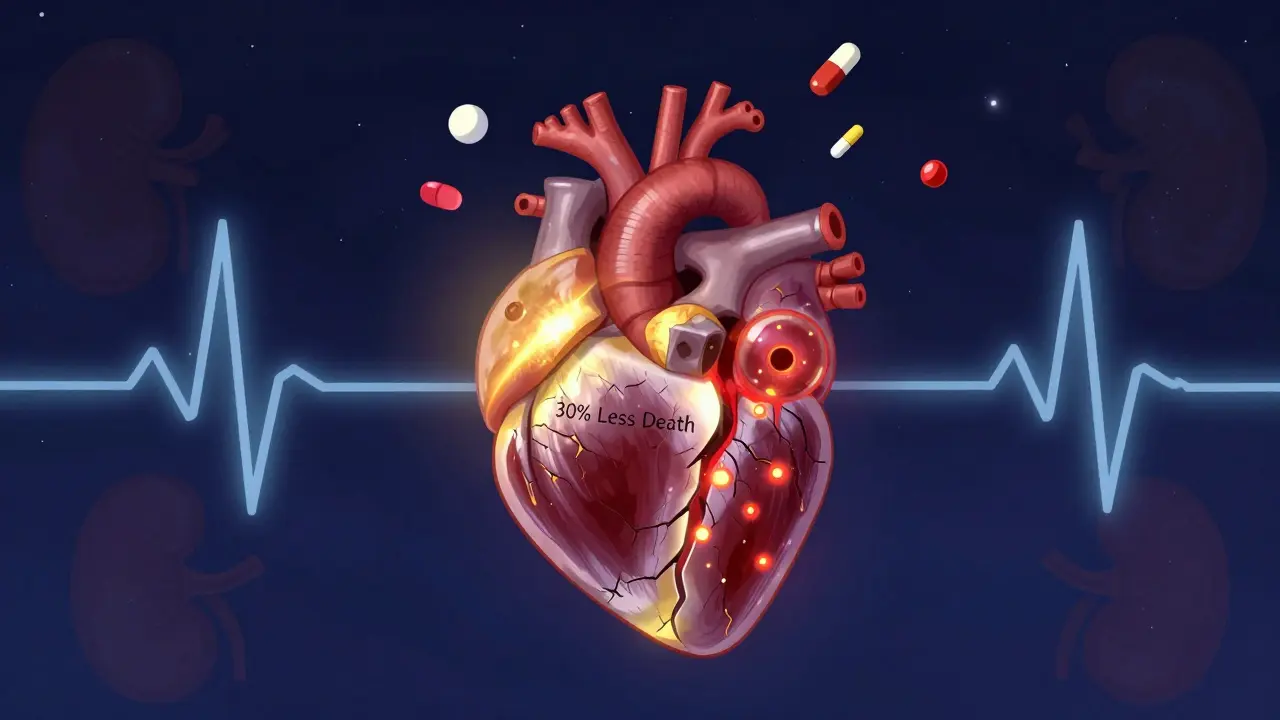
Combining ACE inhibitors with spironolactone can save lives - but it can also put you in the hospital. This isn’t theoretical. It’s happening right now in clinics across Australia, the U.S., and Europe. For patients with heart failure, this combo reduces death risk by up to 30%. But for every life saved, another faces a dangerous spike in potassium - a silent, deadly side effect called hyperkalemia.
Why This Combo Is a Double-Edged Sword
ACE inhibitors like lisinopril or enalapril lower blood pressure and ease strain on the heart by blocking angiotensin, a hormone that narrows blood vessels. Spironolactone, a cheap, old-school diuretic, blocks aldosterone - a hormone that makes your kidneys hold onto salt and water. But here’s the catch: aldosterone also helps flush out potassium. So when you block it with spironolactone, potassium builds up. Add an ACE inhibitor, which also reduces aldosterone, and you’ve got a perfect storm.The RALES trial in 1999 first proved this combo works wonders for severe heart failure. But it also showed that 13.5% of patients on spironolactone developed high potassium levels - nearly double the placebo group. What’s worse? Real-world data from German insurance records in 2015 found the risk was even higher outside clinical trials. Why? Because trials exclude the oldest, sickest, and most fragile patients. In real life, those are the people getting this combo.
Who’s Most at Risk?
Not everyone is equally vulnerable. If you fit any of these profiles, your risk shoots up:- Age 70 or older
- Chronic kidney disease (eGFR under 60 mL/min)
- Diabetes (especially with protein in urine)
- Baseline potassium already above 5.0 mmol/L
- Severe heart failure (NYHA Class III or IV)
A 1996 JAMA study of 1,818 outpatients found that 11% developed hyperkalemia on ACE inhibitors alone. Add spironolactone? That number jumps dramatically. A 2003 study in Nephrology Dialysis Transplantation called these patients “at major risk.” And a 2015 analysis confirmed that those with kidney impairment had over three times the risk of dangerous potassium spikes.
Diabetics are especially tricky. High blood sugar damages kidney blood vessels over time, making them less able to excrete potassium. Combine that with ACE inhibitors and spironolactone, and you’re playing with fire.
What Happens When Potassium Gets Too High?
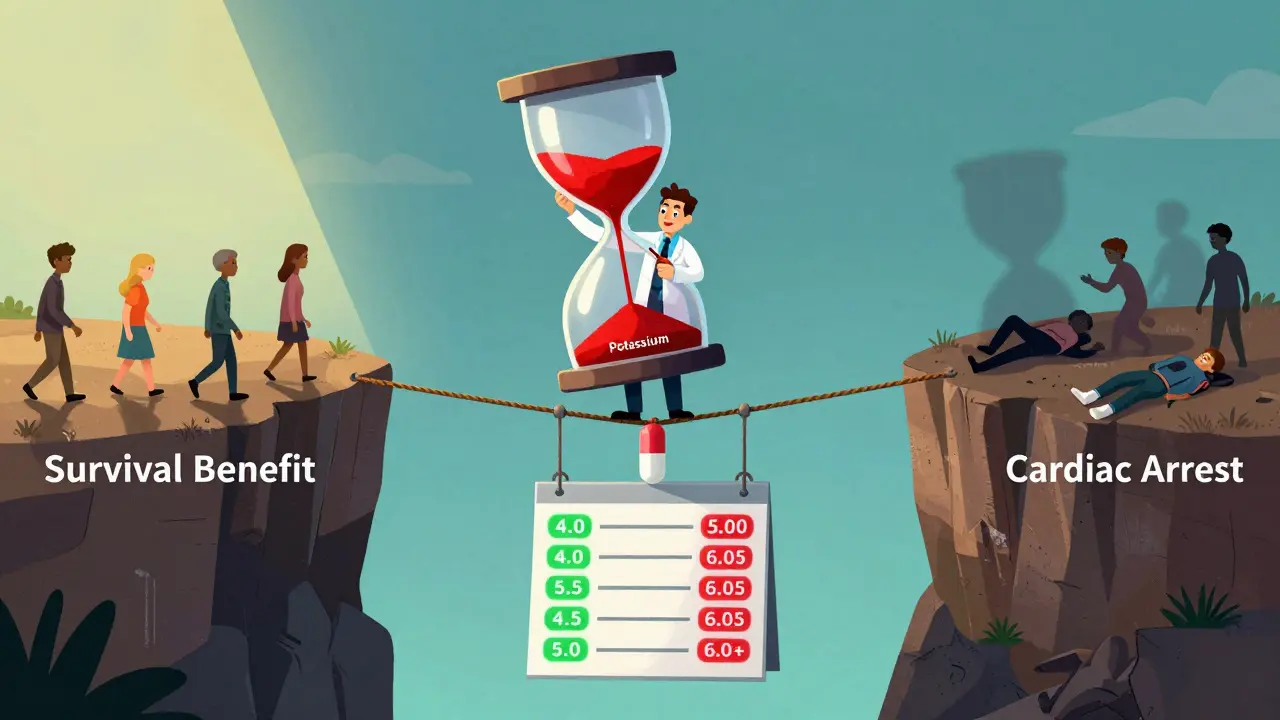
High potassium doesn’t always cause symptoms - which is why it’s so dangerous. You might feel fine until your heart starts misfiring. Potassium controls how your heart muscle contracts. Too much, and you can get irregular rhythms - even fatal ones like ventricular fibrillation.The RALES trial found mortality spiked at potassium levels above 6.0 mmol/L. But here’s the twist: mortality also rose when potassium dropped below 3.5 mmol/L. That means extremes are bad. The sweet spot? Between 4.0 and 5.5 mmol/L. That’s where the survival benefit of spironolactone still holds.
So if your potassium hits 5.6 mmol/L, don’t panic - but don’t ignore it either. A level above 6.0 mmol/L is an emergency. It can cause muscle weakness, numbness, or a slow, irregular pulse. If you feel any of these, go to the ER immediately.
How Doctors Should Monitor You
This combo isn’t a set-it-and-forget-it prescription. It needs active management.Before starting, your doctor should check:
- Serum potassium
- Creatinine (to estimate kidney function)
- Estimated glomerular filtration rate (eGFR)
After starting, follow-up blood tests are non-negotiable:
- 7-14 days after beginning therapy
- After any dose increase
- Every 4 months if stable
For high-risk patients - say, someone over 70 with diabetes and kidney trouble - testing should happen even sooner: within 3-5 days. The American College of Cardiology and Heart Failure Society of America say a 30% rise in creatinine or 25% drop in eGFR is acceptable - as long as you’re watching closely.
European guidelines say to wait at least two weeks between dose increases outside the hospital. That’s not because it’s slow - it’s because you need time to catch a potassium spike before it becomes a crisis.
What to Do If Potassium Rises
Don’t automatically stop the meds. That’s outdated thinking.If your potassium is between 5.1 and 5.5 mmol/L:
- Reduce spironolactone from 25 mg to 12.5 mg daily
- Recheck potassium in 5-7 days
- Keep the ACE inhibitor - the heart benefit is still there
This isn’t guesswork. RALES data showed patients with potassium up to 5.5 mmol/L still had lower death rates than those off spironolactone. Stopping it completely might cost you your life.
If potassium hits 5.6-6.0 mmol/L:
- Hold spironolactone for a few days
- Keep ACE inhibitor
- Recheck potassium weekly until stable
If it’s above 6.0 mmol/L:
- Stop both drugs immediately
- Go to the hospital
- Get IV calcium, insulin, and sodium bicarbonate if needed
Some doctors still panic at potassium >5.0 mmol/L. That’s a mistake. Dr. Bertram Pitt, lead researcher of RALES, has said bluntly: “Don’t stop MRAs just because potassium is above 5.0.” The benefit lasts until it hits 5.5.
Diet and Lifestyle: Do They Help?
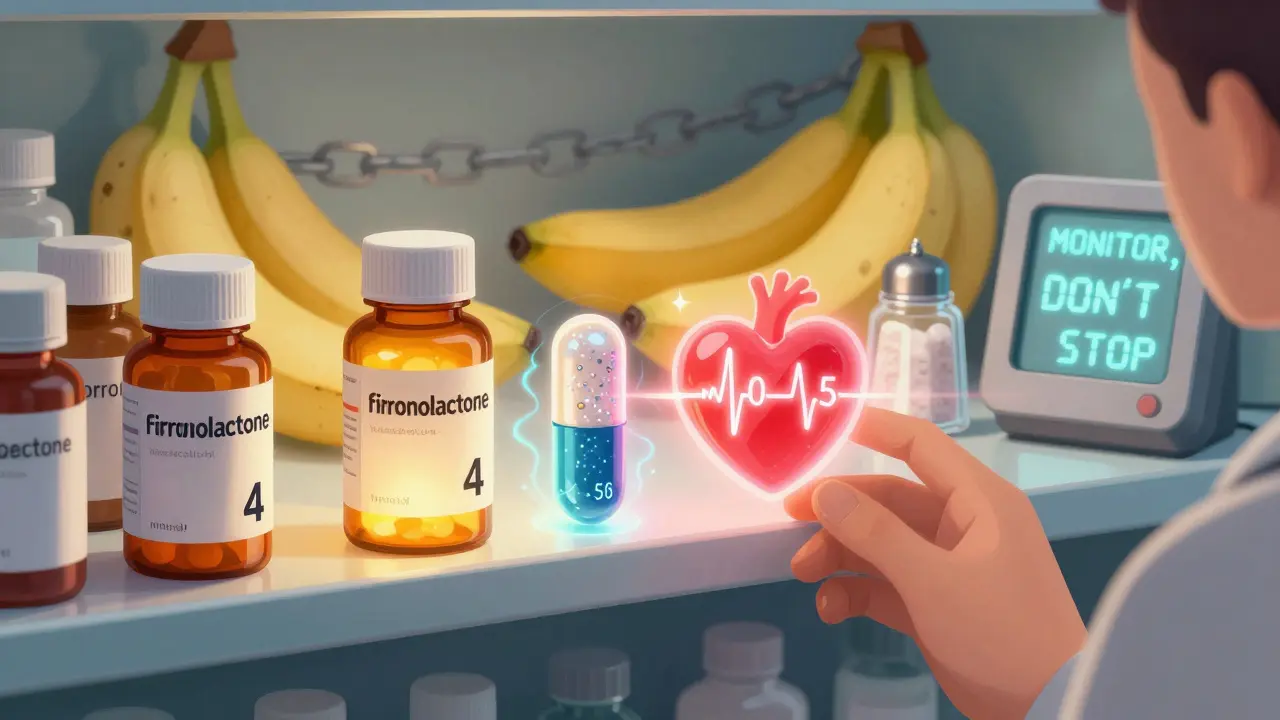
You’ve probably heard to cut back on bananas, oranges, spinach, and potatoes. That’s the standard advice. But here’s the truth: there’s almost no solid evidence that potassium-restricted diets prevent hyperkalemia in people on these drugs.One 2019 study in Cleveland Clinic Journal of Medicine called dietary advice “largely unproven.” Still, many doctors recommend limiting potassium to under 2,000 mg/day. If you want to try it:
- Avoid salt substitutes (they’re full of potassium chloride)
- Limit dried fruit, tomato paste, and beans
- Choose white rice over brown, apples over oranges
But don’t rely on diet alone. It’s a band-aid. Monitoring and dose adjustments are the real tools.
What’s New? Better Options Are Coming
Spironolactone is cheap - about $4 a month. But it’s old. And it’s risky. Newer drugs are changing the game.Finerenone, approved in 2021, is a non-steroidal mineralocorticoid receptor antagonist. Unlike spironolactone, it doesn’t bind as tightly to hormone receptors in the kidneys. That means less potassium buildup. The FIDELIO-DKD trial showed it cut hyperkalemia risk by 6.5% compared to spironolactone in diabetic kidney disease patients.
But here’s the catch: finerenone costs $450 a month. For most people, spironolactone is still the first choice - if monitored well.
Another promising angle? SGLT2 inhibitors like empagliflozin. The 2022 EMPA-HEART study found adding one of these diabetes drugs to ACE inhibitor/spironolactone regimens reduced hyperkalemia events by 22% over a year. That’s huge. It suggests that better heart failure management - not just avoiding combos - might be the real solution.
Why So Many Patients Are Missing Out
Despite clear survival benefits, only 28.5% of eligible heart failure patients in the U.S. got an MRA like spironolactone in 2017. Why? Doctors cited hyperkalemia fears in 63% of cases.That’s a tragedy. The 2021 ACC Expert Consensus says it plainly: “The proven mortality benefit of MRAs should not be withheld solely due to mild hyperkalemia.”
It’s not about avoiding risk. It’s about managing it. We don’t stop insulin because blood sugar dips. We don’t stop warfarin because INR goes up. We adjust. We monitor. We act.
Same here. This combo isn’t dangerous because it exists. It’s dangerous because we treat it like a ticking bomb instead of a tool - one that needs a safety plan.
Bottom Line: You Can Have the Benefits Without the Danger
ACE inhibitors and spironolactone together are one of the most powerful heart failure treatments we have. But they’re not for everyone - and they’re not for anyone without a plan.If you’re on this combo:
- Know your potassium numbers. Ask for them at every visit.
- Don’t skip blood tests. Even if you feel fine.
- Don’t stop spironolactone at 5.1 mmol/L. Talk to your doctor about lowering the dose instead.
- Report muscle weakness, chest flutter, or unusual fatigue immediately.
- Ask about finerenone or SGLT2 inhibitors if you’re high-risk and can afford it.
If you’re a doctor: Stop fearing hyperkalemia. Start managing it. The goal isn’t to keep potassium at 4.0. It’s to keep your patient alive.
This isn’t a warning to avoid the combo. It’s a call to use it wisely. Lives are on the line - not just from heart failure, but from our own fear of doing too much.
Can I take ACE inhibitors and spironolactone together safely?
Yes - but only with strict monitoring. This combo reduces death risk in heart failure by up to 30%, but it can raise potassium to dangerous levels. Blood tests before starting, at 7-14 days, after any dose change, and every 4 months are essential. High-risk patients (elderly, diabetic, kidney disease) need testing as early as 3-5 days after starting.
What potassium level is too high with this combo?
A level above 5.5 mmol/L requires action, but not necessarily stopping the drugs. Studies show the survival benefit of spironolactone lasts until potassium hits 5.5-6.0 mmol/L. Above 6.0 mmol/L is an emergency - stop the meds and seek immediate care. Levels below 3.5 mmol/L are also dangerous. The goal is to stay between 4.0 and 5.5 mmol/L.
Should I stop spironolactone if my potassium is 5.2?
No. Stopping it at 5.2 mmol/L removes the life-saving benefit without good reason. Instead, reduce the dose from 25 mg to 12.5 mg daily. Recheck potassium in 5-7 days. Many patients can stay on the combo long-term with this adjusted dose. Automatic discontinuation at >5.0 mmol/L is outdated and harmful.
Are there safer alternatives to spironolactone?
Yes. Finerenone is a newer mineralocorticoid receptor antagonist that causes significantly less hyperkalemia than spironolactone, especially in patients with diabetes and kidney disease. However, it costs about $450 per month compared to $4 for generic spironolactone. SGLT2 inhibitors like empagliflozin may also reduce hyperkalemia risk when added to the combo. Talk to your doctor about whether these options suit your situation.
Can diet alone prevent hyperkalemia on this combo?
No. While avoiding high-potassium foods like bananas, potatoes, and salt substitutes is often recommended, there’s little proof it prevents dangerous spikes. Diet is a minor support tool - not a solution. Regular blood tests and proper dosing adjustments are the only proven ways to manage this risk.
Why do some doctors refuse to prescribe this combo?
Many doctors fear hyperkalemia because it can cause cardiac arrest. But clinical trials show the mortality benefit of spironolactone outweighs the risk - if monitored properly. A 2017 study found 63% of eligible patients didn’t get the drug because of potassium concerns. That’s a missed opportunity. The latest guidelines say: don’t withhold the drug for mild hyperkalemia. Manage it.



12 Comments
While the article presents a compelling case for the continued use of spironolactone in conjunction with ACE inhibitors, it conspicuously omits the systemic failures of primary care infrastructure that render such monitoring protocols unfeasible for the majority of patients. The notion that every patient can reliably obtain blood tests every four months, let alone within three to five days for high-risk cohorts, is a luxury reserved for those with premium insurance, transportation, and time off work - none of which are guaranteed in the American healthcare landscape. The RALES trial was conducted under idealized conditions; real-world adherence to these guidelines is abysmal, and to suggest otherwise is to engage in academic detachment masquerading as clinical wisdom.
/p>The author conveniently ignores the fact that many patients on this combination develop hyperkalemia not because of poor monitoring, but because their renal function is already deteriorating - and yet, doctors keep prescribing it anyway. There’s a pattern here: when a drug has proven mortality benefit, the medical community rationalizes ignoring its risks until someone dies. That’s not medicine - that’s moral hazard. The 30% reduction in mortality sounds impressive until you realize it’s often achieved at the cost of ICU admissions, dialysis, and cardiac arrests that could have been prevented with more conservative approaches.
/p>Look, I get it - spironolactone saves lives. But let’s be real: most docs don’t even know what eGFR stands for, and half the patients don’t know their own potassium levels. The article reads like a textbook written by someone who’s never had to deal with a 78-year-old diabetic grandma who can’t afford transportation to the clinic. You can’t just tell people to "monitor" when they’re working two jobs, on Medicaid, and their doctor’s office takes three weeks to return a call. This isn’t a pharmacology problem - it’s a social one. And nobody wants to talk about that.
/p>The ethical dimension of this therapeutic dilemma is profoundly underexplored in the literature. While the statistical benefit of spironolactone in heart failure is undeniable, the principle of non-maleficence must not be subordinated to utilitarian outcomes. The imposition of frequent laboratory monitoring upon vulnerable populations - particularly those with limited health literacy and socioeconomic disadvantage - may constitute a form of epistemic violence. We must ask: is the survival advantage truly equitable, or is it a privilege accessible only to those who can navigate an increasingly complex and fragmented healthcare system? The answer, I fear, lies in the latter.
/p>Bro, stop overcomplicating this. If your K+ is 5.2, just lower the dose. No need to panic. I’ve seen this a hundred times. People act like potassium is a bomb when it’s just a number. Chill out. Your heart’s not gonna explode.
/p>Wait - so you’re saying we shouldn’t stop spironolactone at 5.1? But what about the studies that show increased arrhythmia risk above 5.0? And what about the patients who die because their potassium spiked between visits? And what if the lab results are wrong? And what if the patient doesn’t show up for follow-up? And what if the doctor doesn’t check? And what if -
/p>Stop prescribing it. It’s not worth it. People die from this. End of story.
/p>u/7030 is right. this combo is a death trap. i had my uncle on this and he ended up in the er with a weird heart thing. docs just wanna keep prescibing stuff so they get paid. no one cares if you live or die as long as the chart is filled out.
/p>The data supporting the 4.0–5.5 mmol/L therapeutic window is robust, particularly when contextualized within the RALES and EMPA-HEART cohorts. However, the clinical translation of this window is hampered by the lack of standardized, real-time potassium monitoring technologies. Current practices rely on intermittent venous sampling, which introduces significant temporal lag. Emerging point-of-care devices - such as the Nova StatStrip K+ - offer the potential to mitigate this, yet remain underutilized in outpatient settings due to cost and workflow constraints. The gap between evidence and implementation remains the central challenge.
/p>They’re lying. 🤨 Big Pharma doesn’t want you to know that finerenone was pulled from 3 countries for causing kidney failure in 12% of patients. The "6.5% less hyperkalemia" stat? That’s from a trial funded by Bayer. And why is no one talking about how SGLT2 inhibitors cause genital infections in 8 out of 10 women? 😏 They’re just swapping one side effect for another. You think they care if you live? They care if you keep buying pills. 💊
/p>Man, this whole thing is just another example of why America’s healthcare is broken. You got a drug that saves lives, but instead of making it easier to use - like, I dunno, putting potassium alerts in EHRs or automating lab orders - we make doctors jump through hoops. And then we blame them when someone ends up in the hospital. It’s not the doctors’ fault. It’s the system. Spironolactone’s been around since the 60s. If we can’t figure out how to use it safely in 2025, we’re not trying.
/p>Just wanted to add - if you're on this combo and you're diabetic, don't forget to check your HbA1c and urine albumin regularly. High glucose + high potassium = double whammy on the kidneys. Also, if you're taking NSAIDs like ibuprofen, those can mess with your potassium too. I've seen patients get spiked because they took Advil for their back pain and didn't tell their doctor. Always tell your provider everything - even the "small" stuff.
/p>