
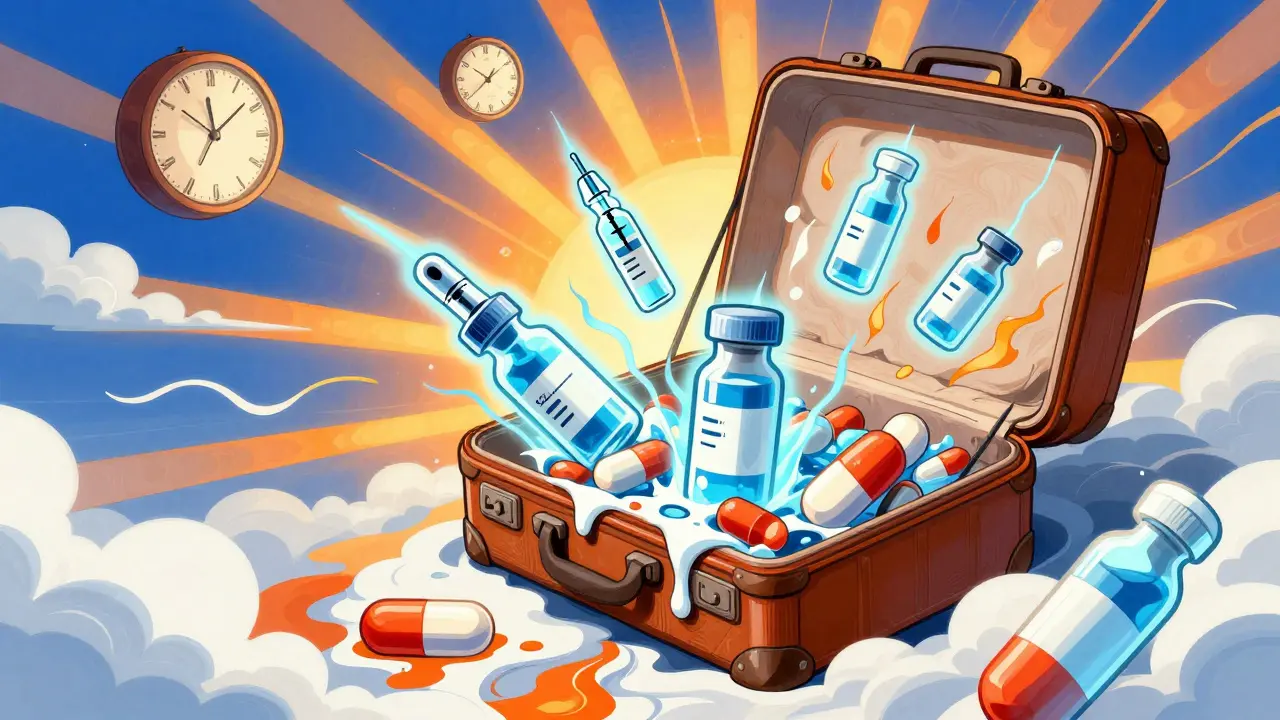
Why Your Medication Schedule Falls Apart When You Travel
You’ve packed your bags, booked your flights, and even checked the weather forecast. But have you thought about what happens to your pills when you cross time zones? If you take daily meds for blood pressure, diabetes, epilepsy, or HIV, a simple flight can turn into a medical risk. Missing a dose by a few hours isn’t just inconvenient-it can cause dangerous spikes in blood pressure, drop your immune defenses, or trigger seizures. And it’s not just about timing. Heat, humidity, and airport scanners can ruin your meds before you even land.
Travelers over 65 are especially vulnerable. One study found that 73% of seniors over 70 made at least one medication timing error while abroad-and nearly 3 in 10 needed medical care because of it. The good news? With the right plan, you can avoid all of this. It’s not about memorizing complex rules. It’s about three simple things: timing, storage, and side effect prevention.
Time Zone Adjustments: When to Switch, When to Wait
Don’t assume your body will adjust to the new time zone the same way your phone does. Medications don’t care about your jet lag-they care about consistency. For most pills, the rule is simple: switch to the destination time zone as soon as you land. But not all meds work the same way.
Take antiretrovirals for HIV. If you’re on dolutegravir, you have a 1-hour window. Miss that, and your viral load could spike. Protease inhibitors are a bit more forgiving-up to 2 hours off is usually okay. But if you’re on insulin? You can’t wing it. Insulin needs precise timing because your blood sugar reacts fast. The same goes for progestin-only birth control pills. You have a strict 3-hour window. Combined pills? You’ve got 12 hours. One missed dose, and your protection drops.
For trips crossing 5+ time zones, some experts recommend shifting your dose schedule gradually. Start 5 days before you leave: move each dose 1 hour earlier (if flying east) or later (if flying west). This reduces side effects like nausea or dizziness by 37%. But here’s the catch: 22% more people miss doses with this method because it’s confusing. For most people, just switching to local time on arrival works better.
Statins? No problem. You can take them up to 4 hours off schedule without losing effectiveness. Blood pressure meds? Expect some fluctuation in the first 72 hours. That’s normal. But if your systolic number jumps over 160, call your doctor. Don’t wait.
Storage: Heat, Light, and the Real Danger in Your Luggage
Your meds aren’t just sitting in your suitcase. They’re exposed to airport tarmacs, hotel rooms without AC, and beach bags in 90°F heat. And that’s deadly for some drugs.
Insulin must stay between 36°F and 46°F. If it gets warmer, it breaks down. You’ll still inject it-but it won’t work. Same with certain antibiotics and thyroid meds. The CDC says 23% of commonly prescribed pills are light-sensitive. That means if you’re packing them in a clear plastic bag, UV rays from the sun or even bright hotel lights can weaken them.
Here’s what to do:
- Keep all meds in your carry-on. Checked bags can sit in freezing cargo holds or bake in 120°F baggage areas.
- Use a small insulated cooler with a reusable ice pack for insulin or other temperature-sensitive meds. Don’t let them freeze.
- Store pills in their original bottles. They’re designed to block light and moisture.
- Avoid leaving meds in the car or by the pool. Even a few hours in direct sun can ruin them.
Pro tip: If you’re heading to a hot country like Thailand or Brazil, buy a small travel fridge (under $50) that plugs into USB. Many travelers swear by them.
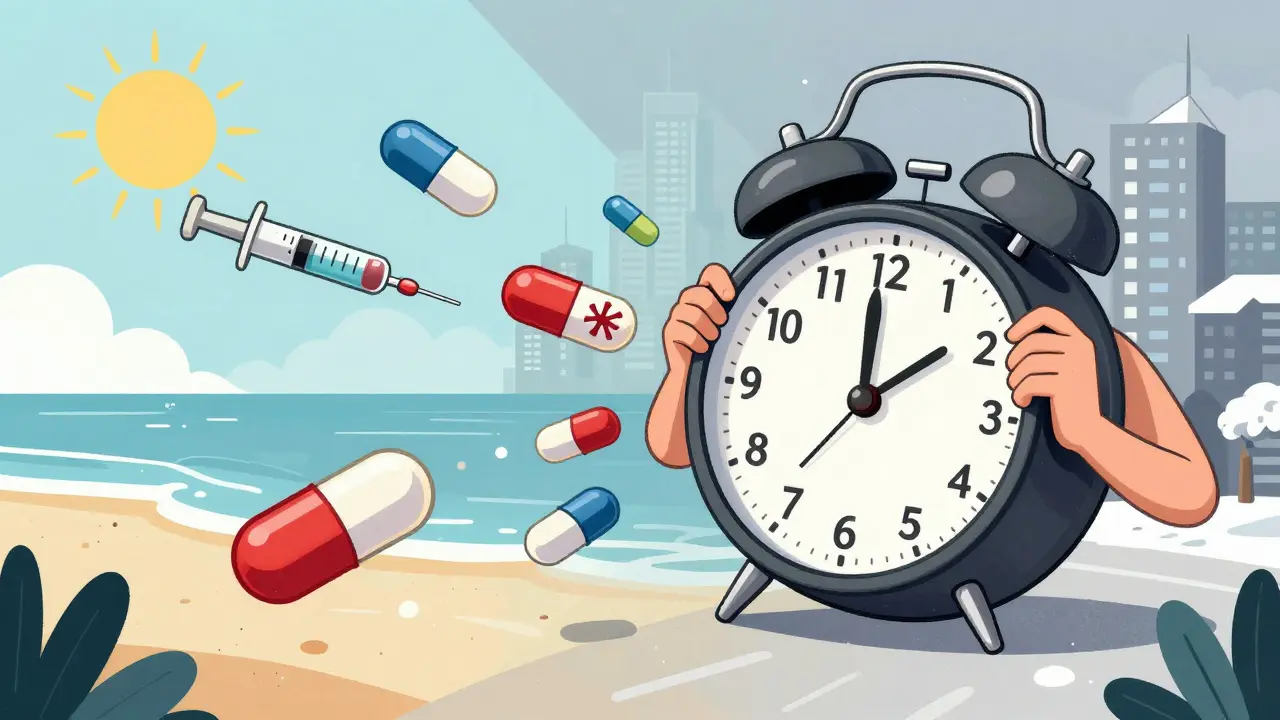
Side Effect Prevention: What to Watch For and How to Stop It
Side effects from meds don’t always show up right away. Sometimes they creep in after a few days-especially when your body’s stressed from travel, sleep loss, or changed eating habits.
Here’s what to watch for based on your meds:
- Blood pressure meds: Dizziness, fatigue, or blurred vision. These can mean your BP dropped too low-or spiked too high. Keep a portable BP monitor if you’re prone to fluctuations.
- Anticoagulants (like warfarin): Unusual bruising, nosebleeds, or dark stools. Warfarin’s half-life is long (20-60 hours), so timing isn’t as tight, but alcohol, new foods, or dehydration can throw it off.
- Antidepressants or anti-anxiety meds: Increased anxiety, insomnia, or nausea. Jet lag can mimic these symptoms. Don’t assume it’s the meds-check with your doctor before adjusting.
- Painkillers or NSAIDs: Stomach upset or kidney strain. Drink more water. Avoid alcohol. Don’t double up on pain meds just because you’re tired.
One of the biggest mistakes? Skipping doses because you’re “too busy” or “don’t feel like it.” That’s how side effects turn into emergencies. Set alarms. Use apps like Medisafe or MyTherapy-they sync with your phone’s location and remind you based on local time. Studies show they improve adherence by 42% during travel.
Legal Risks: What You Can’t Take Across Borders
You think your prescription is safe everywhere? Think again.
Japan bans 52 medications commonly prescribed in the U.S.-including some ADHD drugs, certain painkillers, and even some cold medicines. The UAE requires special permits for 17 drugs, including some antidepressants and sleep aids. Even if you have a doctor’s note, customs agents don’t care. They follow their own rules.
Before you go:
- Check your destination’s health ministry website. Search “[Country] banned medications list.”
- Carry your prescription in English and the local language if possible.
- Keep meds in original bottles with your name on them. No ziplock bags.
- If you’re unsure, call the embassy. Better safe than detained.
Pro tip: If you’re flying out of the U.S., TSA requires all meds to be in original containers. Same rule applies in most European countries and Australia. No exceptions.
How to Plan Ahead: The 4-Step System
This isn’t optional. If you take meds daily, you need a plan-starting 4 to 6 weeks before you leave.
- See your doctor or pharmacist. Bring your itinerary. Ask: “What adjustments do I need for my meds?” Don’t assume they know. Only 39% of U.S. doctors feel confident giving this advice.
- Get a written schedule. Not just “take once daily.” Write: “Take 10 mg at 8 a.m. local time. Do not take with grapefruit.” Include emergency contacts and pharmacy info.
- Pack extra. Carry enough for the trip plus 7 extra days. Delays happen. Airlines require original containers. Don’t risk running out.
- Set location-based reminders. Use your phone. Set 2 alarms for each dose-one 15 minutes before, one at the exact time. Use apps that auto-adjust for time zones.
Seniors on 4+ meds need extra prep. Give yourself 7-10 days before departure to practice the new schedule. Use a pill organizer color-coded by time: red for morning, blue for night. It cuts confusion by half.

What Works: Real Travelers’ Tips
People who’ve done this before know what works.
- “I use a small pill case with 4 compartments-AM, lunch, PM, bedtime. I fill it every Sunday before I leave.” - Sarah, 68, Melbourne
- “I set three alarms on my phone: 1 hour before, at the time, and 1 hour after. If I miss one, I still take it.” - James, 42, New York
- “I keep my insulin in a Frio pack. It stays cool for 45 hours without ice. Lifesaver in Bali.” - Lena, 55, Toronto
- “I printed out a one-page summary of my meds and gave it to my travel buddy. If I pass out, they know what to do.” - Raj, 71, London
Travelers who consult a pharmacist before leaving report 63% fewer problems. That’s not luck. That’s preparation.
What to Do If You Miss a Dose
It happens. You oversleep. Your phone dies. You’re in a taxi with no signal.
Here’s what to do:
- Insulin: If you miss a dose by more than 2 hours, check your blood sugar. Don’t double up. Call your doctor.
- Progestin-only pill: If you’re more than 3 hours late, use backup contraception for 48 hours. Take the pill as soon as you remember.
- Blood pressure meds: If you miss one, take it as soon as you remember-if it’s within 6 hours. If it’s been longer, skip it. Don’t double up.
- Antiretrovirals: If you miss a dose by more than 2 hours, take it as soon as possible. Then go back to your normal schedule. Don’t take two at once.
- Antibiotics: If you miss one, take it as soon as you remember. If it’s close to the next dose, skip it. Never double up.
Rule of thumb: When in doubt, don’t double. Call your doctor or a local pharmacy. They can help.
Can I take my medication on the plane?
Yes, but only if you’re on a strict schedule like antiretrovirals or insulin. For most people, it’s better to wait until you land. In-flight meals aren’t timed to your schedule, and delays make timing unpredictable. If you must take meds mid-flight, do it with water and keep your original prescription bottle handy in case security asks.
Do I need a doctor’s note for my meds?
Not always, but it’s smart. Some countries require it for controlled substances. Even if not required, having a note in English (and ideally the local language) can save you from being questioned at customs. Your pharmacist can print one for you.
What if my meds get lost or stolen?
Carry a list of your meds with dosages and your doctor’s contact info. If you lose them, go to a local pharmacy with your prescription or list. Many countries will fill emergency supplies for travelers. Travel insurance often covers this. Never fly without extra meds.
Are there apps that help with travel medication schedules?
Yes. Medisafe and MyTherapy are both clinically validated and adjust automatically for time zones. They send reminders, track doses, and can alert your emergency contact if you miss a dose. They’re free to use and work offline.
How far in advance should I plan my medication schedule?
At least 4 to 6 weeks before you leave. That gives you time to talk to your doctor, get prescriptions filled, order travel supplies like coolers, and practice your new schedule. If you’re on complex meds, start even earlier.
Final Thought: It’s Not About Perfection-It’s About Prevention
You don’t need to be a scientist to manage your meds while traveling. You just need to be prepared. The goal isn’t to follow the schedule perfectly every single time. It’s to avoid the big mistakes-the ones that land you in the ER. A missed dose, a melted insulin pen, a banned pill in your bag-these aren’t accidents. They’re preventable.
Take the 30 minutes now to write down your meds, check your destination’s rules, set your alarms, and pack your extra pills. That’s all it takes. Your body will thank you when you’re enjoying your trip-not stuck in a foreign clinic wondering what went wrong.





14 Comments
I once forgot my blood pressure meds in Delhi and thought I'd be fine. Ended up in a clinic with a nurse yelling at me in Hindi. Never again./p>
Oh my goodness, this post is like a cozy blanket for anxious travelers. I’ve had insulin melt in a suitcase in Thailand-literally turned to syrup. Now I carry a Frio pack everywhere, even to the pub. My pharmacist gave me a little sticker that says ‘Keep Me Cool, Not a Souvenir’-it’s my new travel accessory. And yes, I’ve started setting three alarms. One for the dose, one for the snack I need with it, and one for the deep breath I take after I’ve remembered to breathe again. You’re not just managing meds-you’re managing your peace of mind. And that’s worth the extra effort./p>
So let me get this straight-you’re telling me I can’t just toss my pills in my carry-on like I do my socks and hope for the best? Shocking. Next you’ll say I shouldn’t drink airport coffee while on warfarin. Wait… that’s actually true? Huh. Guess I’ll stop treating my meds like a game of Russian roulette with a side of jet lag./p>
This is super helpful. I’m from India and we don’t always get good info on meds abroad. I just got back from Dubai-had to check their banned list twice. Turns out my anxiety med was on it. Scary stuff. I printed out the doctor’s note and carried my original bottles. No issues. Just don’t be lazy. A few minutes now saves hours in a foreign hospital./p>
The statistical claims in this article are methodologically unsound. The 73% senior error rate lacks a control group, and the 42% adherence increase from apps is correlational, not causal. Furthermore, the assertion that airport scanners degrade medication is unsupported by peer-reviewed literature. While the intent is commendable, the presentation borders on medical misinformation disguised as practical advice./p>
Honestly? I think the whole meds-on-travel thing is a scam by Big Pharma and TSA. Why do you think they push these ‘original bottle’ rules? They wanna track us. And those apps? Probably selling your data to the government. I just carry my pills in a candy tin and tell customs they’re ‘vitamins for my pet lizard.’ Works every time. 😎/p>
I traveled through Japan last year with my antidepressants. Had no idea they were banned until I got questioned at customs. Calmly showed them my prescription, they nodded, let me through. Just be cool, be prepared, and don’t panic. Most people just want to help. Also, carry a water bottle. Dehydration makes everything worse./p>
Set two alarms. One for when you’re supposed to take it. One for when you’re gonna regret not taking it./p>
The article’s casual tone undermines the gravity of pharmaceutical compliance. Non-adherence to antiretroviral regimens constitutes a public health violation under WHO guidelines. Furthermore, the normalization of ‘just take it when you remember’ for insulin users is dangerously negligent. Patients must be held to clinical standards, not comfort-driven approximations./p>
I can’t believe Americans think they’re the only ones who need to plan for meds. We’ve had proper pharmacy guidelines in the UK since the 90s. You pack your meds in your hand luggage, you know the rules, you don’t make a drama out of it. Honestly, it’s like you think the world revolves around your pill schedule./p>
It’s funny how we treat our bodies like machines that need a manual, but forget they’re also living things that adapt. Maybe the real issue isn’t the time zones or the heat-it’s that we’ve stopped listening to ourselves. I used to stress over every 15-minute window. Now I take my meds, breathe, and trust my body to catch up. Not perfect. But human./p>
I use MyTherapy and it’s a game changer 🙌 Just set it once and boom-reminders in local time, even when I’m on a 14-hour flight with no wifi. Also, I carry a tiny notebook with my meds and emergency contacts. My grandma says, ‘Better to look silly with a list than to end up in a hospital with no idea what you took.’ Wise woman./p>
I’m 70 and on six meds. This post saved me. I used to wing it. Now I fill my pill organizer every Sunday, set alarms, and keep my Frio pack in my backpack like a superhero cape. I didn’t know about the light-sensitive meds thing-my vitamins were in a clear bag for years. Yikes. Thanks for the wake-up call./p>
I’m a fan of the ‘don’t double up’ rule. But also… can we talk about how weird it is that we’re all so terrified of our own pills? Like, it’s not magic. It’s chemistry. You don’t need to be a scientist. Just be a little organized. And yes, your phone can remind you. It’s not cheating. It’s survival. (And yes, I typed this on my phone while waiting for my insulin to warm up. Typo? Maybe. But the point stands.)/p>