
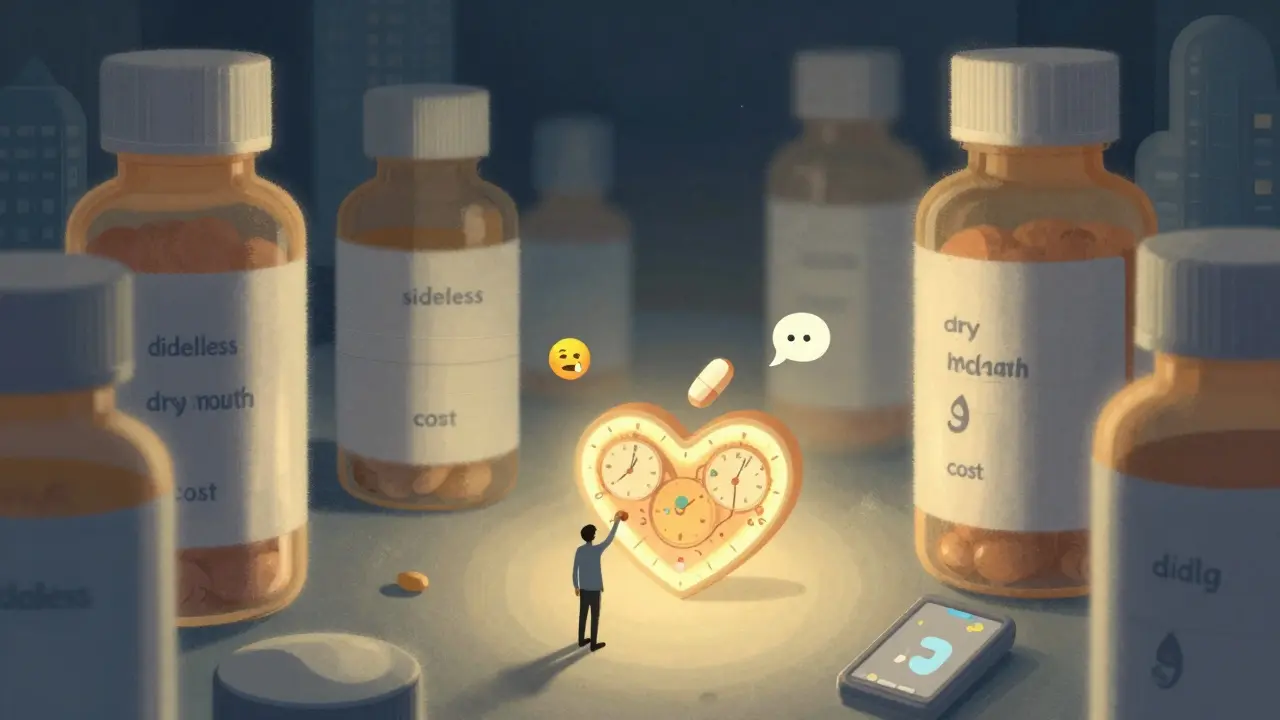
Taking a pill every day for years isn’t just a habit-it’s a lifestyle. For millions of people with conditions like high blood pressure, diabetes, rheumatoid arthritis, or heart failure, medication isn’t optional. It’s survival. But here’s the hard truth: chronic medication adherence is one of the biggest challenges in modern healthcare. Around half of people with long-term conditions don’t take their meds as prescribed. And it’s not because they’re lazy or forgetful. It’s because the emotional, mental, and practical weight of daily medication use can crush even the most motivated person.
Why Daily Pills Feel Like a Burden
Think about it. You’re told to take five different pills at different times of the day. Some need to be taken on an empty stomach. Others can’t be taken with grapefruit juice. You get side effects-dry mouth, dizziness, nausea. Then there’s the cost. A single prescription can cost $50, $100, even $300 a month. If you’re on a fixed income, that’s groceries vs. medicine. And then there’s the psychological toll. Every time you reach for that pill bottle, you’re reminded: I’m sick. This isn’t going away. That’s heavy. Over time, people start to resent their meds. They skip doses. They stop filling prescriptions. They tell themselves, “I feel fine today, I don’t need it.” But the truth? You feel fine because of the meds.The Five Coping Strategies That Actually Move the Needle
Research from a 2022 review of 15 studies across chronic conditions shows five main ways people cope-and not all of them help. Some even hurt.1. Problem-Solving / Active Coping (Most Effective)
This is the strategy that works best. It’s not about hoping things get easier. It’s about making them easier. People who use active coping don’t just take their pills. They build systems around them. - They use pill organizers with days of the week and times labeled. Not the cheap kind. The ones with alarms. - They link taking meds to a daily habit: after brushing teeth, before coffee, right after lunch. - They call their pharmacist and ask: “Can I switch to a once-a-day version?” or “Is there a generic that costs less?” - They keep a simple log: “Took my blood pressure med. Felt a bit dizzy. Did my walk anyway.” In 78% of studies, people who used active coping were significantly more likely to stick with their meds. This isn’t luck. It’s strategy.2. Emotion-Focused Coping (Second Best)
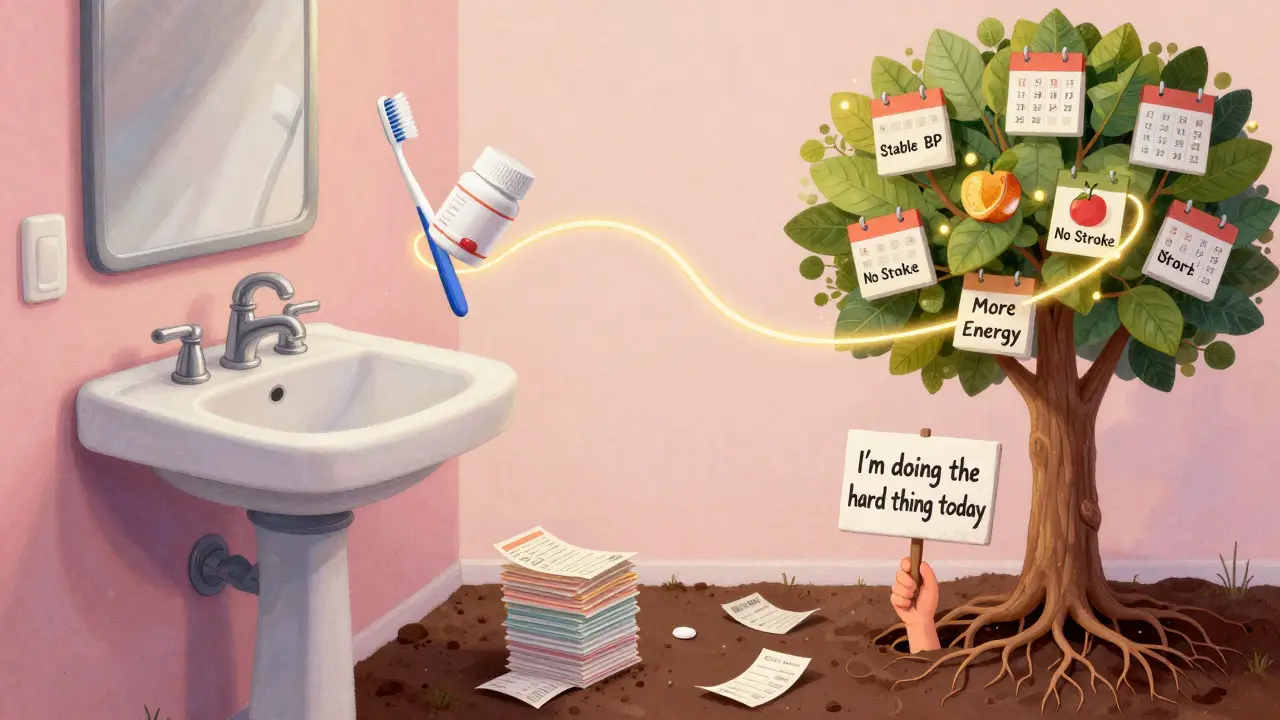
Sometimes, the problem isn’t the pill-it’s the pain behind it. Chronic illness brings grief, anger, fear. Emotion-focused coping helps people process that. - Journaling: “Today I felt angry that I have to take this. But I took it anyway.” - Mindfulness: Taking three deep breaths before swallowing a pill, not as a ritual, but as a pause to acknowledge how hard this is. - Self-encouragement: Saying out loud, “I’m doing the hard thing today.” In 69% of studies, these emotional tools helped. One study on rheumatoid arthritis patients found those who used self-encouragement and distraction techniques had higher adherence-even if other factors like income or age didn’t change.3. Seeking Understanding
People who understand why they’re taking a drug are more likely to take it. Not because they’re smart. Because they’re invested. - Asking: “What happens if I skip this?” - Reading reliable info from their doctor or pharmacist-not Google. - Watching videos from other patients with the same condition. This isn’t about memorizing drug names. It’s about connecting the dots: “My blood pressure is high because my arteries are stiff. This pill relaxes them. If I stop, my risk of stroke goes up.” That kind of clarity sticks.4. Support Seeking
No one should manage chronic illness alone. But many do. - Talking to a friend who also takes daily meds. - Joining a patient group-online or in person. - Letting a family member know: “I need you to remind me on Tuesdays, because that’s when I get tired.” One study showed patients who felt comfortable asking questions to their care team were more likely to stay on track. They weren’t just patients. They were partners.5. Problem Avoidance (The Trap)
This one is dangerous. It sounds harmless: “I’ll just skip it today.” “I’ll start again next week.” “I don’t feel sick, so it’s fine.” In half of the studies, this strategy was linked to lower adherence. People who avoid thinking about their meds often end up avoiding the meds themselves. It’s not laziness. It’s psychological defense. But it’s a trap.What Works in Real Life: Team-Based Care
The best strategy isn’t just one person’s effort. It’s a team. The CDC found that when pharmacists, doctors, nurses, and social workers work together, adherence jumps. In one study, patients who got team-based care-pharmacist-led education, refill reminders, help with costs-had 89% adherence a year after leaving the hospital. The group without it? Only 74%. Here’s what that team does: - Pharmacist reviews all meds and simplifies the regimen. Maybe two pills become one combo pill. - Social worker finds programs to cut costs. RxAssist.org, manufacturer discounts, state aid. - Nurse calls every two weeks: “How’s the pill box working?” Not to nag. To help. - Doctor adjusts prescriptions based on side effects-not just lab numbers. This isn’t luxury care. It’s necessary care.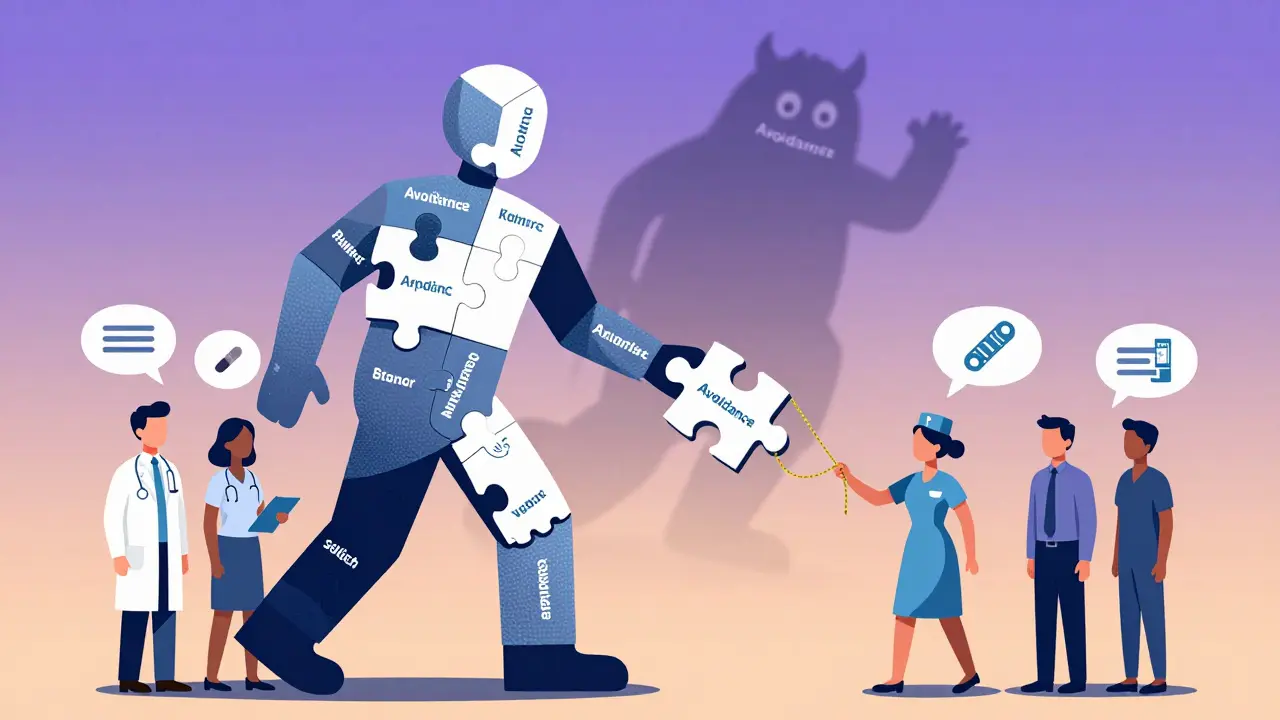
Barriers No One Talks About
We hear about cost and complexity. But there are quieter hurdles: - Gender: In one rheumatoid arthritis study, women were 4.5 times more likely to stick with meds than men. Why? They were more likely to seek support, talk about their feelings, and follow routines. - Age: Older patients tend to be more adherent-but not because they’re better at it. They’ve lived longer with illness. They’ve seen what happens when you stop. - Disease duration: People with shorter illness histories struggle more. The shock hasn’t worn off yet. - Language and culture: If your doctor speaks English and you speak Mandarin, you’re less likely to ask questions. And if you don’t ask, you don’t understand.What to Do Right Now
You don’t need to fix everything at once. Start small.- Put your pills next to your toothbrush. Take them after brushing.
- Call your pharmacy. Ask: “Can I get a 90-day supply? Is there a cheaper version?”
- Write down one thing you’re struggling with. Is it cost? Side effects? Forgetting? Then tell your doctor. Don’t wait for your next appointment.
- Find one person you trust. Tell them: “I’m trying to take my meds every day. Can you check in with me once a week?”
- Use a free app. Medisafe, MyTherapy, or even a simple phone alarm labeled “AM Pill.”
It’s Not About Willpower
The biggest myth is that adherence is about discipline. It’s not. It’s about design. It’s about support. It’s about reducing the friction between you and your health. If your system is broken, no amount of willpower will fix it. That’s why team-based care works. That’s why simplifying regimens saves lives. That’s why asking for help isn’t weakness-it’s strategy. The goal isn’t to take 100% of your pills. The goal is to take enough to stay out of the hospital. To live longer. To feel more like yourself. You’re not failing if you miss a dose. You’re human. But if you keep trying-even in small ways-you’re already winning.Why do people stop taking their chronic medications even when they know it’s important?
People stop because the daily burden becomes overwhelming. It’s not just forgetting. It’s emotional exhaustion, fear of side effects, high costs, complicated schedules, or feeling like the meds don’t make a difference. Over time, the mental weight of managing a lifelong condition can lead to avoidance, denial, or burnout-even in people who care deeply about their health.
Which coping strategy has the strongest evidence for improving medication adherence?
Problem-solving or active coping has the strongest evidence. Studies show 78% of patients using this approach had better adherence. This means actively finding solutions-like using pill organizers, simplifying dosing schedules, asking pharmacists about generics, or linking meds to daily routines like brushing teeth. It’s about changing the environment, not just relying on memory or willpower.
Can emotional coping strategies really help with taking pills every day?
Yes. Emotion-focused coping-like journaling, self-talk, or mindfulness-helps people manage the frustration, sadness, or anger that comes with long-term illness. One study found rheumatoid arthritis patients who used phrases like “I’m doing this for myself” had higher adherence. It doesn’t fix the pill schedule, but it makes sticking to it feel less like a chore and more like an act of self-care.
Is it true that team-based care improves medication adherence?
Absolutely. When pharmacists, doctors, and social workers work together, adherence rates jump. One CDC-backed study showed 89% of patients on team-based care stayed on their meds a year after hospital discharge, compared to 74% without it. Pharmacists help simplify regimens, social workers find financial aid, and nurses check in regularly. It’s not magic-it’s coordinated support.
What should I do if I can’t afford my chronic medication?
Don’t skip doses. Instead, talk to your pharmacist. Ask if there’s a generic version, a lower-cost alternative, or a patient assistance program. Websites like RxAssist.org list free or low-cost options from drug manufacturers. Many states also have programs for low-income residents. Your doctor can sometimes prescribe a 90-day supply to reduce pharmacy fees. You’re not alone-help exists, but you have to ask.
Does gender play a role in medication adherence?
Yes. Studies show women are often more adherent than men-sometimes significantly so. One study found women with rheumatoid arthritis were 4.5 times more likely to take their meds as prescribed. Researchers believe this is linked to higher rates of seeking support, talking about health concerns, and following routines. It’s not about being “better” at health. It’s about social and behavioral patterns.
Are there any tools or apps that can help me remember my meds?
Yes. Free apps like Medisafe, MyTherapy, or even Google Calendar with alarms work well. Set a daily reminder labeled “Morning Pill” or “Evening BP Med.” Some pill boxes have built-in alarms. The key isn’t the tool-it’s consistency. Pick one that fits your life. If you’re more likely to check your phone than a physical box, use an app. If you prefer tactile reminders, get a pill organizer with compartments.
Can I stop taking my meds if I feel fine?
No. Chronic medications often work silently. High blood pressure pills don’t make you feel better-they prevent heart attacks. Diabetes meds don’t cure your condition-they stop complications. Feeling fine is usually a sign the meds are working. Stopping them-even for a few days-can cause dangerous spikes in blood pressure, blood sugar, or inflammation. Always talk to your doctor before making changes.


15 Comments
Okay but can we talk about how ridiculous it is that we’re expected to be pharmaceutical engineers just to survive? I have five different pill organizers, two apps, and a spreadsheet. And still, I forget the damn 3pm pill because my brain is full of other trauma. This isn’t discipline-it’s a full-time job with no paycheck.
/p>The epistemological framework underlying medication adherence is fundamentally flawed when it assumes rational actor models in contexts of embodied chronicity. The phenomenology of daily pill-taking is not merely behavioral-it’s ontological. Each tablet becomes a metonym for mortality, a somatic reminder of the body’s betrayal. Active coping, therefore, is not a strategy-it’s an existential recalibration. The pillbox is a ritual object in a secular liturgy of survival.
/p>Oh sweet baby Jesus, another ‘you just need to try harder’ post. Newsflash: I’m not lazy. I’m broke. My insulin costs more than my rent this month. And no, I can’t ‘just call the pharmacist’-they don’t answer calls from people who use food stamps. This isn’t a self-help blog. It’s a cry for help wrapped in corporate wellness fluff.
/p>Thank you for this. Really. I’ve been taking lisinopril for 12 years. I use a Medisafe app, a physical pillbox, and my wife reminds me every morning. It’s not glamorous. It’s not heroic. It’s just… necessary. I’m glad someone finally said it: this isn’t about willpower. It’s about design. And we need better design. 😊
/p>Ugh. Another ‘emotional coping’ soft-sell. Journaling? Self-talk? Please. You’re not healing your hypertension with affirmations. You’re healing your ego. Real adherence is about structure, not serotonin. If you can’t handle a pill organizer, maybe you shouldn’t be on meds at all. This is medicine, not a yoga retreat.
/p>78%? Source? Also, 'active coping' is just jargon for 'do what you're told.' Also, why no data on non-Western populations? Also, who funded this? Pharma? Also, I skipped my meds last Tuesday and I'm fine. So.
/p>It is both intellectually and ethically indefensible to conflate systemic healthcare failure with individual behavioral deficiency. The notion that ‘team-based care’ constitutes a solution presupposes the viability of a fragmented, profit-driven medical industrial complex. One cannot solve a structural crisis through administrative band-aids. Adherence rates are symptoms, not targets. The real problem is the commodification of health.
/p>Why are we always talking about Americans? What about the rest of the world? In the U.S., we have the luxury of choosing between 17 different blood pressure pills. In other countries, people are lucky to get ONE pill a week. This whole post is colonialist nonsense. We need global equity, not self-help tips for rich white ladies with pill organizers.
/p>Let’s be real. The real reason people stop taking meds? They’re being poisoned by the system. Big Pharma knows you’ll keep taking it. They don’t want you cured. They want you dependent. The ‘side effects’? They’re not accidents. They’re features. The ‘cost’? Designed to keep you trapped. Wake up. This isn’t medicine. It’s a control mechanism.
/p>As a South Asian woman who grew up with a mother who died because she skipped her diabetes meds to save money-I’ve seen what happens when systems fail. This isn’t about ‘coping.’ It’s about justice. We need universal healthcare. We need free meds. We need to stop treating survival like a personal achievement. You don’t get a medal for not dying. You deserve to live without choosing between insulin and rent.
/p>Okay but what if your pillbox is full of lies? What if the doctor gave you the wrong meds and you’ve been taking them for 3 years? What if the side effects are making you suicidal and no one listens? What if you’re a single mom and your kid’s school won’t let you store meds in the nurse’s office? What if your insurance says ‘prior authorization required’ and you wait 14 days and your BP spikes and you almost stroke out? What if you’re not lazy-you’re exhausted? What if you’re not broken-you’re just ignored? What if the system is the problem? What if we’re all just trying not to die and everyone keeps telling us to try harder? What if I’m not a patient? What if I’m a person?
/p>My grandmother in Delhi took her blood pressure pills every morning with chai. No alarms. No apps. Just ritual. She said, 'If I forget, the body remembers.' She lived to 94. Sometimes, the oldest ways are the truest. We overcomplicate survival. Just link it to something you already love. Coffee. Tea. A prayer. A song. The pill becomes part of the rhythm, not the burden.
/p>While I appreciate the empirical grounding of the five coping strategies, I must emphasize that cultural context remains an underexplored variable. In collectivist societies, familial accountability often supersedes individual compliance mechanisms. Moreover, the assumption that digital tools (e.g., Medisafe) are universally accessible neglects the digital divide among elderly and low-income populations. A structural reorientation toward community-based adherence models may yield greater sustainability than individualized behavioral interventions.
/p>My dad’s been on warfarin for 15 years. He uses a pillbox, calls his pharmacist every month, and lets my mom know if he misses one. He doesn’t talk about it much. But he does it. Every day. Not because he’s strong. Because he loves us. And that’s the real strategy. Love doesn’t need an app. It just shows up.
/p>^ This. I’m crying. My dad died of a stroke because he stopped his meds after my mom died. He said, ‘I don’t need them anymore.’ I didn’t know he meant ‘I don’t need to live anymore.’
/p>