
21 Jan 2026
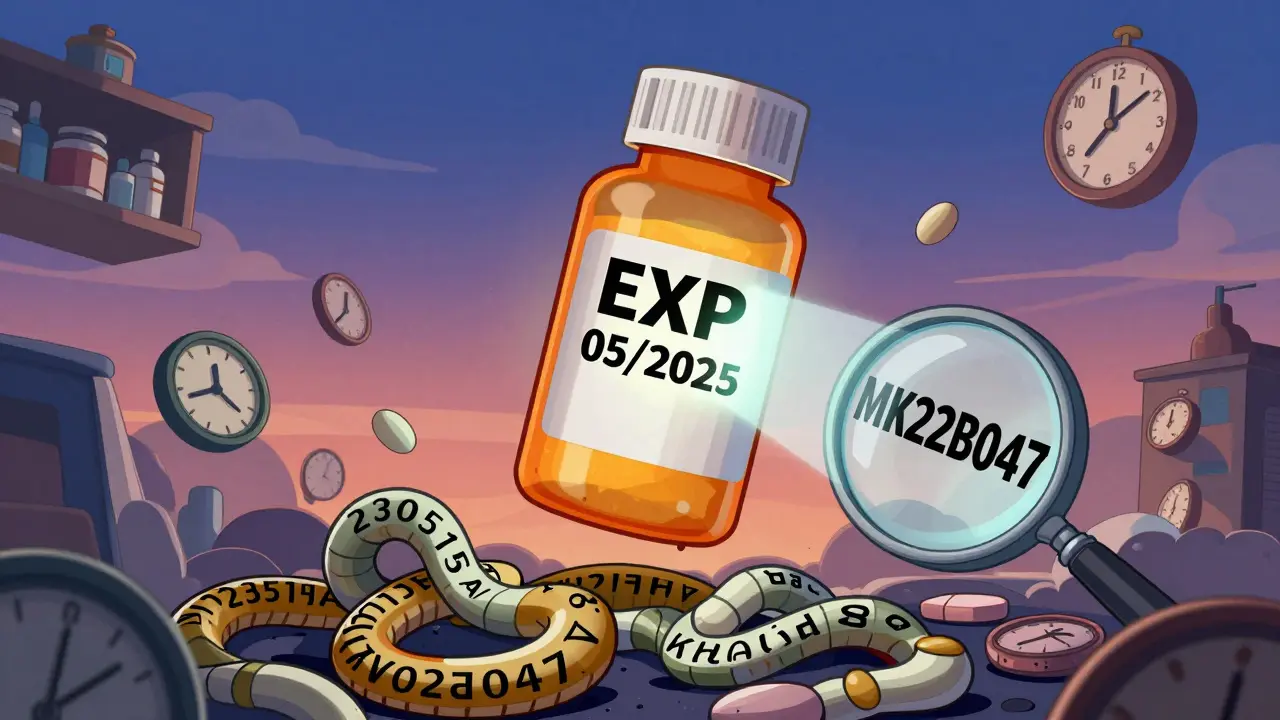
Clearing expired medications isn’t just about cleaning out a shelf. It’s a safety step that can prevent harm, avoid legal trouble, and stop thousands of dollars in waste. But if you’re guessing expiration dates from a jumble of letters and numbers on a pill bottle, you’re doing it wrong. The lot number isn’t your expiration date. It’s a trace code. And mixing them up can lead to dangerous mistakes.
Why Lot Numbers Don’t Tell You When Medicine Expires
You see a lot number like "230515A" on a bottle of blood pressure pills and think: "That’s May 15, 2023-so it expired a year ago?" Wrong. That’s the manufacturing date. Not the expiration. The FDA requires every prescription and over-the-counter medicine to print the actual expiration date right on the package as "EXP" followed by a month and year-like "EXP 05/2025". That’s the only date that matters. Manufacturers use lot numbers to track which batch of pills came from which machine, at which plant, and when. Pfizer might use "230515A" to mean May 15, 2023, production line A. Merck might use "MK22B047" where "22" is the year and "B047" is the batch. But none of those codes tell you how long the drug lasts. Shelf life depends on the chemical formula, packaging, and storage conditions. A bottle of insulin might expire 28 days after opening, even if the bottle says "EXP 12/2026". Another drug might be stable for five years. You can’t guess it. The FDA’s 2022 report found that over 1.3 million emergency room visits in the U.S. each year are tied to expired or misused medications. Most of those happen because someone assumed the lot number was the expiration date.How to Find the Real Expiration Date
Look at the packaging. Every legally sold medicine in Australia, the U.S., Canada, and the EU must show the expiration date clearly. It’s usually on the side of the box, the blister pack, or the bottle label. Look for "EXP", "Expiry", or "Use By". The format is almost always month/year-like "06/2025". Some international brands use day/month/year, like "15/06/2025". If you’re unsure, check the packaging again. If it’s faded, damaged, or missing, treat the medicine as expired. Don’t rely on apps or websites that claim to decode lot numbers. There’s no public database that links batch codes to expiration dates. Even if you find a tool online that says it works, it’s not official. Pharmacies use internal systems that match lot numbers to manufacturer records-but those aren’t available to the public. Your best tool? Your eyes.Check for Recalls Before You Throw Anything Away
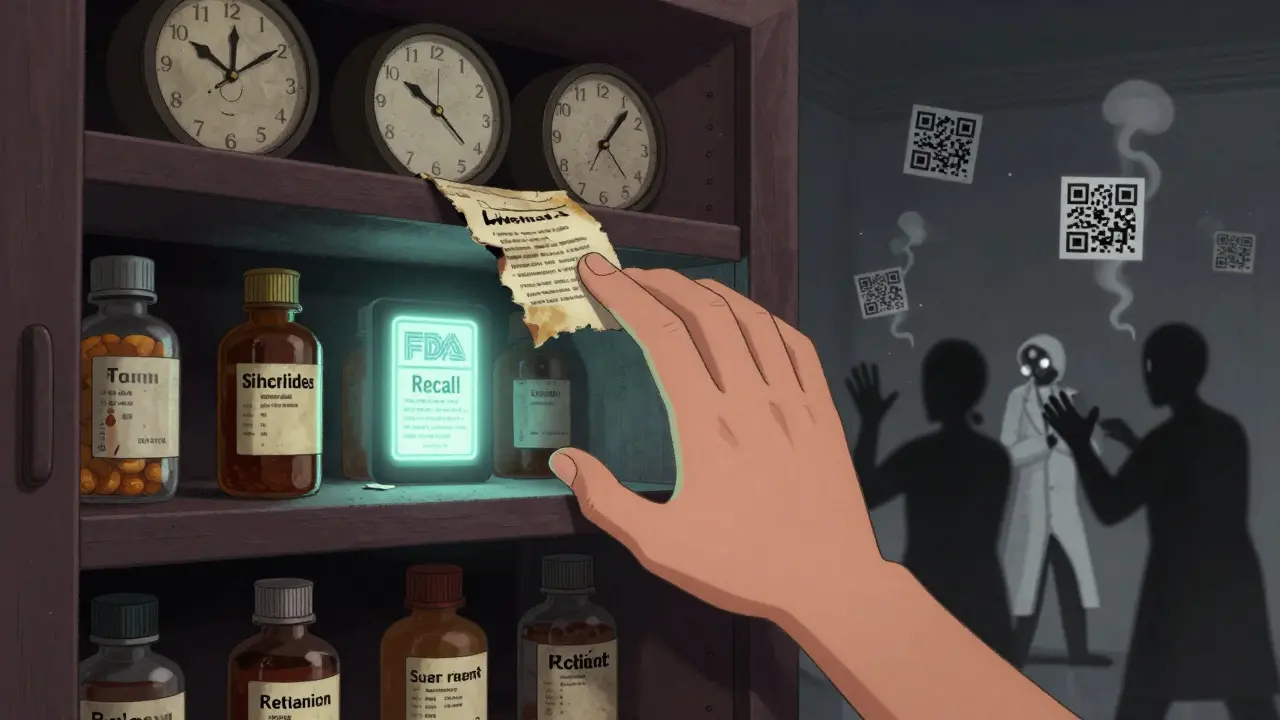
Just because a medicine is expired doesn’t mean it’s safe to toss. Some batches get recalled before their expiration date because of contamination, incorrect dosage, or manufacturing flaws. That’s why you need to cross-check the lot number with official recall databases before disposal. In Australia, use the Therapeutic Goods Administration (TGA) recalls page. In the U.S., use the FDA’s Recalls, Market Withdrawals & Safety Alerts database. Both are free and updated daily. Search by the lot number printed on the package. If there’s a match, follow the instructions. You might need to return it to the pharmacy, even if it’s expired. In 2023, the FDA recorded 217 recall incidents where expired medications were mistakenly kept in stock because staff didn’t check the lot number against recall alerts. One case involved a batch of antibiotics that were contaminated with a toxic chemical-still in use because the expiration date hadn’t passed. People got sick. That’s why step two is always: scan the lot number. Then check the recall list.The Three-Step Clearance Process (ASHP Guidelines)
Pharmacies and clinics follow a strict three-step process to clear expired meds safely. You should too.- Visually confirm the EXP date-Look at the package. If it’s expired, set it aside. Don’t assume.
- Scan the lot number into your inventory system or write it down. This links the physical item to digital records.
- Check the FDA or TGA recall database-Type in the lot number. If there’s a recall, don’t throw it out. Contact your pharmacy or local health authority for return instructions.
What to Do If the Label Is Damaged or Missing
Sometimes bottles get dropped. Labels peel. Ink fades. If you can’t read the EXP date, and the lot number is unreadable too, treat it as expired. Don’t risk it. Even if you think the medicine "looks fine," chemicals degrade over time. Antibiotics can become toxic. Painkillers can lose potency. Hormones can become unpredictable. In these cases, take the bottle to a pharmacy. Most offer free disposal services for expired or unwanted meds. They have secure containers and know how to handle controlled substances like opioids or benzodiazepines. Never flush pills down the toilet or toss them in the trash without mixing them with coffee grounds or cat litter first-that’s a safety risk.Why Automated Systems Are Changing the Game
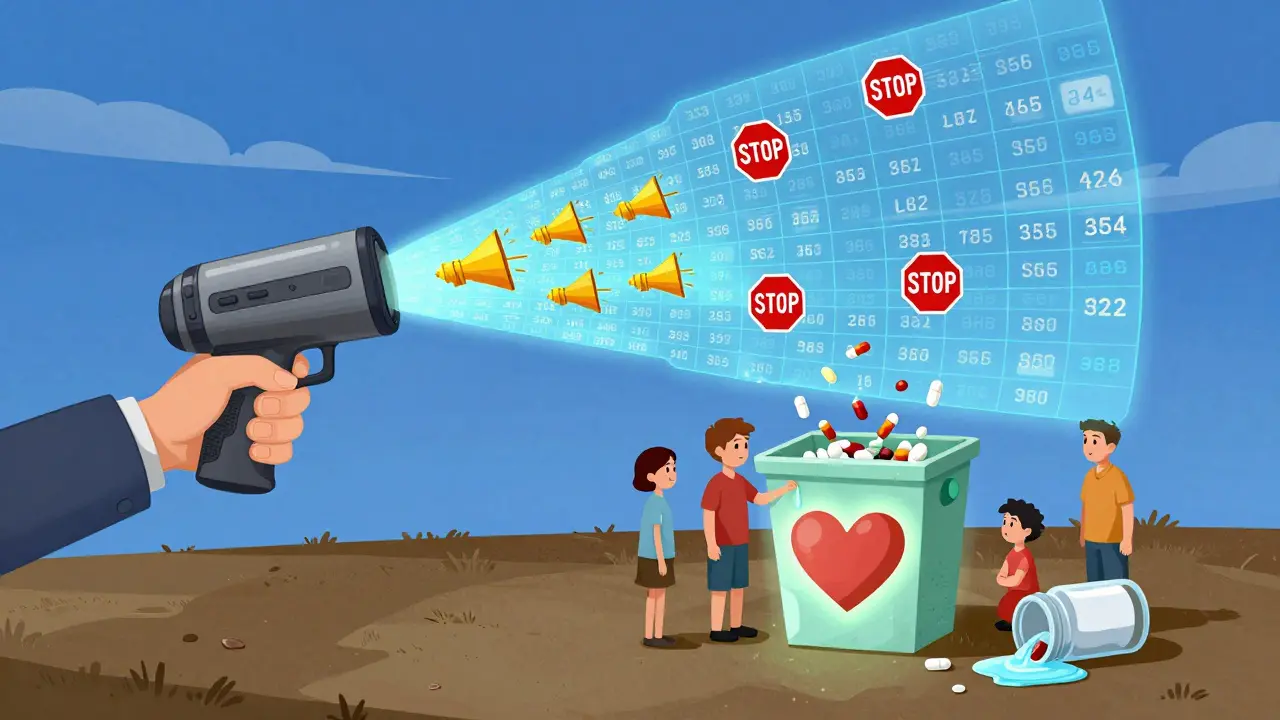
Big pharmacies use barcode scanners linked to manufacturer databases. When they scan a pill bottle, the system pulls up the expiration date, lot number, and recall status in under a second. That’s how they cut clearance time from three hours to 22 minutes per inventory cycle. The FDA approved Medplore’s AI scanner tool in April 2024. It reads EXP dates from blurry, damaged, or poorly lit labels with 99.2% accuracy. That’s huge. A University of Florida study found 31% of medication labels get damaged during handling. Before this tech, many expired meds slipped through. Even small clinics can now use affordable handheld scanners that sync with cloud databases. They cost under $300 and connect to your phone. If you’re managing meds for a home care service, aged care facility, or even a family member’s medicine cabinet, it’s worth the investment.Common Mistakes That Lead to Waste and Risk
Here’s what goes wrong-and how to avoid it:- Mistake: Thinking "MFG 03/2022" means it expired in 2022. Fix: Look for "EXP"-not "MFG".
- Mistake: Assuming all drugs last 2-3 years. Fix: Insulin expires 28 days after opening. Nitroglycerin loses potency after six months. Check the label.
- Mistake: Ignoring recalls because the date hasn’t passed. Fix: A recalled drug is unsafe-even if it’s not expired.
- Mistake: Using a lot number from a different bottle. Fix: Each bottle has its own lot number. Never guess.
- Mistake: Throwing away unopened meds without checking if they’re still viable. Fix: If it’s not recalled and the EXP date is still good, keep it. Don’t waste.


12 Comments
Wow, this is so important-I’ve seen people mix up MFG and EXP dates all the time. I work in home health, and last month, a client almost took a batch of insulin that was recalled due to contamination. Lot number looked fine, but the FDA database flagged it. Thank you for stressing the recall check. Always check. Always.
/p>Also-don’t trust apps that claim to decode lot numbers. I tried one once. It said my Tylenol expired in 2018. It was 2025. I threw it out. Then I realized I’d just wasted $12 because of a sketchy website.
THIS IS A PUBLIC HEALTH CRISIS AND NO ONE IS TALKING ABOUT IT. People are dying because they think ‘230515A’ means it expired in 2023. I had a cousin die from a recalled antibiotic because her pharmacist didn’t check the lot number. She was 34. She had a toddler. And now she’s gone because someone assumed. ASSUMED. That’s not negligence-that’s criminal. Someone needs to get sued. HARD.
/p>you know… i’ve been thinkin’… like… lot numbers are like… fingerprints for pills? but not really? because fingerprints are unique to one person, but lot numbers are for batches… so maybe it’s more like a birth certificate for a whole group of pills? and expiration dates are like… their death certificate? but then again, some pills live longer than others… like, how do we even define ‘life’ for a chemical compound? and why do we trust the FDA to decide that? i mean… what if they’re wrong? what if the real expiration is longer? what if we’re just wasting medicine because of bureaucracy? … i dunno. just thinking out loud. sorry.
/p>also… typo: ‘EXP 05/2025’-should it be ‘EXP 05/25’? or is that just me?
Clarity is a public good. The distinction between manufacturing date and expiration date is not merely technical-it is ethical. Misinterpretation leads to harm. Harm leads to liability. Liability leads to systemic erosion of trust. The three-step process outlined here is not optional. It is foundational. The data is unequivocal. Compliance is not a suggestion. It is a moral imperative.
/p>Of course you’re going to tell people to check the FDA database. But how many people actually know how to navigate it? It’s a nightmare. I tried searching a lot number last year. Took me 47 minutes. Three pop-ups. A CAPTCHA that didn’t work. And then it said ‘no results found’-but the drug was recalled. I called the pharmacy. They said, ‘Oh, we don’t use that system anymore.’ So now what? You’re telling me the average person is supposed to be a regulatory detective? This isn’t helpful. It’s cruel.
/p>Thank you for the comprehensive and meticulously referenced guidance. The integration of regulatory frameworks from both the FDA and TGA demonstrates a commendable commitment to international best practices. The statistical validation from Harvard Medical School and the NCPA survey provides empirical grounding that elevates this from anecdotal advice to evidence-based protocol. I would strongly encourage dissemination of this framework to community pharmacies, long-term care facilities, and family caregivers alike.
/p>Or… we could just stop hoarding meds like they’re gold bars. If you didn’t take it in 2 years, maybe you don’t need it. Stop stressing over lot numbers. Just throw it out. The world won’t end.
/p>Y’ALL. I JUST FOUND A BOTTLE OF MY GRANDMA’S BLOOD PRESSURE PILLS FROM 2019. I WAS ABOUT TO THROW THEM OUT… THEN I SAW THE EXP DATE: 08/2026. I DIDN’T BELIEVE IT. SO I LOOKED UP THE LOT NUMBER. AND IT WAS RECALLED. IN 2021. SHE NEVER KNEW. I CRIED. I TOOK IT TO THE PHARMACY. THEY SAID I SAVED HER LIFE. YOU GUYS. THIS STUFF MATTERS. SHARE THIS POST. NOW.
/p>This is brilliant. I’m from the Philippines and we don’t have the same systems here. But I’ve seen people here use expired meds because they think the numbers on the bottle are expiration dates. I’m translating this into Tagalog and sharing it in our local community groups. We need this everywhere. Thank you for making it so clear.
/p>Just wanted to say thank you for this. My mom has dementia and I manage her meds. I used to just guess. Now I have a little notebook: drug name, lot, exp date, recall check. I even color-code it-red for recalled, green for good. It’s not perfect, but it’s helping. And I feel less scared. You made me feel like I can do this right.
/p>Also-yes, turn on the light. I didn’t realize how dark my cabinet was until I got a little LED clip light. Game changer.
The operational efficiency gains from automated lot tracking systems are non-trivial. Leveraging barcode symbology and API integration with manufacturer databases reduces human error variance by an order of magnitude. The Medplore AI scanner, validated under ISO 13485 protocols, demonstrates a 99.2% F1 score in low-contrast label recognition. Implementation at scale requires infrastructure investment, but ROI is demonstrable in reduced liability exposure and compliance audit outcomes.
/p>Just a quick one: I’ve got a jar of old ibuprofen from 2020. EXP says 2023. Lot number is unreadable. I tossed it in the trash with coffee grounds. Felt good. Don’t overthink it. If it’s expired and you can’t check the lot? Pitch it. You’re not a pharmacist. You’re a person trying not to get sick. That’s enough.
/p>