
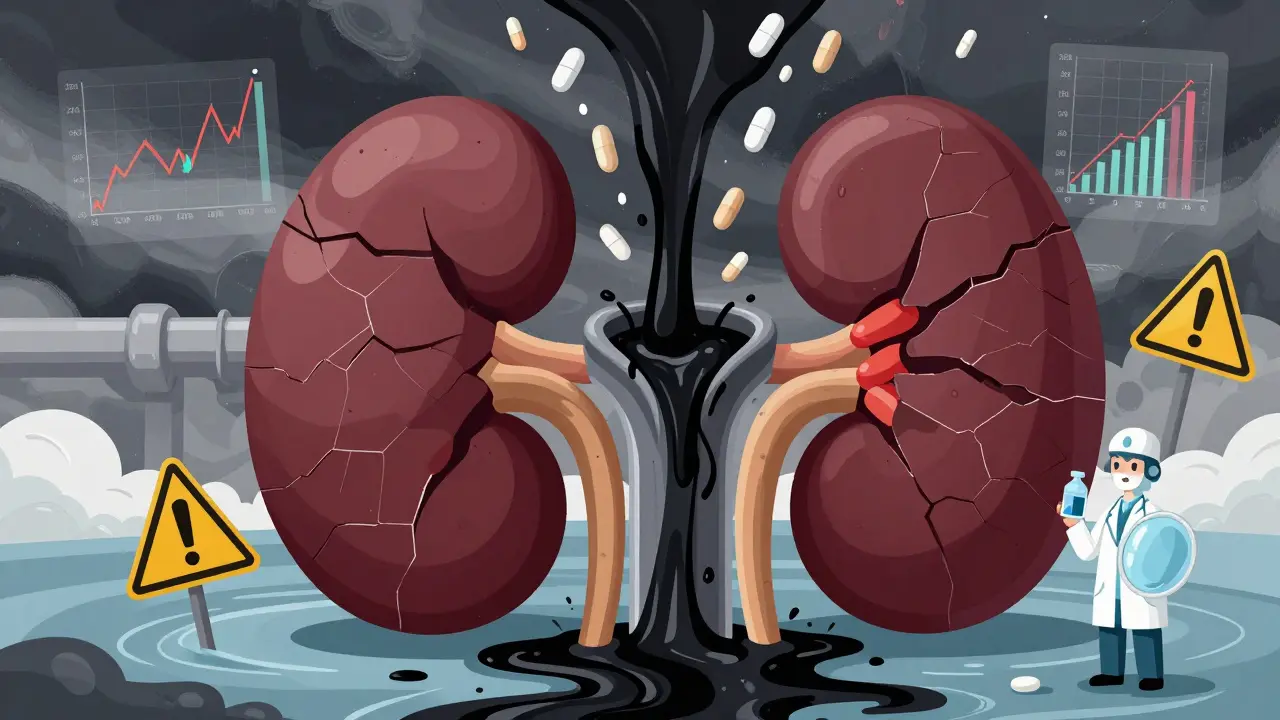
What Happens When AKI Hits Chronic Kidney Disease?
Imagine your kidneys are like filters in a water system. If they’re already clogged from long-term damage - that’s chronic kidney disease (CKD) - and then you add a strong chemical like contrast dye or an NSAID, the system can suddenly shut down. That’s acute kidney injury (AKI) on top of CKD. It’s not just a temporary blip. It’s a dangerous spike in risk that can push someone closer to dialysis or even death.
People with CKD stages 3 to 5 - meaning their eGFR is below 60 mL/min/1.73m² - are especially vulnerable. Studies show that up to 50% of these patients can develop contrast-induced kidney injury after a CT scan with iodinated dye. And it’s not just contrast. Everyday medications like ibuprofen, naproxen, or even certain antibiotics can trigger a sudden drop in kidney function. The result? Hospital stays, longer recovery, and sometimes permanent damage.
Why Contrast Dye Is So Risky for CKD Patients
Contrast dye is used in CT scans, angiograms, and other imaging tests to make blood vessels and organs stand out. For most people, it’s harmless. But in someone with CKD, the kidneys can’t clear it efficiently. The dye lingers, causes swelling in the kidney tubules, and reduces blood flow. This combination leads to cell damage and a sharp rise in creatinine - the classic sign of AKI.
The KDIGO 2012 guidelines, still the global gold standard, say this: avoid contrast when possible. If you absolutely need it - like for a life-threatening stroke or heart attack - use the smallest dose possible (usually under 100 mL). And never give it to someone who’s dehydrated. Hydration is the single most effective shield. Giving isotonic saline at 1.0 to 1.5 mL/kg/hour for 6 to 12 hours before and after the scan cuts risk by 30 to 40%.
Some hospitals still use sodium bicarbonate or N-acetylcysteine (NAC) to try to protect the kidneys, but recent data shows they don’t add much benefit over plain saline. The 2024 KDIGO update confirmed this: normal saline is enough. No fancy cocktails needed.
The Top Nephrotoxic Medications to Avoid
Contrast isn’t the only danger. Many common drugs are quietly harmful to kidneys already under stress. Here’s what to watch for:
- NSAIDs (ibuprofen, naproxen, celecoxib): These are the #1 culprit. They block protective chemicals in the kidney, dropping blood flow just when it’s needed most. In CKD patients, NSAID use increases AKI risk by 2.5 times. Many patients don’t realize their joint pain medicine is a kidney threat.
- Aminoglycosides (gentamicin, tobramycin): Used for serious infections, but they’re toxic to kidney cells. Up to 25% of patients on these drugs develop AKI, especially if given for more than 5 days.
- Vancomycin: Often used for MRSA, but high doses or long courses raise the risk. Trough levels above 15 mcg/mL are dangerous. Monitoring levels is non-negotiable.
- Amphotericin B: A powerful antifungal with up to 80% nephrotoxicity rates. It’s a last-resort drug for a reason.
- ACE inhibitors and ARBs (lisinopril, losartan): These are usually good for CKD - they protect kidneys long-term. But during an acute illness or dehydration, they can cause a sudden creatinine spike of 15-25%. Don’t stop them blindly - talk to your doctor. Sometimes holding them temporarily is safer than risking low blood pressure.
Pharmacists are key here. Studies show pharmacist-led reviews of medication lists in hospitals reduce AKI by 22%. They catch what doctors miss - like a patient on three NSAIDs or an antibiotic that shouldn’t be given with low kidney function.
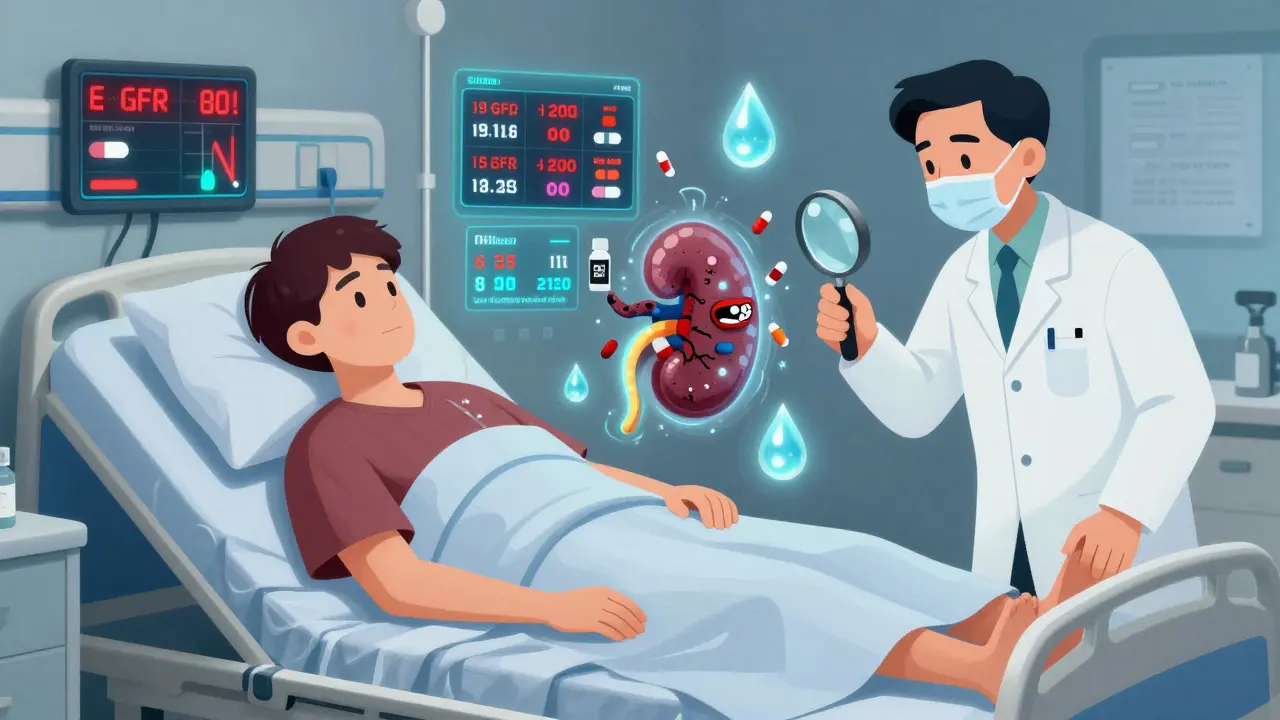
How to Adjust Medications When AKI Strikes
When AKI happens on top of CKD, your kidney function isn’t stable. It’s dropping. So using your old baseline eGFR to dose meds is dangerous. You need to use the current kidney function - even if it’s just for a few days.
For example, if someone with CKD (eGFR 35) gets sick and their creatinine jumps to 2.8 (eGFR now 20), their dose of metformin, warfarin, or digoxin needs to be lowered immediately. Many hospitals still use the old CKD number because it’s in the chart. That’s a mistake.
Use tools like the CKD-EPI equation with the latest creatinine. If you’re unsure, ask a pharmacist. Most have apps or calculators built in. Don’t guess. A wrong dose can cause toxicity, seizures, or even death.
What to Do Before Any Imaging Test
If you have CKD and your doctor says you need a scan with contrast, don’t just say yes. Ask these questions:
- Is this scan absolutely necessary? Could an ultrasound or MRI (without contrast) work instead?
- What’s the lowest dose of contrast they can use?
- Will I get IV fluids before and after? How much and for how long?
- Have my nephrotoxic meds been reviewed? Will anything be held?
- Will my kidney function be checked 48 hours after the scan?
For patients with eGFR below 30, some centers consider dialysis right after contrast. That’s not routine - only for those on regular dialysis or with very advanced disease. But it’s an option worth discussing.
Monitoring and Follow-Up After AKI
AKI doesn’t end when you leave the hospital. If your creatinine stayed high for more than 7 days, you may now have acute kidney disease (AKD) - a new term from KDIGO 2019. This means your kidneys are still healing, and you’re at higher risk for permanent damage.
Follow-up is critical. Get your eGFR and urine albumin-to-creatinine ratio (uACR) checked again in 3 months. If your kidney function didn’t bounce back, you could be heading toward end-stage kidney disease. One study found that 30% of AKI episodes in CKD patients lead to lasting decline. Another 10-15% end up on dialysis within five years.
Check your creatinine every 24 to 48 hours while you’re hospitalized. In stable CKD, you might check it every few months. During AKI, you need daily tracking.
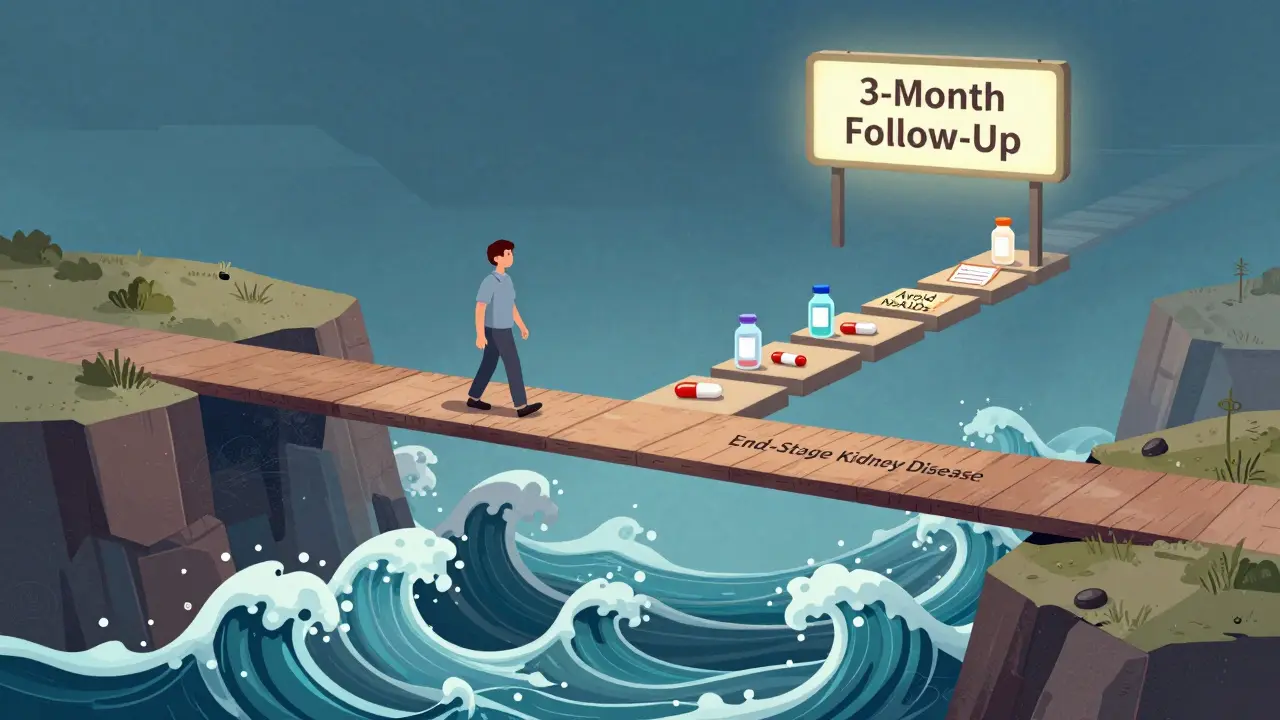
Why Patient Education Saves Kidneys
Most patients with CKD don’t know what nephrotoxic means. They take ibuprofen for back pain. They skip fluids before a scan because they’re nervous. They don’t realize their blood pressure med needs adjusting when they’re sick.
Simple education changes outcomes. One study showed that CKD patients who got clear, written instructions about avoiding NSAIDs and staying hydrated had 25% fewer AKI hospitalizations. That’s huge.
Give them a list: “Avoid these medicines: ibuprofen, naproxen, celecoxib, and any new antibiotic without checking with your kidney doctor.” Tell them to drink water every day, even if they’re not thirsty. Teach them to recognize swelling, less urine, or fatigue as warning signs.
What’s Changing in 2026?
The KDIGO guidelines are being updated in late 2024, and the changes matter. New biomarkers - TIMP-2 and IGFBP7 - can predict AKI within 12 hours, before creatinine even rises. That’s a game-changer. Hospitals are starting to use these tests in ICUs to catch kidney injury early.
Also, the idea of early dialysis for severe AKI is fading. The 2022 AKIKI 2 trial showed that rushing into dialysis doesn’t help survival. Wait until there’s clear danger - like fluid overload, high potassium, or acidosis. Don’t over-treat.
Electronic alerts in hospital systems now flag high-risk patients, but they’re noisy. Forty percent of doctors ignore them because they’re overwhelmed. The next step? Smarter alerts that only pop up for true high-risk cases - like a 70-year-old with CKD stage 4 on NSAIDs and dehydration.
Bottom Line: Prevention Is Everything
AKI on CKD isn’t something you fix after it happens. You stop it before it starts. The tools are simple:
- Hydrate before contrast
- Stop NSAIDs
- Check all meds for kidney risk
- Use the lowest contrast dose possible
- Monitor creatinine daily during illness
- Follow up in 3 months
It’s not about fancy treatments. It’s about paying attention. The biggest threat isn’t the dye. It’s the assumption that nothing’s wrong because the patient has been ‘stable’ for years. Stability doesn’t mean safety. It means you’re one missed dose, one pill, one scan away from disaster.
Don’t wait for the creatinine to spike. Act before it does.
Can I still get a CT scan if I have CKD?
Yes, but only if it’s truly necessary. Always ask if an ultrasound or MRI without contrast could work instead. If contrast is needed, use the smallest amount possible and get IV fluids before and after. Never have the scan if you’re dehydrated.
Are NSAIDs always dangerous for CKD patients?
For most people with CKD, yes. Even short-term use can trigger AKI. Acetaminophen (Tylenol) is a safer option for pain. If you must use an NSAID, talk to your doctor first - never take it without their approval.
Should I stop my ACE inhibitor or ARB if I get sick?
Don’t stop them on your own. These drugs protect your kidneys long-term. But if you’re dehydrated, have a severe infection, or are vomiting, your doctor may advise holding them temporarily. Always check with your provider - don’t guess.
How do I know if my kidneys are getting worse?
Watch for less urine, swelling in your legs or face, fatigue, nausea, or confusion. Get your creatinine and eGFR checked regularly - especially after any illness, hospital stay, or contrast scan. A rising creatinine over days is a red flag.
Can I prevent AKI on CKD completely?
You can’t eliminate all risk, but you can reduce it by 70% or more. Stay hydrated, avoid NSAIDs, review all your meds with your pharmacist, and always tell your doctors you have CKD before any test or procedure. Most AKI cases in CKD patients are preventable.

11 Comments
this post is just another way for hospitals to make more money. they dont care if you get AKI, they just want to bill for the scan and the fluids and the 'monitoring'. i bet they dont even tell you half this stuff until after you're already hooked up to the IV./p>
if you have CKD and you're reading this, stop scrolling and go check your meds right now. i did. turned out i was on naproxen for 3 years. my nephrologist nearly had a heart attack. tylenol works fine. stay hydrated. simple./p>
Let me be clear: if your doctor is still using bicarbonate or NAC instead of isotonic saline, they're practicing medicine from 2010. This isn't rocket science. It's basic physiology. The 2024 KDIGO update is a slap in the face to every lazy nephrologist who clings to outdated protocols. Get with the program./p>
I work in a hospital pharmacy and we've seen a 28% drop in AKI cases since we started mandatory med reviews for CKD patients before imaging. Pharmacists aren't just pill counters. We're the last line of defense against preventable harm. If your doctor doesn't consult one, ask why./p>
The truth is this entire system is designed to fail patients like us. Contrast agents are patented. NSAIDs are cheap. Hospitals profit from procedures, not prevention. They want you to need dialysis. It's more revenue. Don't be fooled by their 'guidelines'./p>
so like... if i have CKD and i take ibuprofen for my back pain, am i basically playing russian roulette with my kidneys? 😅 i mean, i know it's bad but... how bad? like, is it 'oh no i'm gonna die tomorrow' bad or 'maybe i should stop' bad? 🤔/p>
There's a quiet dignity in the way this post lays out the truth: prevention isn't glamorous. It's hydration. It's saying no to a pill. It's asking questions when you're scared. We've turned medicine into a spectacle, but the real healing is in the small, consistent acts of care. Don't underestimate them./p>
Bro, I saw a guy on dialysis last week who got AKI because he took Advil for his headache before a CT. He didn't even know it was a problem. This isn't just medical advice - it's survival 101. If you've got CKD, treat your kidneys like your last phone battery: don't drain it, don't charge it with junk, and never ignore the warning signs./p>
I appreciate the clarity here. It's rare to see such a balanced, evidence-based breakdown without fearmongering. The part about not stopping ACE inhibitors blindly resonated - I've seen patients panic and discontinue them, then crash from hypotension. Context matters. Knowledge is the real shield./p>
You know, I've been thinking - isn't it ironic that we've built an entire medical-industrial complex around the idea of 'fixing' things, when the real solution is... not doing anything? Not giving the dye. Not prescribing the NSAID. Not intervening. Just... letting the body be? We've forgotten that sometimes, the most powerful medicine is restraint. We're so obsessed with action, we've lost the art of non-action. And in that silence, the kidneys breathe./p>
I had CKD stage 3 and took ibuprofen for months because my back hurt. Then I got AKI. I thought I was fine because I didn't feel sick. I was wrong. I spent 4 days in the hospital crying because I didn't know. Please. If you're reading this and you have CKD - stop. Just stop. Drink water. Say no. You're worth more than a pill./p>