
Antibiotic-NSAID Risk Calculator
Risk Assessment
Risk Assessment Results
Overall Risk Level
Kidney Risk
Neurological Risk
When you're prescribed an antibiotic like ciprofloxacin or levofloxacin for a stubborn infection, and your doctor also recommends ibuprofen or naproxen for pain or fever, it's easy to assume these drugs are safe together. But the truth is, combining fluoroquinolone antibiotics with NSAIDs isn't just a routine combo-it's a hidden risk that can trigger serious, sometimes permanent, damage to your kidneys and nervous system.
Fluoroquinolones, including ciprofloxacin, levofloxacin, moxifloxacin, and ofloxacin, have been workhorses in treating urinary tract infections, pneumonia, and other bacterial illnesses. But since 2017, health agencies around the world-including Health Canada, the FDA, and the European Medicines Agency-have been sounding alarms. These drugs carry a rare but real risk of disabling, long-lasting side effects that can affect tendons, nerves, joints, and the brain. And when you add an NSAID into the mix, those risks don’t just add up-they multiply.
How Fluoroquinolones Hurt Your Kidneys
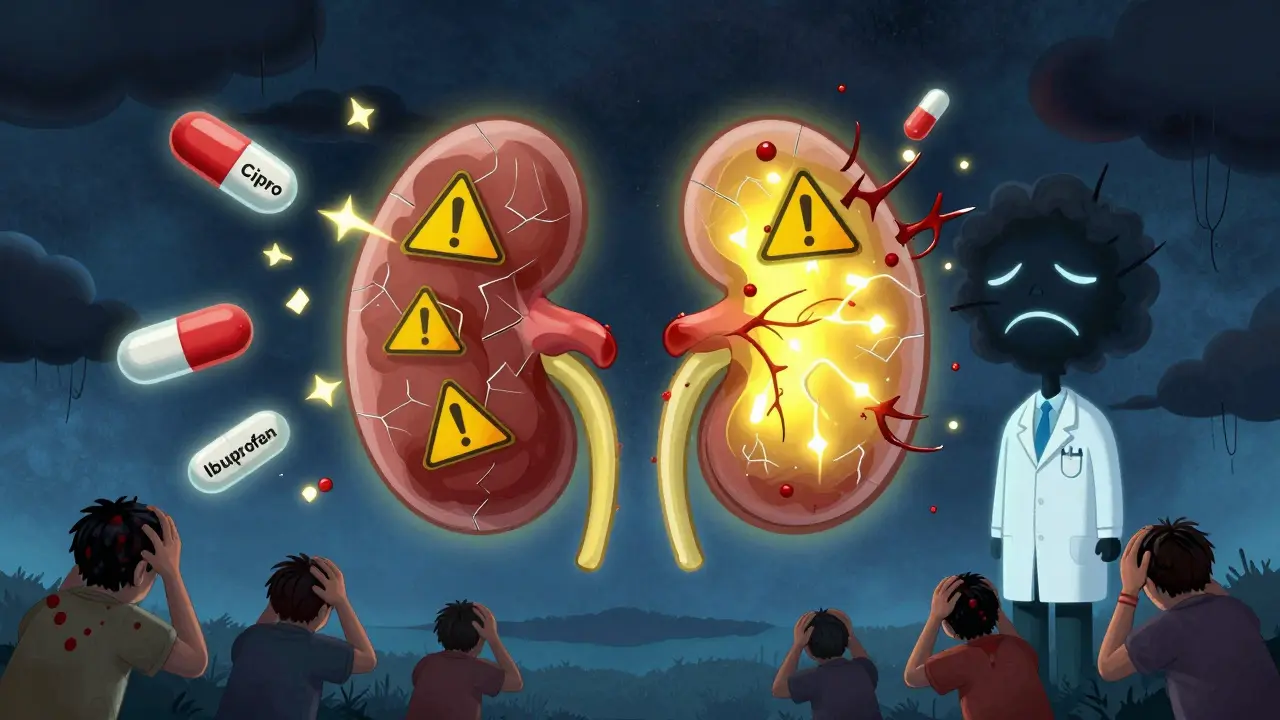
Fluoroquinolones don’t just kill bacteria-they can also damage kidney tissue. The most common problem is acute interstitial nephritis, where immune cells invade the spaces between kidney tubules, causing inflammation. In some cases, this leads to crystalluria-tiny drug crystals forming in urine when pH rises above 6.8-blocking kidney function. More severe cases result in acute tubular necrosis, where kidney cells die off.
A 2013 study in the Journal of the American Medical Association found that adult men taking fluoroquinolones had a twofold higher risk of needing hospitalization for acute kidney injury. That’s not a small number. It means for every 100 people taking these antibiotics, about two extra cases of serious kidney trouble occur compared to those not taking them.
NSAIDs: The Silent Kidney Threat
NSAIDs like ibuprofen, naproxen, and diclofenac are common pain relievers. But they work by blocking prostaglandins-chemicals your kidneys need to maintain blood flow. Without enough prostaglandins, your kidneys can’t filter blood properly, especially if you're dehydrated, older, or already have reduced kidney function.
Studies show that in people over 60, or those with an eGFR below 60 mL/min/1.73m², NSAIDs can reduce kidney filtration by 20-30% within days. It’s not just about long-term use-it’s about acute drops in kidney function that can happen fast.
The Deadly Combo: Fluoroquinolones + NSAIDs
Neither drug alone is ideal for your kidneys. Together? The risk jumps dramatically.
Research published in JAMA Internal Medicine found that when fluoroquinolones and NSAIDs are taken together, the risk of acute kidney injury requiring hospitalization increases by up to 3.5 times compared to using either drug alone. This spike is most dangerous in older adults and those with pre-existing kidney issues. Why? Because both drugs are cleared by the kidneys. When one slows kidney function, the other builds up in your blood.
For example, if you have moderate kidney impairment (eGFR 30-59), fluoroquinolone levels in your blood can rise by 50-100%. Add an NSAID into the mix, and your kidneys are hit with a double whammy: less ability to clear the antibiotic, and less ability to protect themselves from its toxic effects.
Neurological Damage: More Than Just Headaches
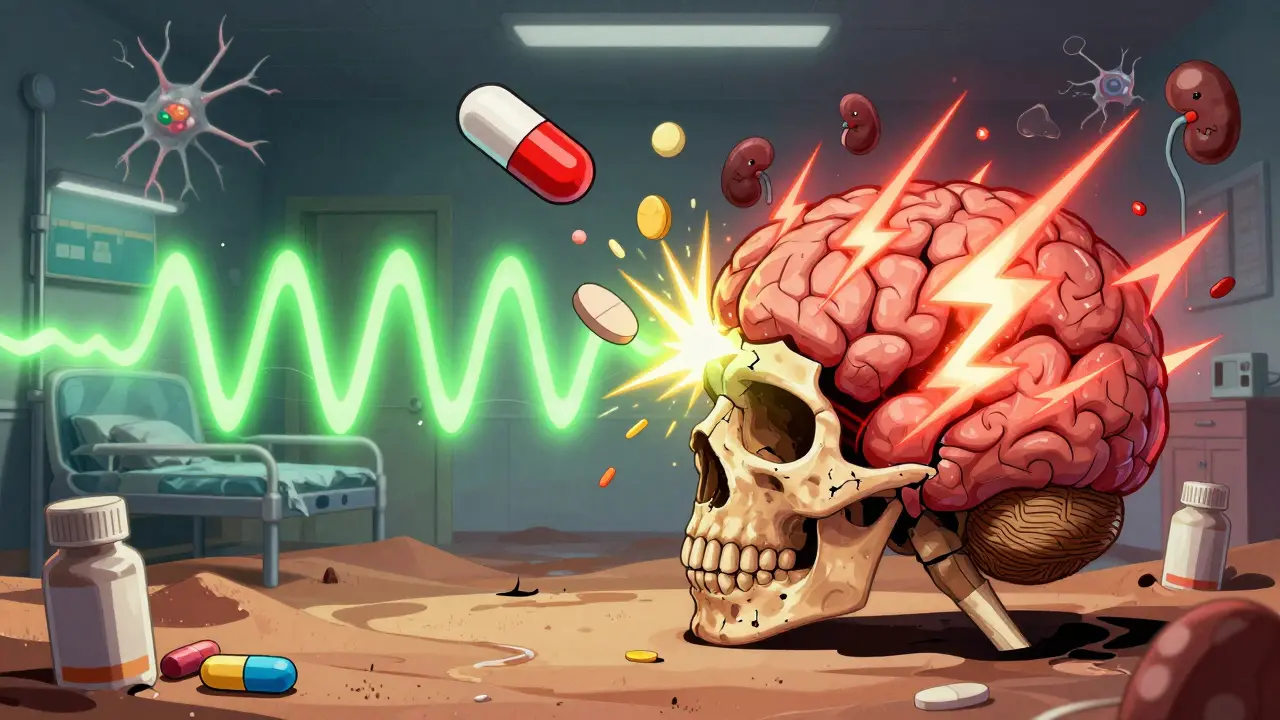
Fluoroquinolones don’t just target bacteria-they can cross the blood-brain barrier and interfere with brain chemistry. They block GABA receptors (which calm nerve activity) and overstimulate NMDA receptors (which excite nerves). This imbalance can trigger seizures, confusion, psychosis, hallucinations, and even delirium.
Levofloxacin is especially linked to seizures and confusion. Ciprofloxacin is notorious for causing mental fogginess. Even ofloxacin, which usually has fewer neurological side effects, can become dangerous when combined with NSAIDs.
NSAIDs alone can cause dizziness (in 5-7% of users) and headaches (in 10-15%). Rarely, they trigger aseptic meningitis-an inflammation of the brain’s protective membranes that mimics infection. But when NSAIDs are taken with fluoroquinolones, especially in people with kidney problems, the risk of severe neurological reactions rises sharply.
Patients with pre-existing conditions like epilepsy, Parkinson’s, or depression are at even higher risk. One UK case reported in the Yellow Card system described a 58-year-old man who developed severe peripheral neuropathy and acute kidney injury after taking ciprofloxacin and ibuprofen together for a UTI. Eighteen months later, he still had chronic nerve pain and reduced kidney function.
Real-World Impact: The Hidden Epidemic
Behind the statistics are real people. The Fluoroquinolone Effects Research Foundation surveyed 1,245 patients who took fluoroquinolones. Of them, 78% reported symptoms lasting more than six months. Thirty-two percent said they were permanently disabled-unable to work, walk normally, or think clearly.
Online communities like Reddit’s r/FQAntibioticDamage have over 14,500 members sharing stories of tendon ruptures, burning nerves, brain fog, and chronic fatigue after what was supposed to be a simple course of antibiotics. Many of them were also taking NSAIDs for pain during treatment.
The economic cost is staggering. In the U.S. alone, fluoroquinolone-related adverse events cost the healthcare system $1.8 billion annually. Kidney complications make up 37% of that total. Neurological damage accounts for nearly 30%.

What Should You Do?
Here’s the hard truth: fluoroquinolones are no longer first-line treatments for most infections. Guidelines now say they should only be used when no safer alternative exists.
If you’re being prescribed a fluoroquinolone:
- Ask if a different antibiotic will work-like nitrofurantoin for UTIs, or amoxicillin-clavulanate for sinus or lung infections.
- If you need pain relief, avoid NSAIDs. Use acetaminophen (paracetamol) instead. It doesn’t affect kidney blood flow or interfere with fluoroquinolone clearance.
- If you’re over 60, have kidney disease, diabetes, or a history of seizures, insist on alternatives. These are high-risk groups.
- Never take fluoroquinolones and NSAIDs together unless absolutely necessary-and even then, only under close monitoring.
Doctors are slowly catching on. IQVIA data shows U.S. fluoroquinolone prescriptions dropped 22% between 2015 and 2022. Levofloxacin prescriptions fell by 34% after FDA warnings. But in countries like India and China, they’re still widely used-often without proper screening.
What’s Changing?
Regulators are tightening restrictions. In 2019, the UK’s MHRA required doctors to consider other treatments first. The EMA now says fluoroquinolones should only be used for infections with no other options. In 2023, the FDA announced it would update labels to include stronger warnings about mitochondrial damage-a newly understood mechanism that may explain why side effects last for years.
Even the FDA’s own data shows fluoroquinolones can cause long-term harm to mitochondria, the energy factories in your cells. That’s why symptoms like fatigue, nerve pain, and muscle weakness can persist for months or years-even after stopping the drug.
Final Thoughts
Fluoroquinolones and NSAIDs might seem like harmless partners in treatment. But when they’re combined, they create a perfect storm for your kidneys and brain. The risks aren’t theoretical-they’re documented, real, and growing.
If you’re currently taking one of these drugs, don’t panic. But do talk to your doctor. Ask: Is this the safest option? Are there alternatives? Should I avoid NSAIDs while on this antibiotic?
Every prescription carries risk. But some risks are avoidable. And in this case, avoiding the combination could mean the difference between recovery-and permanent damage.





12 Comments
lol so now i'm supposed to believe every drug is a death trap? next they'll say water causes kidney failure if you drink it while taking tylenol. this whole post is fearmongering with footnotes. i took cipro and ibuprofen for a UTI last year and didn't turn into a zombie. stop scaring people with jargon and actual data./p>
I just want to say... thank you. This is the kind of info that gets buried under marketing and lazy prescribing. I had a friend who ended up in the hospital after cipro + naproxen for a sinus infection. She’s still got nerve pain two years later. No one warned her. No one even asked if she was taking OTC meds. We need better communication, not just more warnings on labels./p>
This is so important 🙏 I’m so glad someone laid this out clearly. My mom got hit with AKI after a simple UTI treatment combo-she’s 68 and had no idea. Now she only uses acetaminophen and avoids fluoroquinolones like the plague. Doctors need to stop treating patients like robots with preset protocols. We’re not lab rats./p>
I knew it. I KNEW IT. The pharmaceutical industry has been poisoning us for decades. They don't want you to know this because it's cheaper to keep prescribing than to admit they made a mistake. And don't even get me started on the FDA... they're in bed with Big Pharma. I read a whistleblower report once... they suppressed studies on mitochondrial damage for years. It's all connected. Vaccines, fluoroquinolones, glyphosate... it's the same playbook. Wake up./p>
I read the whole thing. Didn’t say anything. Just stared at my ibuprofen bottle. Wondered if I’ve been slowly killing my kidneys for years. Probably. Probably have./p>
Oh wow. A post that actually says something useful instead of ‘just take ibuprofen bro’? Radical. I’m impressed. Now if only doctors would read it. But hey, at least we have Reddit to fill the gap they left./p>
so like... if i took cipro and advil for a week and now i can't stop my leg from twitching... is that the 'permanent damage' or just me being a hypochondriac? just asking for a friend. who is me./p>
The real tragedy here isn't the drug interaction-it's the epistemological collapse of modern medicine. We've replaced clinical judgment with algorithmic prescribing, and patient autonomy with passive compliance. The fluoroquinolone-NSAID synergy isn't just pharmacological; it's a symptom of a system that treats bodies as disposable variables in a cost-benefit equation. Mitochondrial toxicity? That's not an adverse event-it's the body screaming that we've forgotten what healing even means./p>
Fascinating. The pharmacokinetic overlap here is textbook-both agents are renally excreted, and NSAID-induced vasoconstriction reduces GFR, which in turn elevates FQ plasma concentrations. The GABA/NMDA modulation is even more concerning-levofloxacin’s affinity for NMDA receptors combined with prostaglandin suppression creates a neuroexcitotoxic cascade. We need biomarkers for early detection, not just post-hoc warnings./p>
I took cipro once. Felt like my brain was full of cotton. I didn’t know why. Now I do. Never again./p>
I'm a pharmacist in Ohio. This is 100% real. I've seen it. I've had patients come in with tendon pain so bad they couldn't hold a coffee cup. I tell everyone: if you're over 50 or have any kidney history, skip the FQs. Use amoxicillin. Use doxycycline. They work. And if you need pain relief? Tylenol. Always. I wish I could hand this post to every doc in the county./p>
So you're telling me I shouldn't have taken naproxen with cipro for my kidney infection? Wow. I'm just glad I didn't end up in a wheelchair. Guess I'm lucky. Or maybe just stubborn. Either way, next time I'm asking for a second opinion. And I'm telling everyone I know. This needs to be common knowledge, not a Reddit deep dive./p>