
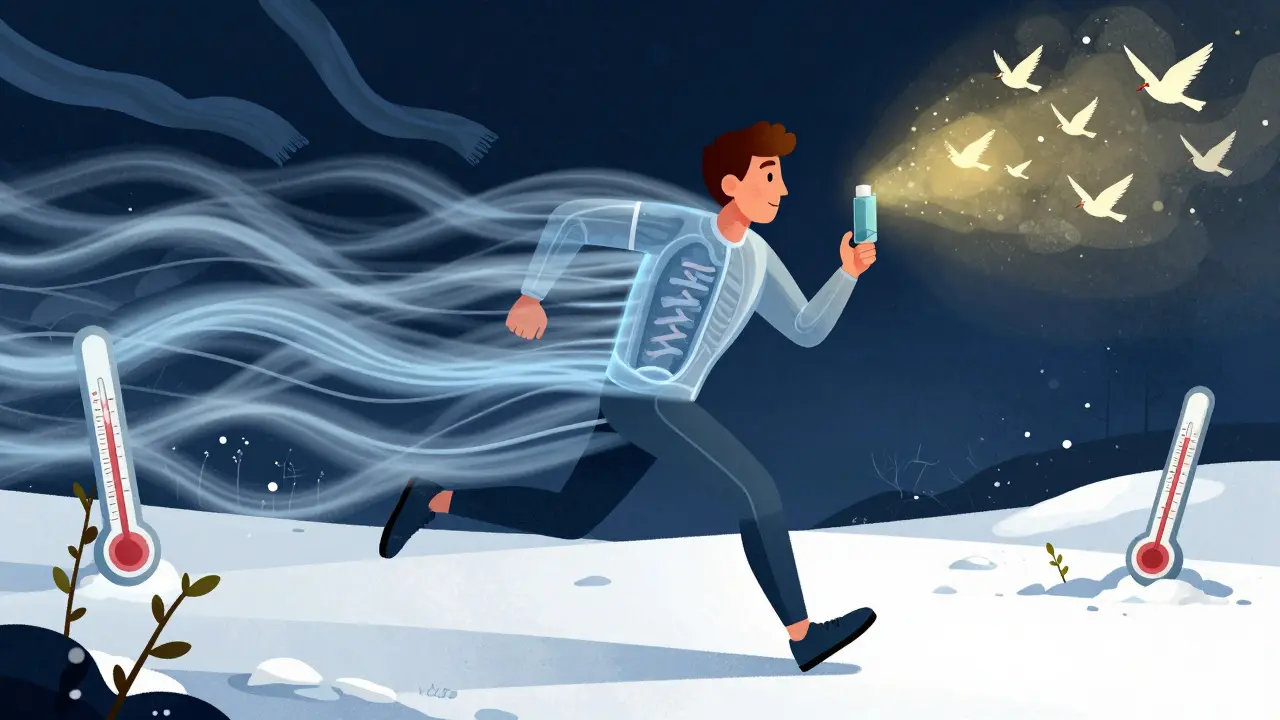
What Exactly Is Exercise-Induced Bronchoconstriction?
When you run, swim, or even briskly walk in cold air and suddenly feel like you can’t catch your breath-coughing, wheezing, chest tightness-it’s not just being out of shape. It’s exercise-induced bronchoconstriction (EIB). This isn’t the same as having chronic asthma, though many people with asthma get EIB. Up to 30% of people without asthma also experience it, especially in cold, dry climates like Melbourne winters. The problem? Your airways narrow after exercise because you’re breathing fast and shallow, losing heat and moisture from your lungs. That triggers inflammation and muscle tightening around the bronchial tubes.
It’s not just uncomfortable-it’s dangerous if ignored. People who avoid exercise because of EIB are 2.3 times more likely to become overweight and lose cardiovascular fitness over time. The good news? With the right steps, 95% of people can exercise without limits.
How Do You Know It’s EIB and Not Just Being Out of Shape?
Normal fatigue after a hard workout feels like tired muscles and heavy breathing that fades within minutes. EIB is different. Symptoms usually start 5-10 minutes after stopping exercise and peak 10-15 minutes later. You might feel:
- Coughing that lasts longer than 30 minutes
- Wheezing or a whistling sound when breathing out
- Chest tightness or pressure
- Shortness of breath that doesn’t improve with rest
Doctors diagnose EIB with a simple test: you exercise on a treadmill or bike at 80-90% of your max heart rate for 6-8 minutes, then your lung function is measured with a spirometer. If your FEV1 (the amount of air you can forcefully exhale in one second) drops by 10% or more after exercise, it’s EIB. No test? Don’t guess. See a GP or respiratory specialist.
Non-Medical Ways to Prevent EIB
Before you reach for your inhaler, try these proven, drug-free strategies. They work-especially when combined.
- Warm up properly. Do 10-15 minutes of moderate activity-like brisk walking or light cycling-before your main workout. This triggers a protective "refractory period" that can block bronchoconstriction for up to two hours. Follow it with a 5-minute rest before starting intense activity.
- Avoid cold, dry air. If the temperature is below 10°C (50°F) and humidity is under 40%, your risk of EIB jumps by 73%. Exercise indoors when possible. If you must go outside, cover your nose and mouth with a scarf or a heat-exchange mask. (Note: Most fitness masks like the Nike E+ or Respro® only reduce symptoms by 42%. They’re not a replacement for medication.)
- Choose your sport wisely. Sports with short bursts of effort-like baseball, football, or sprinting-trigger EIB in only 22% of people. Endurance sports like cross-country skiing, ice hockey, or long-distance running trigger it in up to 85%. You don’t have to quit your favorite sport, but know your triggers.
- Improve your fitness. Every 1-MET increase in your VO2 max (a measure of aerobic fitness) reduces EIB severity by 12%. Regular cardio makes your airways more resilient.
- Check air quality. Pollen counts over 9.7 grains/m³ or an air quality index above 50 can worsen symptoms. Use apps like AirVisual to plan outdoor workouts.
How to Use Your Inhaler Correctly (It’s Not as Simple as You Think)
Albuterol (salbutamol) is the go-to quick-relief inhaler for EIB. But here’s the truth: 63% of people who say their inhaler "doesn’t work" are actually using it wrong. The medicine isn’t failing-you are.
Here’s how to do it right:
- Shake the inhaler well. At least 5 shakes before each puff.
- Breathe out fully. Empty your lungs before inhaling.
- Press the inhaler and breathe in slowly. Start breathing in just as you press down. Don’t spray and then inhale-timing matters.
- Hold your breath for 10 seconds. This lets the medicine settle in your airways. It increases lung deposition by 30%.
- Wait 30 seconds between puffs. If you need two puffs, don’t rush. Wait at least 30 seconds before the second puff.
And here’s the biggest mistake: using the inhaler without a spacer. A spacer is a plastic tube that attaches to your inhaler. It holds the medicine so you can breathe it in slowly. Without it, up to 80% of the dose hits your throat and mouth. With a spacer, 70% more medicine reaches your lungs. Buy one. Use it every time.
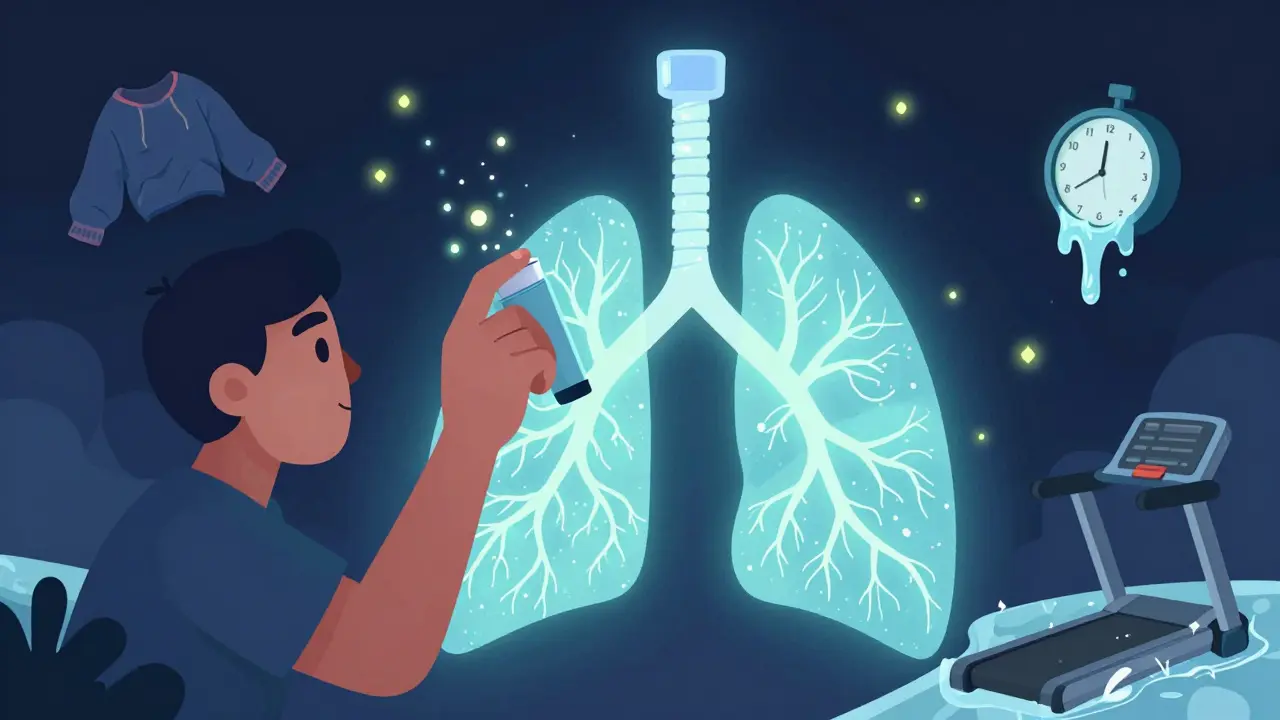
When and How Much to Use Your Inhaler
Timing is everything. Albuterol should be taken 5 to 20 minutes before exercise. Taking it too early? It wears off. Too late? It won’t have time to work. One puff (90 mcg) is often enough, but most people take two puffs for full protection.
Its effect lasts 2-4 hours, so if you’re doing multiple workouts in a day, you can re-dose before each session. But don’t use it more than 8 puffs in 24 hours unless directed by a doctor.
If you find yourself needing your rescue inhaler more than twice a week for EIB, you’re not just having bad days-you’re having uncontrolled inflammation. That’s when you need daily controller meds.
What If Your Inhaler Isn’t Enough?
About 35% of people still get symptoms even with albuterol before exercise. That’s not your fault. It means your airways are inflamed underneath.
Doctors may add one of these daily medications:
- Inhaled corticosteroids (ICS) like fluticasone (200-400 mcg daily). These reduce inflammation over time. They take 1-2 weeks to show full effect, but they cut EIB symptoms by 50-60%.
- Leukotriene receptor antagonists (LTRAs) like montelukast (10mg daily). These block chemical triggers of airway narrowing. They’re taken once a day, even on non-exercise days. They help about 30-40% of users.
- Combination therapy. Using albuterol before exercise plus daily ICS reduces symptom frequency by 78%, compared to 55% with albuterol alone.
Some people wonder about supplements. Vitamin C (500mg daily) reduced symptoms by 48% in people with low baseline levels. Omega-3s (2-4g daily) cut rescue inhaler use by 31% in one study. But the Mayo Clinic says there’s not enough proof to recommend them routinely. Don’t skip your prescribed meds for supplements.
What Athletes and Competitive Sport Participants Should Know
If you’re an athlete, you’re not alone. Up to 90% of elite winter sports athletes have EIB. The good news? The International Olympic Committee now allows all EIB medications without needing special exemptions. You can use your inhaler legally.
But here’s the catch: some athletes overuse albuterol thinking it boosts performance. That’s risky. Albuterol doesn’t make you stronger-it just keeps your airways open. Using it without EIB can cause heart palpitations, tremors, and even dangerous electrolyte imbalances.
Smart athletes use a written action plan. They track symptoms, inhaler use, and performance. Some now use smart inhalers like Propeller Health, which connect to your phone and remind you to use your inhaler. In pilot studies, these devices improved adherence by 47%.

How to Store Your Inhaler and Spacer
It’s easy to forget: your inhaler isn’t magic if it’s cold or old.
- Store it at room temperature (20-25°C). Below 10°C, the propellant loses power and only delivers 60% of the dose.
- Replace your spacer every 6 months. Plastic cracks and static builds up after a year, cutting efficiency by 25%.
- Don’t leave your inhaler in your car or gym bag in winter. That’s how it gets ruined.
Why So Many People Still Struggle With EIB
Despite all the science, 41% of teens with EIB are undiagnosed. Why? Because they think it’s just "being out of shape." Parents and coaches often dismiss coughing during gym class as laziness. That’s a mistake.
Left untreated, EIB leads to a cycle: fear of symptoms → avoid exercise → weight gain → worse fitness → more symptoms. It’s not just about lungs-it’s about your whole health.
The fix? Education. If you or your child has unexplained coughing or breathlessness after exercise, get tested. Don’t wait. You don’t need to be an elite athlete to deserve to move without pain.
What’s Next for EIB Treatment?
Researchers are looking at new tools. One promising test measures fractional exhaled nitric oxide (FeNO). If your FeNO level is above 25 ppb, you’re likely to respond well to inhaled steroids. This could mean personalized treatment-no more guessing.
Biologics, which target specific immune pathways, are being tested for severe, hard-to-treat cases. And smart inhalers are getting smarter-some now track your breathing patterns and alert you to worsening control.
But the biggest breakthrough isn’t a new drug. It’s realizing that EIB isn’t a barrier to movement. It’s a condition you manage-so you can live fully.






14 Comments
man i thought i was just out of shape till i read this. been coughing after every run for years. thought it was just because i smoke like 3 cigs a day (ok fine 10) but turns out i got EIB. now i use a spacer and warm up like a nerd. best decision ever. also my scarf works better than that nike mask lol/p>
This is why America needs to stop coddling people. If you can't breathe while running you shouldn't be running. Just walk. Or don't move at all. Stop treating every minor discomfort like a medical crisis./p>
OMG I KNEW IT 😭 I've been using my inhaler like a vape pen and now I feel like a dumbass. Also why is everyone in this thread acting like they just discovered oxygen? I've been using spacers since 2017. 🙄❤️🩹/p>
Great breakdown. I'm from India and we don't talk about this much. I used to think wheezing after gym was normal. Now I use albuterol 15 mins before workout and my VO2 max improved 18% in 3 months. Also, vitamin C helps if you're deficient. Don't skip the spacer. It's not optional./p>
I'm a physio and I see this ALL the time. People think they're lazy. Nope. They've got EIB. I always tell my patients: warm up, use a scarf in winter, and GET A SPACER. Also, don't store your inhaler in your car in December. I've seen so many ruined inhalers. So easy to fix!/p>
I used to think my asthma was just 'bad lungs' until I learned about the refractory period. Now I do 12 mins of light cycling before every run and boom - no coughing. Also, the 'hold breath for 10 seconds' thing? Total game changer. I used to just puff and walk away. Dumb./p>
I'm from California and we don't have cold weather here so I didn't think this applied to me. Turns out my pollen allergies make EIB worse. AirVisual app saved my life. Also, why are we talking about Canada? We don't need to hear about your snow./p>
I'm from Canada and yes we have cold winters and yes I ski and yes I wheeze like a broken accordion. But I learned the hard way - no scarf, no spacer, no mercy. Now I use a heat-exchange mask and a spacer and I'm still out there. You don't have to give up your sport. Just get smart./p>
I'm a respiratory specialist and I'm tired of people treating this like a lifestyle hack. This isn't yoga. It's a medical condition. If you're using supplements instead of ICS, you're endangering your lungs. Stop listening to Instagram influencers and see a doctor./p>
I used to avoid running for years because I thought I was weak. Then I got tested and it was EIB. Now I run 5k every morning. I use my inhaler before I leave the house. I keep my spacer next to my toothbrush. Small habits. Big difference./p>
so wait so you just breathe in and hold for 10 seconds and it works better how come no one told me this before i thought you just spray and run/p>
The clinical data presented here aligns with current ATS/ERS guidelines on EIB management. The 10% FEV1 drop threshold remains validated. However, the emphasis on spacer use is particularly critical - suboptimal inhaler technique is the leading cause of therapeutic failure in primary care settings. Additionally, the refractory period phenomenon is well-documented in the Journal of Allergy and Clinical Immunology, 2021./p>
this made me think about how we treat our bodies like machines that should just work. but they’re not. they’re alive. messy. fragile. and beautiful. if your lungs tighten when you move hard - that’s not weakness. it’s your body saying ‘hey, i need help.’ and asking for help? that’s the bravest thing you can do. you’re not broken. you’re just human. and humans deserve to move without pain. 🌱❤️/p>
spacer. now. no excuses./p>