
REMS Program Checker
Enter a medication name to see if it's part of the FDA's REMS (Risk Evaluation and Mitigation Strategies) program. REMS programs are required for drugs with serious safety risks that can't be managed through standard labeling alone.
Required Safety Measures:
When a drug can save your life but also carry a serious, even deadly, risk - like causing birth defects, organ failure, or sudden loss of consciousness - how do you make sure it’s used safely? That’s where REMS programs come in. These aren’t just paperwork. They’re real, enforced systems put in place by the U.S. Food and Drug Administration (FDA) to control dangerous side effects of certain prescription drugs. If you’ve ever waited days to fill a prescription for acne medication or had your doctor jump through hoops to prescribe an antipsychotic injection, you’ve experienced a REMS program firsthand.
What Exactly Is a REMS Program?
REMS stands for Risk Evaluation and Mitigation Strategies. It’s a formal requirement created by the FDA in 2007 under the Food and Drug Administration Amendments Act (FDAAA). The goal isn’t to block access to a drug - it’s to make sure the benefits clearly outweigh the risks. Not every medication needs this. In fact, about 95% of FDA-approved drugs are managed with standard labeling and routine safety monitoring. REMS is reserved for the remaining 5% that carry severe, life-threatening dangers.
Think of it this way: if a drug can cause irreversible harm, like thalidomide causing birth defects or clozapine wiping out white blood cells, the FDA doesn’t just say “read the label.” It builds a whole system around it. These systems are customized. One drug might need special training for doctors. Another might require patients to sign up in a registry. Some even force pharmacies to verify your identity and blood test results before handing out the pills.
How REMS Works: The Three Core Elements
REMS programs aren’t one-size-fits-all. They’re built around three main tools, depending on the drug’s specific risks:
- Medication Guides - These are printed handouts given to patients explaining the risks in plain language. Think of them as a safety cheat sheet.
- Communication Plans - These are directed at doctors and pharmacists. They include emails, training modules, or alerts to make sure providers know the latest safety info.
- Elements to Assure Safe Use (ETASU) - This is the heavy-duty part. It’s where things get strict. ETASU might require:
- Doctors to get certified before prescribing
- Patients to enroll in a national registry
- Only certain pharmacies to dispense the drug
- Lab tests before and during treatment
- Observation periods after injection
Take Zyprexa Relprevv, an injectable antipsychotic. Because it can cause sudden sedation or delirium within minutes after injection, the FDA requires it to be given only in certified clinics. Patients must be watched for at least three hours afterward. No exceptions. That’s ETASU in action.
Real-World Examples: What REMS Looks Like in Practice
Some of the most well-known REMS programs are also the most frustrating for patients and providers:
- iPLEDGE for isotretinoin (Accutane) - This drug prevents severe acne but causes serious birth defects. The REMS requires women of childbearing age to take two negative pregnancy tests, use two forms of birth control, and complete monthly counseling. Pharmacies must verify all of this online before dispensing. Many patients wait 3-7 days just to get their prescription filled.
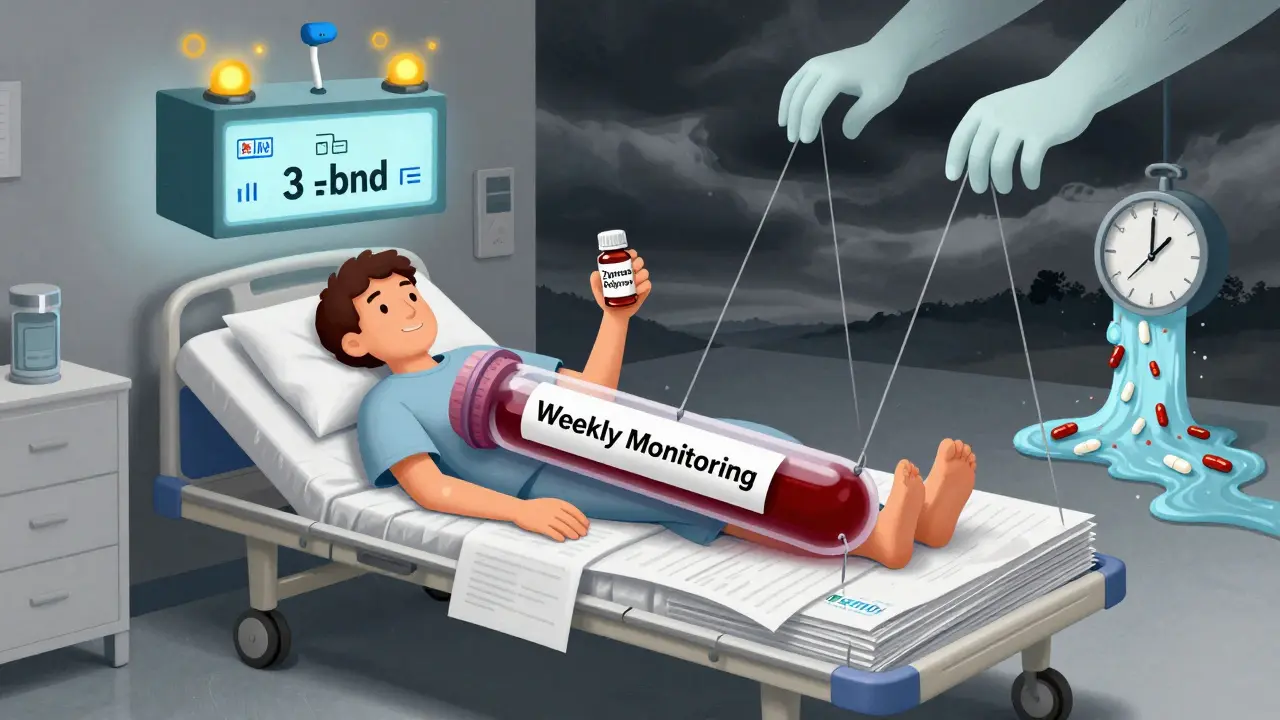
- Clozapine REMS - Used for treatment-resistant schizophrenia, clozapine can destroy white blood cells. Patients must get weekly blood tests for the first six months. Pharmacists must check each result before filling the prescription. One hospital pharmacist told Pharmacy Times they spend 2-5 extra hours per week just managing clozapine paperwork.
- TIRF REMS for opioid painkillers - This one requires prescribers to complete a training course on safe opioid use. But critics say it doesn’t stop misuse - it just delays care. A 2021 Senate hearing found many doctors didn’t even complete the training, and patients still got addicted.
These aren’t hypotheticals. They’re daily realities in clinics and pharmacies across the U.S.
Who Pays for REMS - And Why It Matters
The FDA doesn’t run these programs. The drug companies do. Pharmaceutical manufacturers are legally responsible for designing, funding, and managing their own REMS. That means billions of dollars go into building websites, training portals, registries, and compliance teams.
According to PhRMA, the industry spends about $1.2 billion per year on REMS. Some programs cost $500,000. Others - like those with patient registries and mandatory lab tracking - cost over $15 million annually. And it’s not just about money. It’s about time. A 2022 survey found that community pharmacists spend 15-20 minutes per REMS prescription just verifying eligibility. That’s time taken away from other patients.
And when companies mess up? The FDA hits them hard. In 2022, the agency issued 17 warning letters for REMS failures. One generic drugmaker paid a $2.1 million fine for not properly tracking clozapine blood tests.
The Access Problem: When Safety Slows Down Care
Here’s the uncomfortable truth: REMS programs can delay life-saving treatment. A 2019 study in JAMA Internal Medicine found that patients waiting for REMS-required drugs took an average of 5.4 days longer to get their first prescription. For rare disease patients who travel hundreds of miles for specialist care, that delay can mean hospitalization, worsening symptoms, or even death.
A 2022 survey of 1,250 U.S. doctors by the American Medical Association found that 68% saw delays in starting REMS drugs. Of those, 42% said it hurt their patients. One oncologist reported a patient with leukemia died because the REMS system couldn’t verify her lab results in time.
And it’s not just doctors. Pharmacists are drowning in paperwork. Reddit threads from pharmacy techs describe iPLEDGE as a “nightmare.” One user wrote: “I spent three hours on the phone with a patient’s dermatologist because the portal said her pregnancy test was expired - but she had a new one. The system didn’t update.”
Is REMS Working? The FDA’s Own Doubts
The FDA knows REMS isn’t perfect. In fact, they admit it.
Dr. Janet Woodcock, former acting FDA commissioner, said in 2022: “Not all REMS programs have been equally effective.” She added that the agency is actively trying to cut unnecessary barriers.
That’s why big changes are happening:
- In August 2023, the FDA ended the REMS for thalidomide - after 20 years - because better education and alternative controls made the program obsolete.
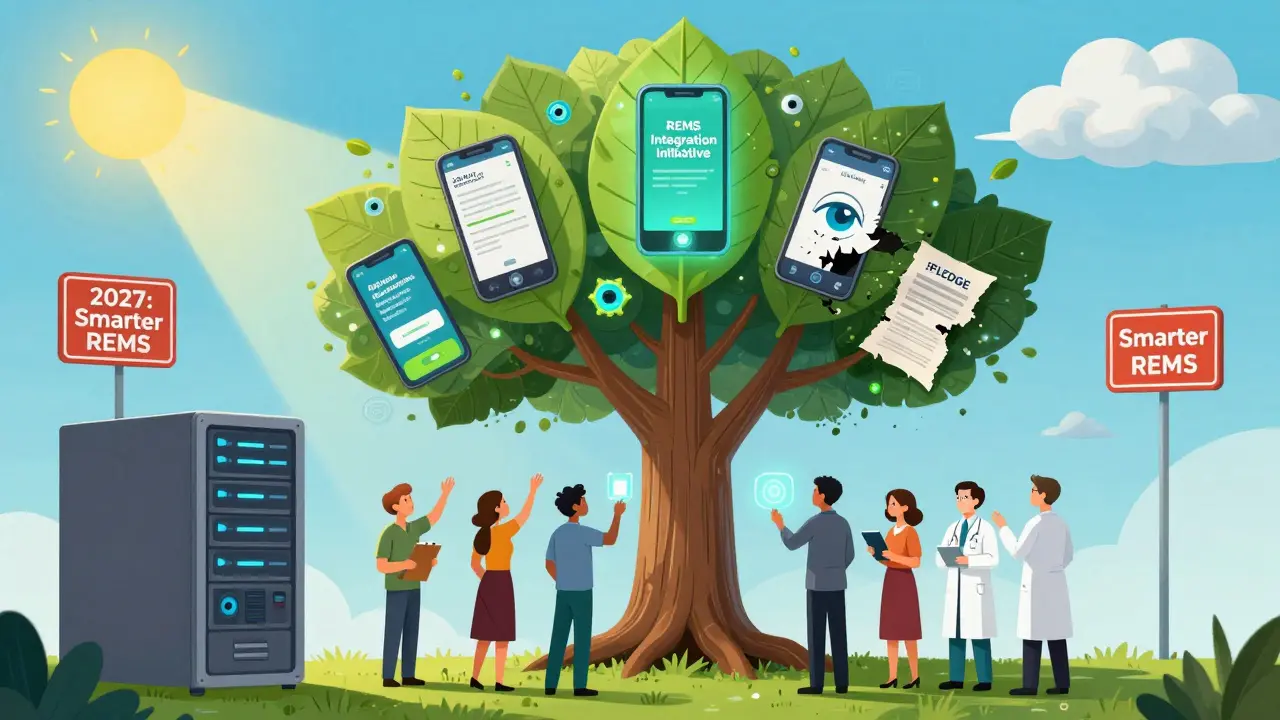
- The FDA launched the REMS Integration Initiative, which by late 2023 had standardized 22 of 78 REMS programs onto one platform. This cuts down on duplicate logins and confusing portals.
- New REMS proposals now require sponsors to prove the program won’t unfairly block access - especially for rural or low-income patients.
- Pilot programs are testing smartphone apps to monitor patients on blood thinners in real time. If it works, it could replace in-person visits and lab tests.
Still, a joint FDA-PhRMA report from September 2023 found that 63% of REMS programs have no way to measure whether they actually improve safety. That’s a red flag. If we’re spending millions and delaying care, we need to know it’s working.
The Future of REMS: Digital, Smarter, Simpler
By 2027, Evaluate Pharma predicts 45% of new cancer drugs will need REMS - up from 38% today. That’s because targeted therapies are more powerful… and more dangerous.
The future of REMS isn’t more paperwork. It’s better tech:
- Electronic health records (EHRs) that auto-send lab results to REMS portals
- Mobile apps that remind patients to take tests or report side effects
- Blockchain systems to securely track patient enrollment
- AI that flags high-risk prescribing patterns before they happen
The goal? Keep patients safe without making them wait. The FDA’s 2024-2026 plan is clear: modernize REMS using digital tools. If successful, the next generation of REMS won’t feel like a bureaucracy. It’ll feel like care.
What You Need to Know
If you’re a patient:
- Ask your doctor if your drug has a REMS program
- Know what’s required - blood tests? Registration? Training?
- Start the process early. REMS delays are real.
If you’re a provider:
- Use the FDA’s REMS Dashboard to find current requirements
- Don’t assume the pharmacy will handle everything - verify your certification
- Push back if a REMS requirement seems outdated or unnecessary
REMS programs aren’t perfect. But they exist for a reason. They’re the price we pay for letting powerful drugs into the hands of people who need them - even when those drugs can hurt.
What drugs require a REMS program?
REMS programs apply to prescription drugs with serious safety risks that can’t be managed with standard labeling. Examples include isotretinoin (for acne), clozapine (for schizophrenia), thalidomide (for cancer and leprosy), Zyprexa Relprevv (an injectable antipsychotic), and certain extended-release opioids. As of October 2023, the FDA had 78 active REMS programs covering about 150 medications, with oncology drugs making up the largest group.
Who is responsible for running a REMS program?
The pharmaceutical company that makes the drug is legally required to design, fund, and manage the REMS program. The FDA sets the requirements and monitors compliance, but the company handles everything from training doctors to maintaining patient registries and online verification systems. This can cost between $500,000 and over $15 million per program annually.
Can a REMS program be removed?
Yes. The FDA can remove or modify a REMS program if new evidence shows the risks are better managed by other means. In August 2023, the FDA ended the REMS for thalidomide after 20 years, because improved education and alternative safety measures made the program unnecessary. This is rare but shows that REMS isn’t permanent - it’s meant to evolve with science.
Why do REMS programs cause delays in getting medication?
REMS often requires multiple steps: prescriber certification, patient registration, lab test verification, and pharmacy portal checks. For example, the iPLEDGE program for isotretinoin requires two negative pregnancy tests, birth control confirmation, and monthly counseling - all verified online. If one step fails or the system is down, the prescription can’t be filled. On average, REMS drugs take 5.4 days longer to reach patients than non-REMS drugs.
How is the FDA improving REMS programs?
The FDA is working to make REMS less burdensome. They’ve launched the REMS Integration Initiative to standardize 22 programs onto one digital platform. They now require sponsors to prove their program won’t block access, especially for underserved patients. Pilot programs are testing smartphone apps for real-time monitoring, and the FDA has begun sunsetting outdated REMS - like the one for thalidomide. The goal is to keep patients safe without creating unnecessary delays.
REMS programs are a necessary part of modern medicine - but they’re not done evolving. The real test isn’t whether they keep drugs safe. It’s whether they can do it without making patients wait.

15 Comments
REMS is just corporate bureaucracy dressed up as patient safety. They charge drug companies millions, then those costs get passed to us in higher prices. And for what? To make pharmacists spend 20 minutes per script verifying paperwork? We’re not saving lives here-we’re just making healthcare slower and more expensive.
/p>Who the hell thought up this system I mean really like they want to save people but then make it harder to get the medicine that saves them its like locking the door then yelling at people for not coming in/p>
Interesting read. In India, we don’t have anything like REMS, but we do have strict prescription rules for opioids and psychotropics. Still, I’ve seen patients wait weeks for meds because pharmacies are understaffed and paperwork is messy. Maybe tech can help both places?
/p>As a pharmacist for 12 years, I’ve seen REMS from both sides. The system is broken, but the intent is good. We need better EHR integration-not more forms. One portal. One login. Auto-sync labs. That’s all it takes. The FDA’s 2024 digital push? Finally something worth supporting.
/p>i mean like the whole thing is sooo over the top right like why do we need a whole registry for acne medicine?? its not like isotretinoin is cocaine or something??/p>
Let’s not pretend REMS is about safety. It’s about liability. Pharma companies created these programs to shield themselves from lawsuits, not to protect patients. And the FDA? They’re happy to outsource regulation to corporations who have zero incentive to simplify anything. The 2022 Senate hearing proved it: 60% of prescribers didn’t complete training. Yet nothing changed. That’s not oversight. That’s complicity.
/p>I get that REMS exists for good reasons-thalidomide, clozapine, you name it-but the system is a relic. We’re in 2024. We have real-time EHRs, blockchain, AI-driven alerts. Why are we still relying on handwritten forms, expired pregnancy tests, and 3-hour observation windows? The FDA’s own report admits 63% of REMS programs have no measurable outcomes. That’s not just inefficient-that’s unethical. We’re sacrificing patient access on the altar of outdated protocols. And the worst part? The people who suffer most are the ones who can’t afford to wait five days for a prescription. Rural patients. Low-income families. People who don’t have time to call their dermatologist three times because the portal glitched again. This isn’t safety. This is systemic neglect wrapped in a lab coat.
/p>REMS is a government mind control program. Did you know the FDA works with Big Pharma to track every patient on these drugs? They’re building a national database to monitor who takes what, when, and why. That’s not safety-that’s surveillance. And don’t even get me started on how they use your blood test results to flag you for future meds. They’re preparing for the next phase of the Great Reset. You think this is about acne? Think again. This is step one.
/p>OMG YES I’M A PHARMACY TECH AND I’M SO OVER THIS 😭😭😭 I SPENT 4 HOURS TODAY ON IPLEDGE JUST BECAUSE A PATIENT’S PREGNANCY TEST WAS ‘EXPIRED’ BUT SHE HAD A NEW ONE AND THE PORTAL WAS DOWN AND HER DOCTOR’S EMAIL WASN’T WORKING AND I HAD TO CALL 3 DIFFERENT CLINICS AND ONE OF THEM THOUGHT I WAS A ROBOT 😭😭😭
/p>Been on clozapine for 8 years. REMS is annoying, sure-but it saved my life. My white cell count dropped once, and the system flagged it. I got treated before I got septic. I get the delays. I get the frustration. But if you’ve never had a psychotic episode, maybe don’t yell about how ‘unfair’ it is. The system’s flawed, but it’s not the enemy.
/p>You know what’s cool? The FDA’s new integration platform. I just got certified for my first REMS drug last week-did it all online in 12 minutes. No more 3-hour training videos. No more password resets. Just clean, simple, mobile-friendly. This is the future. Let’s not throw the baby out with the bathwater. The system’s evolving. We just need to help it along.
/p>Let’s be real: REMS isn’t about safety. It’s about control. The same people who told us opioids were ‘safe’ are now building these fortress-like systems to keep people from getting meds. Why? Because they’re scared of liability. And they’re using patients as pawns. The fact that a 22-year-old with acne has to jump through 7 hoops just to get a pill? That’s not medicine. That’s psychological torture. And don’t tell me ‘it’s for the babies’-because I’ve seen the stats. Most of these REMS programs have zero impact on birth defect rates. They just make life hell for women who already have enough to deal with.
/p>I waited 9 days for my Zyprexa. My psychiatrist cried. My insurance cried. The pharmacy cried. I almost died. This system is a joke./p>
Big Pharma spends $1.2B a year on REMS? Imagine what we could do with that money-free lab tests, telehealth for rural patients, real-time monitoring apps. Instead, we get portals that crash and doctors who don’t even finish training. The system’s broken. But it’s fixable. Let’s not give up. Let’s demand better.
/p>In India, we don't have REMS, but we have our own problems. Patients get fake medicines. Doctors prescribe without checking. So yes, REMS is frustrating-but if it stops bad drugs from being sold? Maybe it's worth it. We need structure, even if it's messy.
/p>