
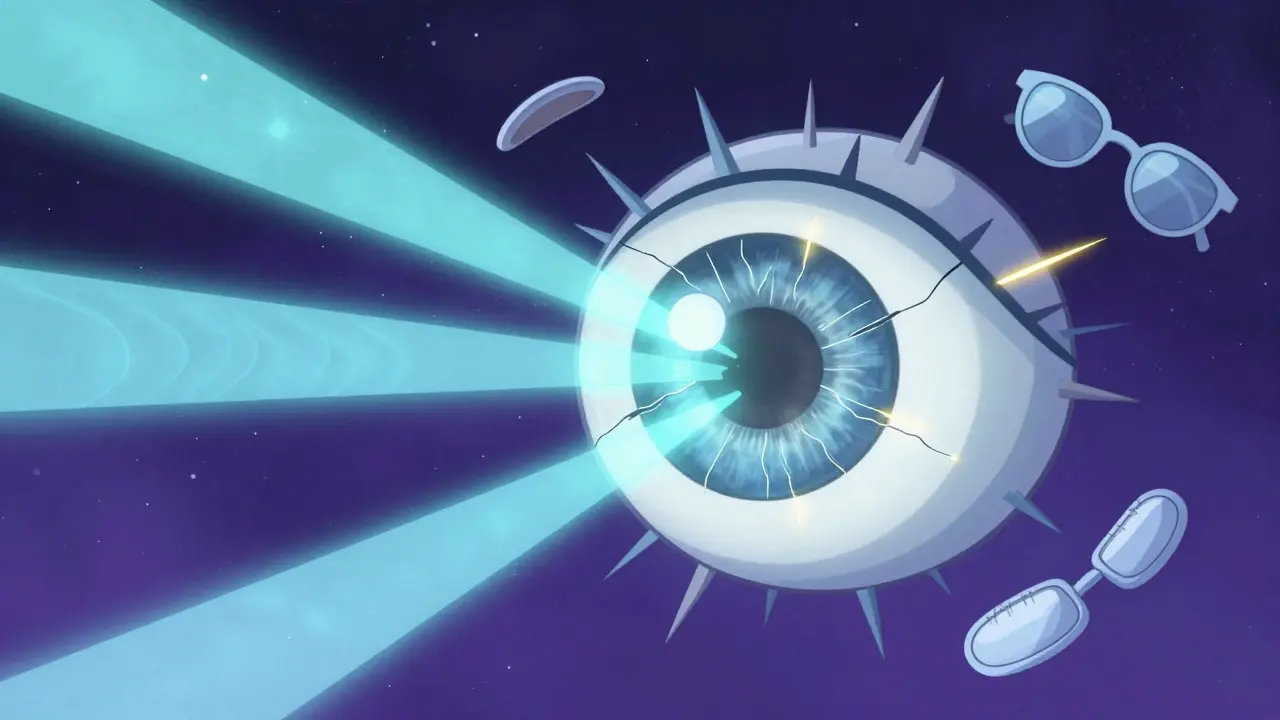
Blurry vision isn’t just annoying-it’s a sign your eye isn’t focusing light the way it should. This happens in three common ways: myopia (nearsightedness), hyperopia (farsightedness), and astigmatism. Together, they account for more than half of all vision problems in adults, and they’re getting more common every year. In places like Singapore and South Korea, up to 90% of young adults are nearsighted. Here’s what’s really going on-and how we fix it today.
What Causes Myopia, Hyperopia, and Astigmatism?
It all comes down to shape. Your eye works like a camera: light enters through the cornea and lens, then focuses on the retina at the back. If the eye is too long, too short, or unevenly curved, the light lands in the wrong spot. That’s when blur happens.
Myopia means you can see close things clearly but struggle with distance. It happens when your eyeball is longer than normal-usually over 24mm in adults-or your cornea curves too sharply (more than 43 diopters). Light focuses in front of the retina instead of on it. This usually starts around age 10 and gets worse through the teens. Kids who spend most of their time indoors or doing close-up work (screens, books) are more likely to develop it.
Hyperopia is the opposite. You see distance okay but struggle up close. It happens when your eyeball is too short (under 22mm) or your cornea is too flat (less than 40 diopters). Light focuses behind the retina. Many people are born with mild hyperopia, but it often doesn’t cause problems until later in life, especially after 40, when the lens loses flexibility.
Astigmatism is different. It’s not about length or shape alone-it’s about uneven curvature. Think of your cornea like a football instead of a basketball. That means light doesn’t focus at one point; it splits into multiple blurry points. This can mess up both near and far vision at the same time. About 30 to 60% of people have some level of astigmatism, even if they don’t notice it.
How Do You Correct These Problems?
The goal is simple: get light to focus exactly on the retina. Three main tools do this: glasses, contacts, and surgery.
Glasses are the oldest and safest option. They use lenses that bend light before it enters your eye to cancel out the error. For myopia, you need minus (-) lenses that spread light out. For hyperopia, you need plus (+) lenses that squeeze light together. Astigmatism needs a special cylinder-shaped lens with a specific angle (axis) to fix the uneven curve. Most people adjust to new glasses in a few days. Complex astigmatism prescriptions can take up to three weeks.
Contact lenses work the same way but sit directly on the eye. That gives a wider field of view and no frames to fog up or slide down. But they come with risks. About 3 to 4% of contact wearers get a serious eye infection called microbial keratitis each year. Daily disposables reduce this risk, but you still need to clean your hands and follow the schedule. Many users report discomfort after 8 hours, especially with extended wear.
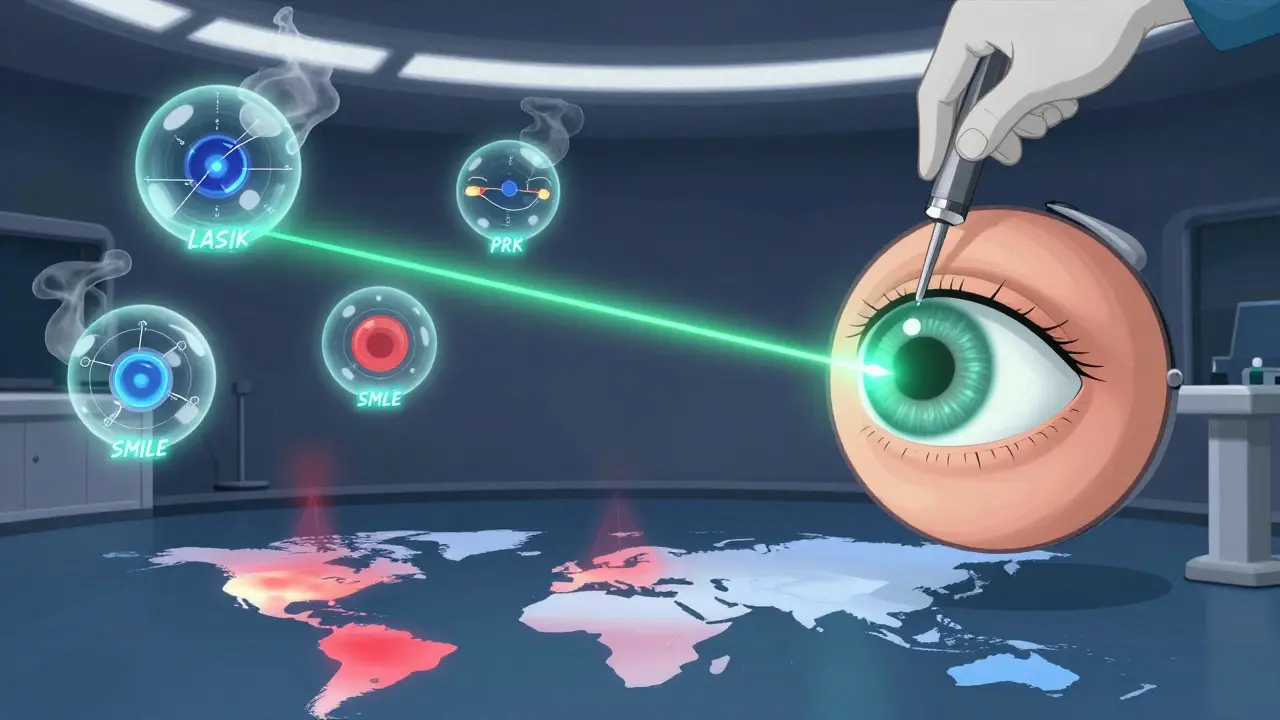
Surgery changes the shape of your cornea permanently. The most common is LASIK, approved by the FDA in 1995. A laser removes tiny bits of corneal tissue to reshape it. Another option is PRK, which removes the outer layer of the cornea first-better for thinner corneas. The newest is SMILE, which uses a single laser to create and remove a small lens-shaped piece of tissue inside the cornea. SMILE causes fewer dry eye issues than LASIK and is growing fast.
Modern lasers are incredibly precise. They can correct vision within 0.25 diopters. Wavefront-guided systems even map your eye’s unique imperfections, making them ideal for complex astigmatism.
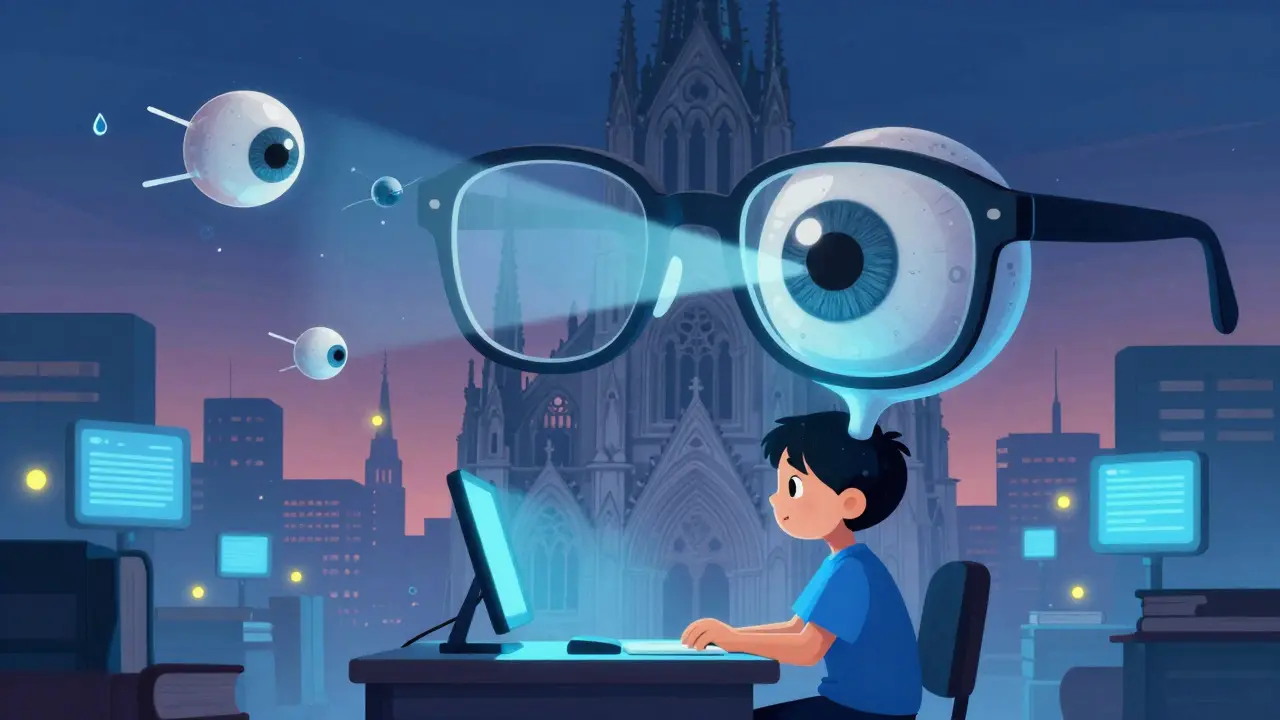
Which Method Is Best for You?
There’s no one-size-fits-all. Here’s how they stack up:
| Method | Pros | Cons | Best For |
|---|---|---|---|
| Glasses | Safe, immediate, no risk of infection | Can fog, slip, break, limit peripheral vision | Children, people with dry eyes, first-time users |
| Contact Lenses | Wider view, no frames, good for sports | Risk of infection, daily maintenance, discomfort after long wear | Active adults, cosmetic preference |
| LASIK/PRK | Permanent, no daily upkeep, high satisfaction | Costly, dry eyes (20-40%), night glare, not for everyone | Stable prescription, healthy corneas, age 18+ |
| SMILE | Less dry eye than LASIK, faster healing | Not available everywhere, limited for high prescriptions | People concerned about dry eyes, moderate myopia |
Satisfaction scores from 12,500 patient reviews show glasses at 4.2/5, contacts at 3.8/5, and LASIK at 4.5/5. Many say, “The clarity after LASIK was immediate.” But others say, “I couldn’t sleep without my contacts after 8 hours.”
Special Cases and Emerging Solutions
Not all refractive errors are treated the same. High myopia-worse than -6.00 diopters-carries real risks. It increases chances of retinal detachment and degeneration by 5 to 10 times. That’s why early correction matters.
For kids with progressing myopia, new methods are changing the game. Orthokeratology (Ortho-K) lenses are worn overnight to gently reshape the cornea. Studies show they slow myopia progression by 36 to 56%. Low-dose atropine eye drops (0.01% to 0.05%) are also proving effective, cutting progression by 50 to 80% over two years. These aren’t cures, but they help keep prescriptions from spiraling.
Children often resist glasses. But compliance jumps when they get to pick their frames. One study found kids who helped choose their glasses wore them 70% more than those who didn’t.
Astigmatism correction can be tricky. Some users report “distorted vision like looking through water” until the exact cylinder axis is dialed in. One Reddit user took three weeks to adjust to a 175-degree axis. That’s normal. Don’t give up if it feels off at first.
Who Should Avoid Surgery?
Not everyone is a candidate. To qualify for LASIK or SMILE, you need:
- A stable prescription for at least 12 months
- Corneal thickness over 500 microns
- Age 18 or older
- No active eye disease (like keratoconus)
People with autoimmune diseases, uncontrolled diabetes, or very thin corneas are usually ruled out. Pregnancy and hormonal shifts can also make your prescription unstable-wait until after.
And yes, there’s a global trend. The World Health Organization says 2.2 billion people have uncorrected vision problems, mostly from refractive errors. By 2050, half the world could be myopic. That’s not just a health issue-it’s a system issue. More people will need glasses, contacts, and surgeries. That’s why prevention and early detection matter more than ever.
What Should You Do Next?
If you’re having trouble seeing clearly, don’t wait. A simple eye exam can tell you exactly what’s going on. The American Academy of Ophthalmology recommends:
- Children: First exam at 6 months, again at 3 years, and before starting school
- Adults under 40: Every 2 years if no issues
- Adults over 40: Yearly, especially if you have diabetes or family history
Don’t assume blurry vision is just aging. It could be myopia, hyperopia, or astigmatism-and all of them are fixable.



10 Comments
I never realized how much myopia has skyrocketed until I started noticing it in my nieces and nephews. My 12-year-old nephew got his first pair at 9, and now he’s at -4.5. It’s wild how screen time and indoor living are rewiring kids’ eyes. I’ve started forcing them outside for at least an hour a day-sunlight seems to help slow progression. My optometrist said natural light triggers dopamine in the retina, which might literally stop the eyeball from elongating. I wish more parents knew this. It’s not just about glasses-it’s about lifestyle./p>
Ugh. Another tech bro article pretending science is magic. LASIK? Please. You think they don’t profit off this? My cousin got it done, lost her night vision, and now she’s stuck with contacts and reading glasses. They sell you freedom then take away your depth perception. And don’t even get me started on how they push kids into Ortho-K like it’s a wellness trend. It’s a $1000/year racket. Wake up./p>
Glasses still win for safety. I’ve seen too many people skip annual exams because they ‘don’t need them’ after LASIK. Corneas thin over time. Dry eyes get worse. And SMILE? Great for moderate myopia, but if you’re over -8, you’re still stuck with lenses. Don’t let marketing fool you. The eye doesn’t forget its shape./p>
I had astigmatism for years and thought I was just bad at focusing. Then I got my first prescription and everything looked like a Pixar movie. The axis was 175 degrees-felt like looking through a funhouse mirror for two weeks. I almost gave up. But my optometrist said, ‘Give it time, your brain’s recalibrating.’ And it did. Now I don’t even remember what blurry looked like. If you’re struggling, don’t panic. It’s not the glasses. It’s your brain. It’s learning./p>
I’ve been reading about this. I think it’s all part of the government’s plan to make people dependent on medical tech. They’re slowly replacing natural vision with lasers and contacts so we’re forced to go to clinics every year. Did you know the WHO says half the world will be myopic by 2050? That’s not a coincidence. That’s a target. And who profits? Big Pharma. Big Optics. Big Tech. They want you dependent. Don’t fall for it. Try eye exercises. Blink more. Look at trees. Nature heals. Not lasers./p>
It is imperative to note, with the utmost gravity, that the commodification of ocular correction has reached an alarming zenith in the so-called ‘developed’ nations. One cannot help but observe the grotesque commercialization of refractive surgery as a panacea for societal laziness. The normalization of LASIK among adolescents is not merely a medical phenomenon-it is a moral decay. We have abandoned the discipline of visual hygiene in favor of the illusion of perfection. One must ask: is clarity worth the erosion of natural physiology?/p>
Ortho-K works. My 8-year-old wears them at night. His prescription went from -1.75 to -1.5 in 18 months. No surgery. No daily contacts. Just sleep. It’s not a cure, but it’s the best non-invasive tool we’ve got for kids. And yes, it’s expensive. But cheaper than a -7.00 prescription at 25./p>
In India, we have a different reality. Most people can’t even afford glasses. I’ve seen kids squinting at blackboards because their parents think ‘eye problems’ are just temporary. No one talks about low-dose atropine here. No one even knows what Ortho-K is. This article is great, but it’s written for people who already have access. We need global equity in vision care-not just better tech for the rich./p>
Wait wait wait. You know what’s REALLY happening? The blue light from screens is ZAPPING your retina cells. And they don’t tell you this. LASIK doesn’t fix the damage-it just makes the blur go away so you keep staring at your phone. I used to wear blue light glasses. Then I started doing eye yoga. Now I don’t even need glasses. I’m 32 and I see better than my 20-year-old nephew. It’s all about energy. The cornea is alive. You gotta nourish it. Not cut it. #EyeAwakening/p>
Just got my first pair of glasses at 28. Took two days to adjust. Now I can read road signs. Best $120 I ever spent./p>