
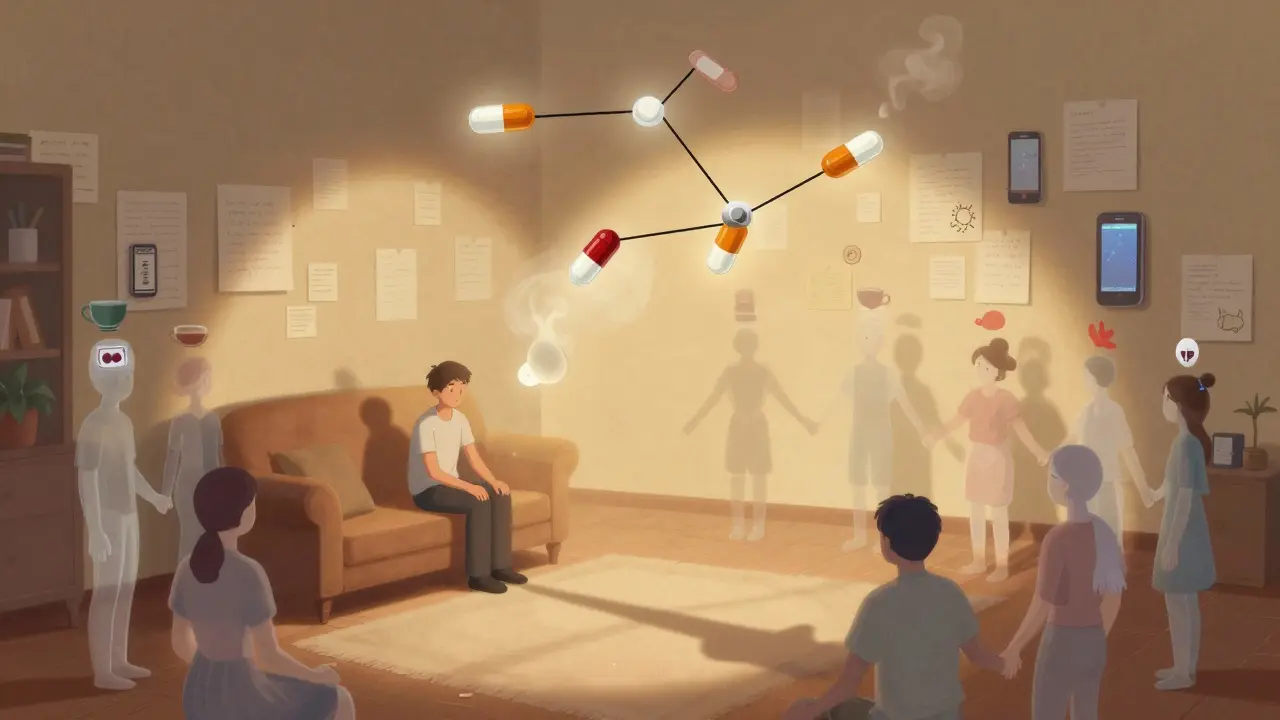
Half of all people taking medication for chronic conditions don’t take it as prescribed. That’s not laziness. It’s not ignorance. It’s complex - forgetfulness, side effects, cost, fear, depression, or just feeling fine and thinking, “I don’t need this anymore.” The result? More hospital visits, worse health, and billions wasted. But there’s a quiet, powerful fix that’s working: support groups and community programs designed not to lecture, but to connect.
Why Talking to People Who’ve Been There Works Better Than Brochures
You’ve probably seen the posters: “Take your pills on time!” with a calendar and a pill bottle. They don’t work. Studies show educational materials alone improve adherence by less than 15%. But when someone who’s been through the same struggle - someone who knows what it’s like to forget a dose because of work, or to skip pills because the side effects made them feel worse - sits down with you? That changes everything. Peer-led programs, where trained patients guide others with similar conditions, have been shown to improve medication adherence by 30% or more. In one study, people with high blood pressure who joined a weekly support group cut their missed doses in half within three months. Why? Because it’s not about being told what to do. It’s about hearing, “I used to do that too. Here’s how I got past it.”How These Programs Actually Work
There’s no single model. Programs come in different shapes, but they all share the same core: connection, consistency, and practical help.- Face-to-face groups: Usually meet once or twice a week in community centers, clinics, or churches. Groups of 8-12 people. Led by someone who’s been managing their condition for at least two years. They don’t give medical advice - they share what worked for them: how they set phone alarms, how they dealt with nausea from their meds, how they talked to their pharmacist about costs.
- Home visits by community health workers: Especially helpful for older adults or people with mobility issues. A trained worker comes to your home every few weeks. They don’t just check if you took your pills. They make tea, sit down, and ask, “What’s been hard this week?” They help you organize pillboxes, call your doctor if you’re having side effects, or even help you apply for drug assistance programs.
- Digital support communities: Apps and online forums where people share tips, vent frustrations, and celebrate small wins. These are great for 24/7 access, but they miss something vital - the emotional weight of a real hug, a shared silence, or seeing someone cry and still show up next week.
The most effective programs mix these. One study found that people with hypertension who got weekly in-person meetings plus daily text reminders had 34% better adherence than those who got only one type of support.
Who Runs These Programs? And Who Pays?
You might think these are run by doctors. They’re not. Most are run by nonprofits, community organizations, or public health departments. Some are tied to hospitals, but the real magic happens when the facilitator isn’t a clinician - they’re a person who’s been there. Training matters. Programs where facilitators get at least 40 hours of training (covering active listening, cultural sensitivity, basic medication knowledge) see 37% better results than those with less. A good facilitator doesn’t fix your problem. They help you find your own solution. Cost-wise, many are free for participants. Funding comes from grants, public health dollars, or partnerships with insurance plans. Medicare Advantage plans now cover these programs for 63% of their members. The Veterans Health Administration runs them across 140 facilities, serving 250,000 veterans a year. Kaiser Permanente has 147 condition-specific groups. These aren’t fringe ideas - they’re becoming standard care.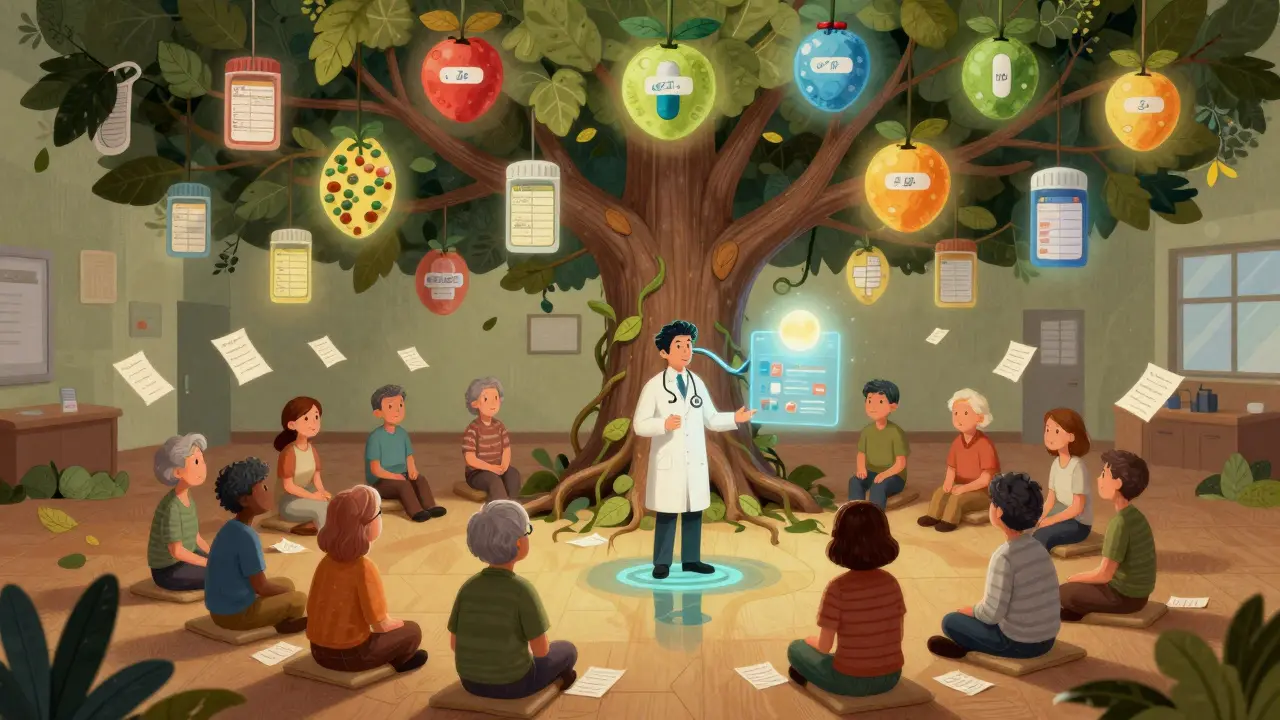
What Makes a Program Actually Work?
Not all groups are created equal. Some fizzle out after a few months. Others stick. Here’s what separates the good from the great:- They focus on behavior, not just information. Instead of saying, “You need to take your statin,” they ask, “What’s stopping you from taking it every morning?” Then they help you build a habit - like linking your pill to brushing your teeth.
- They include pharmacists. Pharmacists are the most accessible health professionals. In programs where pharmacists join group sessions or offer one-on-one check-ins, adherence rates jump 23% compared to doctor-led groups.
- They use real tools. The best programs track progress using validated scales like the Morisky Medication Adherence Scale. They don’t just guess if you’re doing better - they measure it.
- They adapt to culture and language. A study found African American participants in hypertension groups were 35% more likely to stay engaged if the group was led by someone from the same background. Only 22% of programs offer non-English support, even though 1 in 4 Americans speaks a language other than English at home.
Programs that use four or more behavior-change techniques - like goal-setting, reminders, social reinforcement, and problem-solving - are 31% more effective than those that use just one.
The Real Stories: What People Say
On Reddit, a user named DiabetesWarrior87 wrote: “I was missing 3-4 doses a week. My A1c was 8.5%. After joining the weekly support group, it dropped to 6.9% in six months. I didn’t change my meds. I changed how I thought about them.” A survey of 12,450 users on PatientsLikeMe found that 78% felt their adherence improved because of their support group. The top reason? “Hearing how others manage side effects.” That’s the power of shared experience. You realize you’re not broken. You’re not alone. Others are struggling too - and they’re still taking their pills. But it’s not perfect. Some people hate group settings. Others can’t make the time. One in three participants in mental health groups cited scheduling conflicts as a reason they dropped out. And 27% said they wished there was more medical oversight - someone to answer clinical questions on the spot.Where These Programs Fall Short
Rural areas are left behind. There are 47% fewer support programs per capita in rural communities than in cities. If you live 50 miles from the nearest town, attending a weekly meeting isn’t feasible. That’s why hybrid models - combining phone check-ins with mobile app reminders - are the future. Another problem? Sustainability. Nearly half of nonprofit programs report financial instability. They rely on grants that last one or two years. When the money runs out, the group shuts down. Without a way to pay facilitators - through insurance billing or government reimbursement - these programs can’t survive long-term. And let’s be honest: support groups won’t fix a 12-pill-a-day regimen. If your doctor gives you six different meds at four different times, no amount of peer support will help if the schedule is impossible. That’s why the best programs team up with prescribers to simplify regimens - reducing four doses a day to two, or switching to combination pills. One study showed that simplifying the schedule improved adherence by 18% - more than peer support alone.
What You Can Do Right Now
You don’t have to wait for a program to start in your town. Here’s how to find one - or start one:- Ask your pharmacist. Most know about local groups. If they don’t, they can connect you with community health centers.
- Check with your insurance. Medicare Advantage and many private plans now cover these programs. Call the number on your card and ask: “Do you have a medication adherence support program?”
- Look for nonprofits. Organizations like the American Heart Association, the American Diabetes Association, and NAMI (National Alliance on Mental Illness) run or partner with local groups.
- Start small. If there’s nothing nearby, gather three others with the same condition. Meet once a month in a library or park. Share tips. Ask questions. You don’t need a facilitator. You just need to show up.
The Bigger Picture
Medication adherence isn’t just about pills. It’s about dignity. It’s about not feeling like a burden. It’s about knowing someone else understands the weight of managing a chronic illness every single day. The data is clear: when people feel seen, heard, and supported by others who’ve walked the same path, they take their meds. They live longer. They spend less time in hospitals. And the system saves money - up to $18 for every $1 spent on these programs. This isn’t a nice-to-have. It’s a necessary part of care. And it’s working - one conversation, one shared story, one week at a time.Do support groups replace my doctor or pharmacist?
No. Support groups complement your care team - they don’t replace them. Facilitators are trained peers, not medical professionals. They help you navigate challenges, share tips, and stay motivated, but they don’t diagnose, adjust doses, or give medical advice. Always talk to your doctor or pharmacist about changes in how you feel or questions about your meds.
Are these programs free?
Most community-based programs are free to join. They’re funded by grants, public health funds, or insurance partnerships. Some hospital-based programs may charge a small fee, but financial assistance is usually available. Always ask - if you’re told there’s a cost, find out if there’s a waiver option.
What if I’m shy or don’t like group settings?
You’re not alone. Many people feel that way at first. Some programs offer one-on-one peer support instead of group meetings. Others use phone calls or online forums. Try a different format. You don’t have to speak in the first meeting. Just listening can help. And if a group doesn’t feel right, it’s okay to leave and try another.
Can family members join these programs?
Yes - and they should. Studies show that when family members are involved, medication adherence improves even more. Some programs include family sessions. Others let you bring a loved one to meetings. Having someone who understands your routine, reminds you about pills, or helps you manage side effects makes a huge difference.
How do I know if a program is any good?
Look for these signs: facilitators have at least 40 hours of training, the program tracks outcomes (like pill-taking rates), and they use tools like the Morisky scale. Ask if they’re partnered with a hospital, university, or public health agency. Avoid programs that only hand out pamphlets - real ones focus on conversation, not lectures.
What if there’s no program near me?
Start with digital options. Apps like PatientsLikeMe or MyTherapy offer peer forums. You can also join online groups on Reddit or Facebook. If you want something more personal, ask your pharmacist or local health department if they know of any virtual groups. And if you’re motivated, gather a few others with your condition and meet once a month - even in a park or over Zoom. Peer support doesn’t need a fancy setup. It just needs people showing up.
Do these programs work for mental health meds?
Yes - and they’re especially critical here. People taking antidepressants, antipsychotics, or mood stabilizers often stop because they feel better or fear stigma. Support groups for mental health conditions like depression, bipolar disorder, or schizophrenia reduce isolation and normalize the struggle. Programs run by NAMI and similar groups have shown strong results in improving adherence for psychiatric medications.
How long does it take to see results?
Most people notice a difference in 4-8 weeks. Adherence rates start climbing as soon as people feel heard. But lasting change takes time - usually 3-6 months of consistent participation. The goal isn’t just to take pills this week. It’s to build a life where taking them becomes natural, not a chore.

9 Comments
My mom had hypertension and joined a church-based support group last year. She didn’t change her meds, but she started taking them like clockwork because someone else in the group would text her every morning just to check in. No lectures. Just, ‘Hey, took your pill yet?’ It sounds small, but it stuck.
/p>I wish more doctors would refer people to these instead of just handing out pamphlets.
Let’s be real - if your med regimen is so fucking complicated that you need a fucking support group just to remember to swallow a pill, maybe your prescriber is the problem, not you.
/p>4 doses a day? 6 different pills? That’s not patient noncompliance - that’s polypharmacy malpractice. Peer support won’t fix a regimen designed by a resident on a 36-hour shift. Simplify the damn script first. Then the group can help you remember to take the *two* you actually need.
Also, ‘trained facilitators’? More like volunteers who read a PDF. Real clinical oversight is what’s missing. Not more hugs.
Oh wow, another feel-good, touchy-feely, ‘let’s all hold hands and take our lisinopril’ article. Let me guess - this was written by a social worker who’s never had to pay for their own meds.
/p>12-pill-a-day regimens? You think a group chat is gonna fix that? Nah. It’s gonna fix your *guilt*. Meanwhile, the real issue - insurance denying combination pills, pharmacies charging $400 for a 30-day supply, doctors refusing to simplify - gets ignored because it’s easier to blame the patient than the system.
And don’t get me started on ‘cultural sensitivity.’ You don’t need a facilitator who ‘looks like you’ - you need a pharmacy that accepts your insurance. But sure, let’s keep pretending empathy replaces economics.
Wow. Just… wow.
/p>So now we’re replacing medical expertise with peer storytelling? Next thing you know, we’ll have TikTok influencers prescribing insulin based on their ‘personal journey.’
And let’s not ignore the elephant in the room: 78% of users say they improved because they ‘heard how others manage side effects.’ Translation: they’re self-diagnosing and adjusting doses based on Reddit threads. That’s not adherence - that’s dangerous improvisation.
Also, why is every single program funded by grants? Because they’re unsustainable. They’re band-aids on a hemorrhage. We need systemic reform, not feel-good group therapy disguised as healthcare.
And yes - I’m a nurse. I’ve seen what happens when ‘shared experience’ replaces clinical judgment. It’s not pretty.
From India, I can say: in our villages, people don’t have support groups, but they have family. My aunt with diabetes, she takes her pills every day because her granddaughter reminds her - and she makes chai together after. No app. No group. Just love.
/p>Also, in India, we don’t have ‘facilitators’ with 40 hours training - we have local pharmacists who know everyone’s name, and who call if you haven’t picked up your refill in two weeks.
Maybe the answer isn’t more programs… but more human connection. Simple. No jargon. Just care.
Also, sorry for typos - English is not my first language, but I hope you understand the heart of it.
I used to think these groups were just a waste of time… until I joined one for my anxiety meds. I didn’t speak for the first three weeks. Just sat there. Listened. Cried once. Didn’t say why.
/p>Then someone said, ‘I skipped my meds for six months because I thought I was ‘fixed.’ I wasn’t. I was just numb.’
That hit me. Like a brick.
I started taking them again the next day.
I don’t know why I’m telling you this. I just needed to say it out loud.
This is so important. I work at a community center and we started a simple group for seniors on blood pressure meds. We meet every Thursday at 2. We bring cookies. We talk. We don’t lecture. We just ask: ‘What made today hard?’
/p>One woman said she stopped her pills because she didn’t want to be ‘a burden.’ We told her she wasn’t. She’s family.
Now she takes them every day. And she brings her neighbor.
It’s not magic. It’s just kindness. And it works.
If you’re reading this and you’re struggling - you’re not alone. Call someone. Even if it’s just one person. You matter.
my dad’s on 7 meds. he forgets half the time. we got him a pillbox with alarms. it helped a little. then we started having dinner with him every night and just asking ‘did you take your stuff?’
/p>no group. no app. just us.
turns out the best ‘support program’ was sitting at the table with him.
also i hate when people call this ‘adherence.’ sounds like we’re robots. we’re people. we’re tired. we’re scared. we just need someone to sit with us.
Let’s deconstruct this with a systems-theory lens: peer-led interventions are emergent properties of social capital, but without institutional embedding, they remain epiphenomenal. The Morisky scale is a proxy variable, not a causal mechanism. You’re conflating correlation with efficacy.
/p>Furthermore, the economic model is unsustainable because it relies on externalities - grants, goodwill, and voluntarism - which are non-scalable. True ROI requires integration into DRG reimbursement codes and FQHC funding streams.
Also, cultural alignment without structural equity is performative allyship. You can’t ‘normalize’ adherence if the cost of a statin is 40% of a rural worker’s daily wage.
TL;DR: empathy is necessary but insufficient. Policy change is non-negotiable.