
Acetaminophen Daily Dose Calculator
Track Your Acetaminophen Intake
The FDA recommends not exceeding 4,000 mg of acetaminophen per day. This tool helps you calculate your total daily intake from multiple medications.
Total daily dose:
0 mg
Safe limit: 4,000 mg
Note: Acetaminophen is in many medications including cold/flu remedies, pain relievers, and combination drugs like Vicodin. Don't forget to check all bottles!
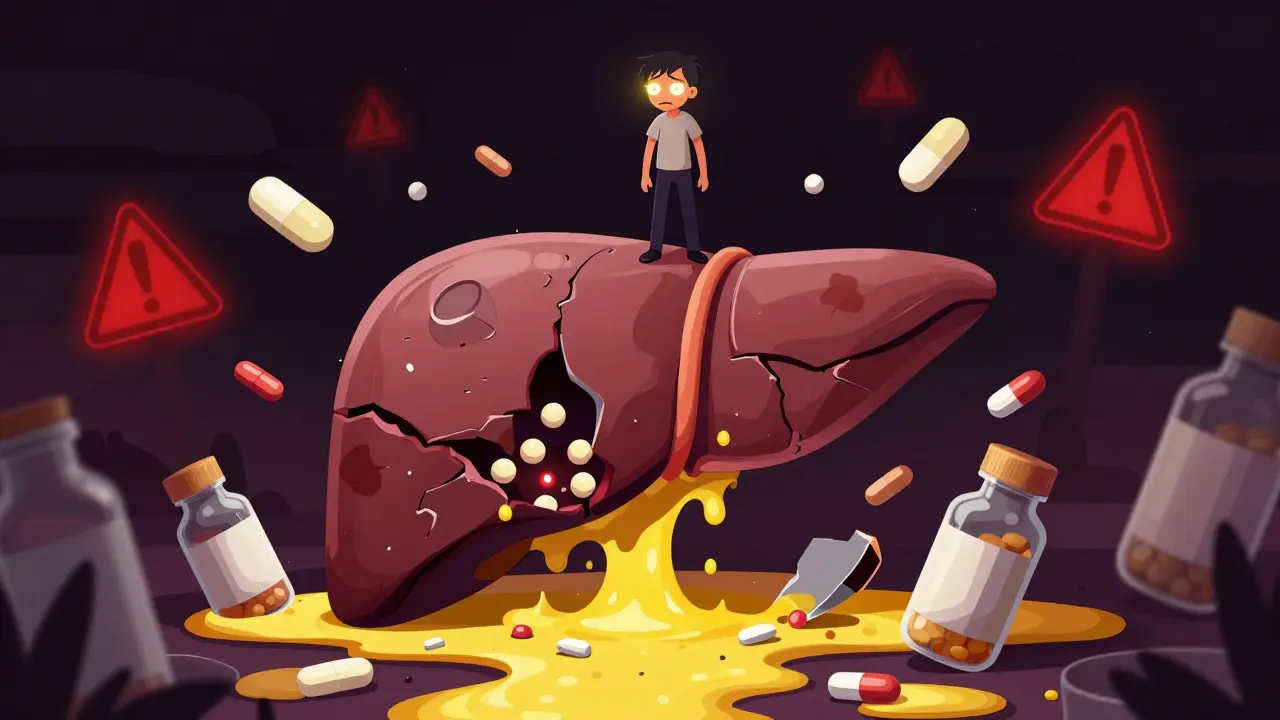
When someone suddenly becomes confused, yellow-eyed, and vomiting with no clear cause, it’s not just a bad flu. It could be fulminant hepatic failure - a liver that’s collapsing in hours, not weeks. And the worst part? It’s often caused by something most people think is safe: medication.
Every year in the U.S., about 2,000 people develop this condition. Nearly half of those cases come from drugs - not just illegal ones, but the pills sitting in your medicine cabinet. Acetaminophen, the active ingredient in Tylenol and hundreds of cold and pain meds, causes nearly half of all medication-induced liver failures. And here’s the scary truth: 38% of these cases show up at the ER too late for the one treatment that can save them.
What Exactly Is Fulminant Hepatic Failure?
Fulminant hepatic failure (FHF), also called acute liver failure, isn’t just liver damage. It’s the liver shutting down fast - in days or even hours - in someone who had no prior liver problems. Three things scream this diagnosis: yellow skin (jaundice), mental confusion (encephalopathy), and blood that won’t clot (coagulopathy).
The term "fulminant" comes from Latin for "lightning strike." That’s how fast it hits. In hyperacute cases, patients go from feeling off to unconscious in under 7 days. The liver doesn’t just get sick - it stops working entirely. Without a transplant, survival drops to 28%. But if caught early? Survival jumps to 63%.
This isn’t theoretical. A nurse in Ohio once saw a 45-year-old woman come in with confusion after taking 4 grams of acetaminophen daily for back pain - the "safe" daily limit. Her INR (a clotting test) was 8.2. Normal is under 1.2. She nearly died because no one connected the dots.
Acetaminophen: The Silent Killer
Acetaminophen is the biggest culprit. It’s in Tylenol, Vicodin, Percocet, Excedrin, and dozens of cold medicines. People think they’re safe because it’s over-the-counter. But here’s the catch: taking just 7.5 to 10 grams in one day - or 150 mg per kilogram of body weight - can cause liver death.
And it’s not always an overdose. A common scenario: someone takes one hydrocodone/acetaminophen pill every 6 hours for pain. That’s 4 pills a day - 2,000 mg of acetaminophen. Then they add Tylenol for a headache. Suddenly, they’re at 3,000 mg. Add a cold medicine with acetaminophen? They’ve crossed the line. Twenty-eight percent of acetaminophen-induced liver failures come from this kind of "therapeutic misadventure."
The body’s warning signs? Nausea. Not vomiting. Not diarrhea. Just persistent nausea, even when you’re hungry. Family members often notice subtle personality changes - irritability, slurred speech, forgetfulness - before the patient even realizes something’s wrong.
Doctors use the Rumack-Matthew nomogram to predict risk. If the blood level of acetaminophen is above 150 μg/mL at 4 hours after ingestion, there’s a 60% chance of liver damage. But here’s the problem: 23% of patients with acetaminophen-induced liver failure deny taking any extra pills. That’s why the American Association for the Study of Liver Diseases says: Test everyone with ALT over 500 IU/L. Don’t wait for a confession.
Other Drugs That Can Destroy the Liver
Acetaminophen isn’t the only offender. Antibiotics like amoxicillin-clavulanate (Augmentin) can cause liver failure, but they play a different game. Instead of sudden collapse, they cause slow-burning damage. Jaundice lasts more than 18 days before confusion sets in. Blood tests show high alkaline phosphatase - not just high ALT.
Antiseizure drugs like valproic acid trigger a different pattern: microvesicular steatosis (fat buildup in liver cells) and ammonia levels above 150 μmol/L. That’s what leads to brain fog and coma.
And then there are herbal supplements. People think "natural" means safe. It doesn’t. Green tea extract - especially in high-dose capsules - caused 42% of supplement-related liver failures between 2019 and 2022. One patient took 800 mg of epigallocatechin-3-gallate daily for weight loss. Three months later, she was in the ICU with INR 6.1. Seventy-six percent of these cases are women.
Kava, comfrey, and black cohosh are other dangerous culprits. One Reddit user described a friend who took 3,000 mg of kava daily for anxiety for six months. He woke up one morning unable to stand. His INR was 5.8. He needed a transplant.
How to Spot It in the Emergency Room
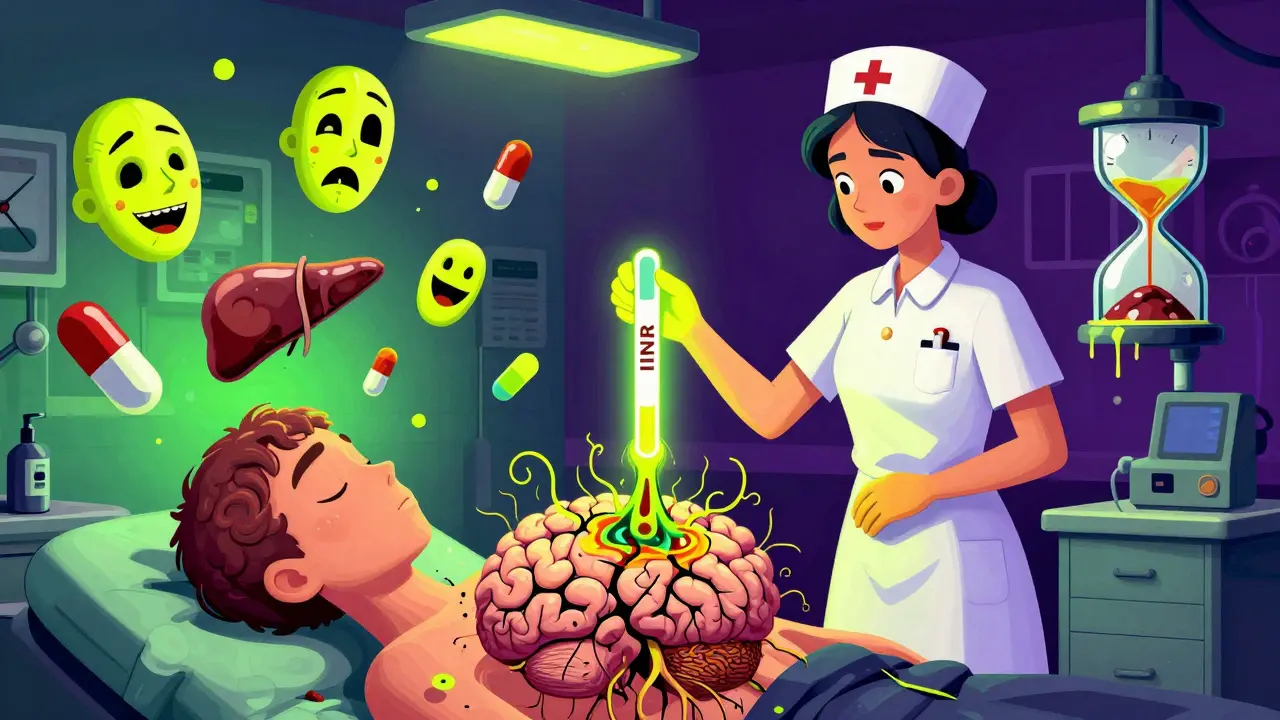
Time is liver. The faster you act, the better the chance. The Acute Liver Failure Study Group has a 30-minute triage protocol for ERs:
- Check ALT, INR, and acetaminophen level in anyone with nausea + jaundice. This combo catches 98.7% of cases.
- Assess mental status every hour using the West Haven Criteria. Is the patient confused? Slurring words? Sleeping too much? That’s encephalopathy.
- If INR is above 1.5, retest every 6 hours. Rising INR means the liver is failing faster.
Don’t rely on symptoms alone. A 2022 Johns Hopkins study found 17 patients misdiagnosed with gastroenteritis. They were vomiting and had abdominal pain - but their real problem was NSAID-induced hepatitis. Median delay to diagnosis? Over 5 days.
The King’s College Criteria are the gold standard for deciding who needs a transplant:
- INR over 6.5 with grade III or IV encephalopathy
- Acetaminophen case with pH below 7.3 or INR over 3.5 and creatinine above 3.4 mg/dL at 96 hours
If either of these are true, transplant is the only option. Without it, mortality is over 90%.
The One Treatment That Can Save You
N-acetylcysteine (NAC) is the antidote for acetaminophen overdose. It works by replenishing glutathione, the liver’s natural detoxifier. But it only works if given early.
After 8 hours, its effectiveness drops sharply. After 24 hours, it’s mostly useless. That’s why the goal is to give it within 8 hours - and ideally within 3.
A Cleveland Clinic case in 2021 showed how fast action saves lives. A 22-year-old took 12 extra-strength Tylenol after a breakup. Her mom brought her in 3 hours later. NAC was started at 5 hours. Her ALT peaked at 1,800 IU/L - but she recovered fully. No transplant. No long-term damage.
For non-acetaminophen cases, NAC is still used off-label. It’s not proven, but it’s low-risk and may help. The European Association for the Study of the Liver says: if a patient meets Hy’s Law - ALT or AST over 3 times the upper limit of normal AND bilirubin over 2 times normal - they need hospitalization and daily INR checks.
What’s Changing in 2026
The FDA has started requiring bold warnings on prescription acetaminophen products. But OTC products? Still no warning. That’s a gap.
New tools are emerging. In 2023, the FDA cleared HepaPredict AI - a system that analyzes 17 clinical factors to predict liver failure with 89% accuracy within 24 hours. It’s being rolled out in major hospitals.
And a national FHF Alert System launches in Q2 2024. ERs will be required to report suspected cases within one hour so transplant centers can mobilize. In California, this cut time-to-transplant by over 38 hours.
Researchers are also testing microRNA biomarkers. miR-122, a liver-specific molecule, shows up in blood within 6 hours of acetaminophen toxicity - way before ALT spikes. That could mean detection before the liver is even damaged.
What You Can Do
If you or someone you know is taking multiple medications, check every bottle for acetaminophen. Add up the total. Don’t assume "it’s just one pill."
If you notice:
- Persistent nausea without vomiting
- Yellow eyes or skin
- Confusion, forgetfulness, or personality changes
- Unexplained bruising or bleeding
Go to the ER. Ask for: ALT, INR, and acetaminophen level. Don’t wait for a diagnosis. Push for it.
And if you take supplements - especially green tea extract, kava, or weight-loss pills - stop them immediately if you feel off. No supplement is worth a liver.
The cost of this failure? On average, $387,450 per hospital stay. Most of that is for ICU and transplant. But the real cost? A life lost because no one knew to look.
Can you survive fulminant hepatic failure without a transplant?
Yes - but only if caught early and treated immediately. For acetaminophen-induced cases, about 67% recover without transplant if N-acetylcysteine is given within 8 hours. For other drug-induced cases, survival without transplant drops to 29%. The key is speed: liver damage is often reversible in the first 48 hours if the toxin is removed and support is given.
Is acetaminophen safe if I take it as directed?
Not always. The "directed" dose is 4 grams per day - but many people take more without realizing it. Combination painkillers like Vicodin or Percocet already contain acetaminophen. Adding Tylenol or cold medicine can easily push you over 6 or 7 grams. That’s enough to cause liver failure. Always check every medication label for acetaminophen and add up the total.
Can herbal supplements really cause liver failure?
Absolutely. Between 2019 and 2022, herbal and dietary supplements caused 42% of all non-prescription drug-induced liver failures in the U.S. Green tea extract is the biggest offender, especially in doses over 800 mg per day. Kava, comfrey, and weight-loss teas have also caused transplants. There’s no regulation on purity or dosage, and reactions can take months to show up.
What should I ask the ER doctor if I suspect liver failure?
Ask for three tests: ALT (liver enzyme), INR (clotting time), and acetaminophen level. Don’t let them dismiss you because you didn’t overdose. Many cases are from normal doses taken over time. Also ask: "Could this be drug-induced liver failure?" and "Do I need N-acetylcysteine?" If they say no, ask why - and push for a second opinion.
How long do I have to act if I think I took too much acetaminophen?
You have about 8 hours for N-acetylcysteine to be most effective. After 24 hours, it offers little benefit. But don’t wait for symptoms. If you took more than 7.5 grams in 24 hours, go to the ER immediately - even if you feel fine. Liver damage can start before you feel sick.
Are there any warning signs before it gets serious?
Yes. The most common early sign is persistent nausea - even if you’re still hungry. Family members often notice subtle changes: confusion, slurred speech, drowsiness, or personality shifts. These are signs of early encephalopathy, which means toxins are building up in the brain. By the time jaundice appears, the liver is already in crisis.
Final Thought: Don’t Wait for a Diagnosis
Medication-induced liver failure doesn’t announce itself with a siren. It whispers. Nausea. Fatigue. A little confusion. Then - boom - collapse. The people who survive are the ones who acted before the symptoms became obvious. They didn’t wait for a doctor to say, "This is serious." They asked the question themselves: "Could this be my liver?"
If you’re taking multiple meds - prescription, OTC, or herbal - know what’s in them. Know the signs. And if something feels wrong, don’t hesitate. Your liver can’t wait. Neither should you.


12 Comments
Let’s be real - this isn’t about acetaminophen. It’s about how we’ve turned medicine into a buffet. People think if it’s on the shelf, it’s harmless. That’s not just ignorance, it’s systemic negligence. The FDA lets OTC drugs fly under the radar while prescription meds get bombarded with warnings. Meanwhile, someone’s grandma is taking Tylenol for arthritis, Advil for the knee, and NyQuil because she’s got a cold - all at once. No one’s counting. No one’s teaching. And now we’re surprised when the liver gives out? This isn’t an accident. It’s a design flaw.
/p>My uncle took 6 Tylenol a day for years. Said it was "just for back pain." Died at 58. No warning. No drama. Just gone. They didn’t even test his liver until it was too late. Don’t wait for symptoms. Check your meds. Now.
/p>People don’t understand that "natural" doesn’t mean safe. Green tea extract? It’s not tea. It’s concentrated poison in a capsule. And yet, we let influencers sell it as a "fat burner" to teenage girls. This isn’t medical negligence - it’s moral collapse. We’ve outsourced responsibility to corporations and then blame the victim when they die. Shameful.
/p>I work in ER triage. We see this every month. Someone comes in with "flu symptoms," we check labs, and boom - ALT at 8,000, INR at 4.5. They swear they didn’t take anything extra. Then we ask about the cold medicine they took last night. Oh - that one had acetaminophen. And the painkiller from last week? Also had it. And the sleep aid? Also had it. Three sources. 5,000 mg. No overdose. Just "normal use." We need mandatory labeling that adds up the total daily dose across all products. Not just on the bottle - on the damn website too.
/p>Let’s be honest - if you’re taking more than 3,000 mg of acetaminophen daily, you’re not a patient. You’re a walking clinical trial. And if you’re combining it with alcohol, opioids, or kombucha, you’re basically playing Russian roulette with your hepatocytes. The fact that this is still even a conversation is a testament to how little we value biological literacy. You wouldn’t drive a car without knowing how the engine works. Why do you take pills without knowing how your liver works?
/p>Wait… so the same FDA that lets Big Pharma sell OTC drugs with zero warnings is now rolling out "AI liver failure predictors"? 😂 Like, what? We’re gonna AI our way out of corporate negligence? The real solution is to ban combination meds that hide acetaminophen in plain sight. And make every single pill bottle have a giant red warning: "THIS CONTAINS LIVER KILLER. DO NOT COMBINE." But nah. Profit over people. Again.
/p>This is one of the most important posts I’ve read in years. I’ve shared it with my entire family. I didn’t realize how many of my meds contained acetaminophen - not just painkillers, but sleep aids, cold meds, even some migraine pills. I just started a spreadsheet. Every pill. Every dose. Every day. I’m 42. I don’t want to be another statistic.
/p>my buddy took kava for anxiety for 8 months. 3k mg a day. thought it was "natural stress relief." woke up one morning with yellow eyes and couldn’t walk. ended up in liver ICU. transplant saved him. now he’s got a scar down his belly and a new life philosophy: "if it’s not FDA approved, don’t put it in your body." also he doesn’t trust anything labeled "herbal" anymore. fair.
/p>Thank you for writing this. I’m a nurse, and I’ve seen too many people come in too late. I wish we had a simple checklist we could hand out: "Check your meds. Add up the acetaminophen. If it’s over 3g/day, stop. If you’re confused or nauseous, go to the ER. Don’t wait. Your liver can’t wait." Simple. Clear. Life-saving.
/p>Interesting how the article blames patients for not knowing, but never mentions that pharmacies don’t warn you when you buy multiple products with acetaminophen. No one says, "Hey, you’re buying NyQuil and Vicodin - that’s 4.5g of acetaminophen today." The system is designed to let you overdose. It’s not your fault. It’s corporate.
/p>Man, I used to think "acetaminophen" was just a fancy word for Tylenol. Now I know it’s the silent assassin hiding in 200+ products. I read this post and went through my cabinet. Found 4 different bottles with it. One was labeled "allergy relief" - no one would ever guess. I’m throwing out half my meds now. And I’m teaching my kids to read labels like they’re reading a map. This isn’t fear-mongering. It’s survival.
/p>So… if I take 1 Advil, 1 Tylenol, and 1 cold pill - that’s 3,000 mg already. But if I take 1 Tylenol, 1 Vicodin, and 1 NyQuil? That’s 4,500 mg. And I thought I was being careful. 😅 Turns out I’m just a walking liver hazard. Thanks for the wake-up call. I’m printing this out and taping it to my medicine cabinet. No more guessing.
/p>