

QT Interval Safety Calculator
What Your Results Mean
The corrected QT interval (QTc) accounts for heart rate to provide a more accurate assessment of the heart's electrical cycle. Normal QTc is typically below 440ms for men and below 460ms for women.
When you take a new medication-whether it’s an antibiotic, an antipsychotic, or a heart rhythm drug-your doctor doesn’t just check if it works. They also watch for something invisible: a tiny delay in your heart’s electrical cycle called the QT interval. If this interval stretches too long, it can trigger a dangerous heartbeat called torsades de pointes, which can lead to sudden cardiac death. For years, this risk was checked in clinics with bulky 12-lead ECG machines. Now, a new wave of wearable ECG devices is making real-time QT monitoring possible-right from your wrist or pocket.
Why QT Interval Monitoring Matters
The QT interval measures how long it takes your heart’s ventricles to recharge between beats. A normal QT interval is under 440 milliseconds in men and under 460 in women. But many common drugs-like azithromycin, fluoxetine, or even some COVID-19 treatments-can push it past 500 ms. That’s the danger zone. Traditionally, doctors would order an ECG before starting the drug, then another a few days later. But QT prolongation doesn’t always show up on a single snapshot. It can creep in slowly, or spike suddenly after a dose. That’s why continuous monitoring matters.How Wearable ECGs Work
Modern wearable ECG devices use tiny electrodes to pick up the heart’s electrical signals through the skin. The Apple Watch Series 4 and later models have a single-lead ECG app that activates when you place your finger on the digital crown. It records 30 seconds of data and gives you a readout labeled “Normal” or “Possible Atrial Fibrillation.” But behind the scenes, it’s also capturing the QRS complex and T wave needed to calculate the QT interval. Then there’s the KardiaMobile 6L by AliveCor. It’s a palm-sized device with electrodes on both top and bottom. To use it, you rest your thumbs on the top sensors and your left ankle or knee on the bottom ones. This setup creates a six-lead ECG-similar to what you’d get in a hospital, but portable. It’s not just for detecting irregular rhythms. It’s been validated to measure QT intervals with accuracy close to standard 12-lead ECGs.What the Research Shows
A 2021 study in Scientific Reports tested the Apple Watch against hospital-grade ECGs in 60 patients. The results? Spearman correlation coefficients were above 0.88 for lead I and II, and 0.914 for the average QT value across leads. That’s strong agreement. Bland-Altman analysis confirmed the device’s measurements stayed within clinically acceptable limits across different QT correction formulas-Bazett, Fridericia, Framingham, and Hodges. The KardiaMobile 6L fared just as well. In a study cited by the Cleveland Clinic Journal of Medicine (2024), its QT measurements were within ±20 milliseconds of standard 12-lead ECGs in over 90% of cases. That’s better than most Holter monitors used in outpatient settings. But here’s the catch: these devices were never designed for QT monitoring. Their algorithms were built for atrial fibrillation detection. That’s why the FDA issued special guidance in April 2020 during the pandemic, allowing the KardiaMobile 6L to be used for QTc measurement in patients on hydroxychloroquine and azithromycin. It was an emergency override-and it worked.Real-World Use Cases
In 2020, Dr. Jason Chinitz published a case report in Innovations in Cardiac Rhythm Management about a patient on hydroxychloroquine for COVID-19. The patient’s QT interval spiked from 420 ms to 510 ms after two days. Without daily wearable ECG checks, this change might have gone unnoticed until a collapse occurred. With the Apple Watch, the patient’s doctor adjusted the dose in real time. No hospital visit. No delay. Today, pharmaceutical companies are using these devices in clinical trials. Phase I drug safety studies now routinely include wearable ECGs to track QT changes across hundreds of patients. Instead of sending people back to the clinic every 48 hours, they wear the device for a week. The data flows automatically to researchers. That cuts costs, speeds up trials, and catches problems earlier.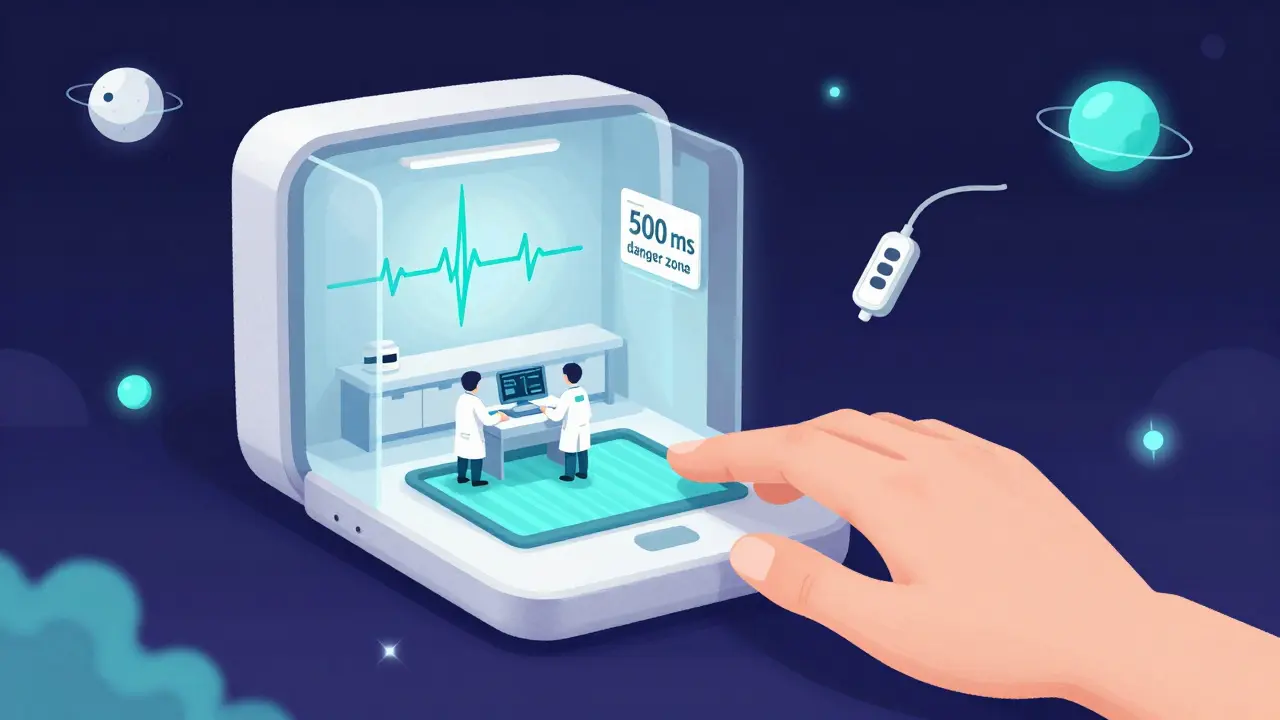
Limitations and Risks
Don’t mistake these devices for medical-grade diagnostic tools. They’re screening tools-with limits. - They can’t reliably detect Q waves or ST-segment changes. One study found only 20.6% sensitivity for pathologic Q waves. - Signal quality drops if the skin is dry, sweaty, or hairy. High skin-to-electrode impedance causes noise. - The Apple Watch only gives you one lead. That’s enough for QT, but not for diagnosing ischemia or bundle branch blocks. - No consumer device has a built-in QT algorithm approved by the FDA. The measurement is calculated by the app, not the device itself. And while the KardiaMobile 6L gives you six leads, you still need to position it correctly. Place your thumb on the wrong electrode? The signal becomes unreliable. That’s why training matters. Patients need clear instructions: “Place your left ankle on the bottom, thumbs on top. Stay still for 30 seconds.”The AI Breakthrough
The biggest leap forward isn’t in hardware-it’s in software. In 2024, researchers at Stanford and MIT published a deep learning model in PLOS Digital Health that predicts QT prolongation from just two beats of a single-lead ECG. Using a Residual Neural Network trained on 686 patients with genetic long QT syndrome, the AI achieved 94% accuracy in identifying QTc > 500 ms. Why is this huge? Because manual review of hundreds of wearable ECGs is slow. A single patient might generate 100 recordings in a week. A cardiologist can’t review them all. But AI can. This model doesn’t replace the doctor. It flags the high-risk recordings for review. That’s the future: AI as a first filter, clinician as the final gatekeeper.What’s Next?
AliveCor has received FDA clearance for 16 different ECG-related uses, including QT monitoring. Apple’s ECG app is now used in over 100 million watches. The next wave will include smart rings and clothing with embedded sensors-devices that monitor 24/7 without you even thinking about it. But the real goal isn’t just detection. It’s prevention. Imagine a patient starting a new antipsychotic. Their wearable ECG records every 12 hours. The AI notices QT creeping up. It sends an alert to their pharmacy. The pharmacist calls: “Your doctor wants to lower your dose.” No ER visit. No cardiac arrest. Just a quiet adjustment, made in time.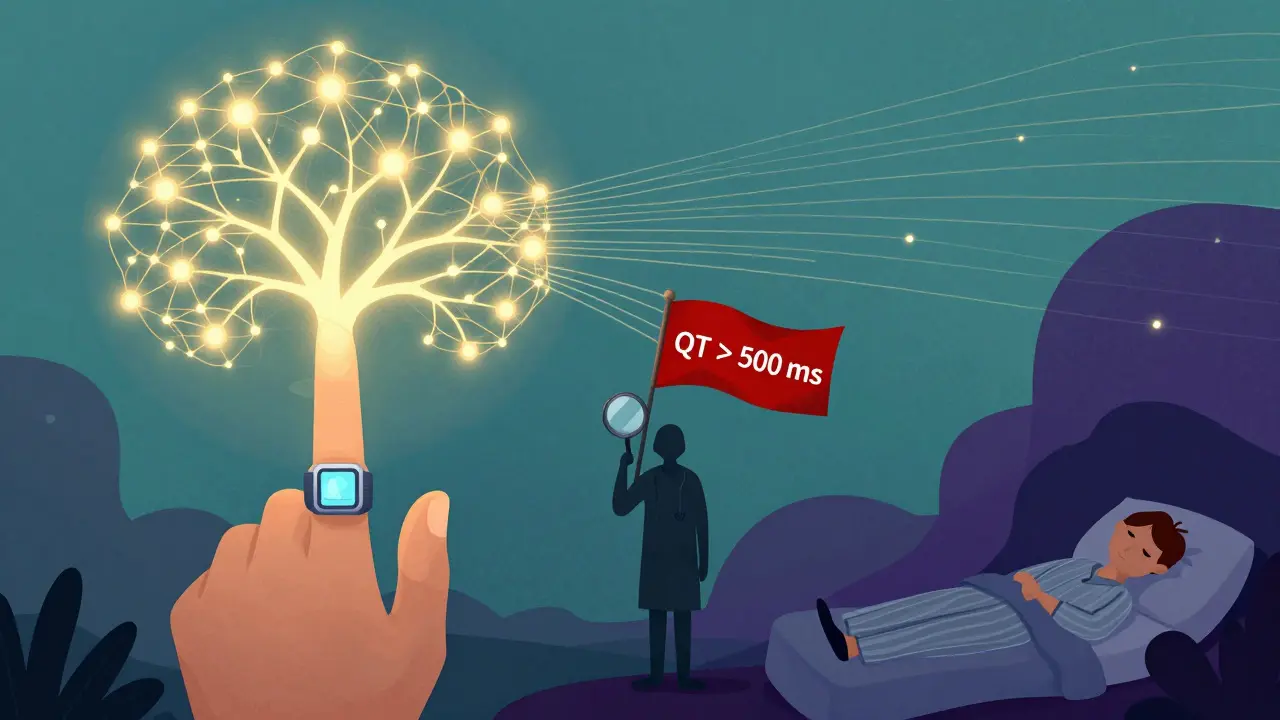
Who Should Use This?
This isn’t for everyone. But if you’re on any of these medications: - Antibiotics: azithromycin, moxifloxacin, levofloxacin - Antipsychotics: haloperidol, risperidone, quetiapine - Antiarrhythmics: amiodarone, sotalol - Antidepressants: citalopram, escitalopram - Anti-nausea drugs: ondansetron …and you have risk factors like heart disease, low potassium, or kidney issues-you should ask your doctor about wearable QT monitoring. It’s not a replacement for clinic visits. But for high-risk patients, it’s the closest thing to a personal cardiac safety net.Getting Started
If you’re considering a wearable ECG for QT monitoring:- Choose a device with FDA clearance for QT measurement: KardiaMobile 6L or Apple Watch Series 4+
- Get a prescription or clinical order from your doctor
- Follow placement instructions exactly-position matters
- Don’t rely on the device alone. Always confirm abnormal readings with a standard ECG
- Share your data with your care team. Many devices sync to apps like Kardia or Apple Health
Final Thoughts
Wearable ECGs for QT safety aren’t science fiction. They’re here, validated, and already changing how drugs are monitored. The technology isn’t perfect. But it’s better than waiting for symptoms to show up. For patients on high-risk medications, real-time QT monitoring means fewer surprises-and more control.Can I use my Apple Watch to monitor my QT interval without a doctor’s order?
You can record an ECG with your Apple Watch anytime, but interpreting the QT interval requires clinical context. The device doesn’t give you a QT value-it only shows if your rhythm is normal or shows possible atrial fibrillation. To get accurate QT measurements, you need a doctor’s order and a validated device like the KardiaMobile 6L. Even then, results should be reviewed by a clinician.
Are wearable ECGs as accurate as hospital ECGs for QT measurement?
For QT interval measurement, the KardiaMobile 6L and Apple Watch Series 4+ have been validated against standard 12-lead ECGs in multiple peer-reviewed studies. Accuracy is within ±20 milliseconds in most cases, which is clinically acceptable. However, they’re not designed to replace full diagnostic ECGs for conditions like heart attacks or bundle branch blocks. Their strength is continuous monitoring-not comprehensive diagnosis.
Which is better: Apple Watch or KardiaMobile 6L for QT monitoring?
The KardiaMobile 6L is better for QT monitoring because it records six leads, giving more data points for accurate interval calculation. The Apple Watch only records one lead, which can limit precision, especially in patients with irregular rhythms or complex heart conditions. But the Apple Watch is always on your wrist, so it’s more convenient for daily use. If you need high accuracy for drug safety, choose KardiaMobile 6L. If you want daily checks with minimal effort, Apple Watch is sufficient.
Can AI replace cardiologists in reading wearable ECGs?
No. AI can flag high-risk QT prolongation with over 90% accuracy, but it can’t interpret other ECG abnormalities like ischemia, electrolyte imbalances, or structural heart disease. The goal of AI is to reduce the workload on cardiologists-not replace them. It acts like a filter: showing only the most concerning recordings for human review. That’s how it saves time and prevents missed cases.
Are wearable ECGs covered by insurance?
Coverage varies. Medicare and some private insurers cover KardiaMobile 6L when prescribed for specific conditions like drug-induced QT prolongation or arrhythmia monitoring. Apple Watch ECG features are generally not covered because they’re considered consumer devices. Check with your insurer and ask for a prescription-many providers can help you get the device under a medical benefit code.
How often should I record an ECG if I’m on a QT-prolonging drug?
Typically, you’ll record daily for the first week after starting the drug, then every 2-3 days if results are stable. If your QT interval rises above 500 ms or increases by more than 60 ms from baseline, stop the drug and contact your doctor immediately. Your care team may adjust the frequency based on your risk level, kidney function, or other medications you’re taking.





15 Comments
This is so cool! 🙌 My grandma’s on amiodarone and now she checks her heart every morning with her Apple Watch. No more scary clinic trips. Life changed.
/p>UK’s NHS should be using these. We’re still stuck with paper ECGs in 2024. Pathetic.
/p>Bro, the Kardia 6L is the real MVP. I work in pharma trials and we ditched the Holters for these. QT data’s cleaner, less noise, and the API feeds straight into our LIMS. Game changer. Just make sure the electrodes are clean-sweat kills the signal.
/p>Oh please. Apple Watch QT measurements? That’s like using a ruler to measure the width of a virus. The algorithm is trained on 60 people in a 2021 study with cherry-picked subjects. Meanwhile, real cardiology uses 12-lead with 1000+ data points per beat. This is tech bro snake oil wrapped in a FDA emergency waiver.
/p>I’ve been using my Kardia for six months since starting quetiapine. It’s not perfect-but it’s given me peace of mind. My QT went from 430 to 485 over a week. I called my doc, they adjusted my dose, and now it’s stable. Tech isn’t magic, but it’s a safety net. Thank you for writing this.
/p>While the technological advancements are undeniably impressive, one must critically interrogate the epistemological foundations underpinning consumer-grade electrocardiographic interpretation. The Bazett correction, for instance, is notoriously flawed in tachycardic states, and yet these devices default to it without clinical context. This is not monitoring-it is algorithmic overreach masquerading as medical innovation. The FDA’s emergency authorization was a regulatory lapse, not a triumph.
/p>As someone who works with cardiac data daily, I’ve seen both sides. The KardiaMobile 6L’s accuracy is genuinely impressive-within ±18ms in our validation cohort. But here’s the thing: most patients don’t know how to position it right. I’ve seen 30% of recordings fail due to thumb placement. Training matters. A lot. Maybe add a short video link in the app? That’d help.
/p>Wait… so Apple is spying on our hearts now? And the government is okay with this? What’s next? They’ll track our thoughts through the microphone? This is how they build the biometric database for the next pandemic lockdown. Don’t trust the tech. Don’t trust the doctors. Don’t trust the FDA.
/p>This is one of the most thoughtful, well-researched pieces I’ve read on digital health in years. The balance between optimism and caution is perfect. I especially appreciated the emphasis on AI as a filter-not a replacement. That’s the ethical core of responsible innovation. Thank you for writing this. I’ve shared it with my entire cardiology team.
/p>I am from India. My uncle takes sotalol. He has no money for fancy watches. Can this help him? Or is this only for rich people?
/p>Interesting. But how many people actually follow the daily recording schedule? In real life, most forget after day 3. The tech works, but human behavior doesn’t. Maybe integrate with pill reminders? That’d be smarter.
/p>Let’s be honest-this is just another way for Silicon Valley to monetize your biometrics. Apple doesn’t care if you live or die. They care if you buy the next watch. The fact that they’re not even required to disclose their QT algorithm? That’s not innovation. That’s exploitation.
/p>Why are we letting foreign companies like AliveCor (which is based in California, by the way) control our heart data? This is a national security issue. We need American-made, American-owned, American-approved cardiac tech. No more foreign surveillance tools in our pockets.
/p>Wait-so you’re telling me I can just… wear a watch… and it’ll tell me if I’m gonna die from a drug? That’s it? No blood tests? No EKG in a hospital? No doctor even looking? This feels like a dystopian sci-fi movie where people die because their phone said they were fine. I’m not doing it. I’ll stick to my 1998 ECG machine. At least then I know a human saw it.
/p>AI predicting QT from two beats? That’s wild. But if the model was trained mostly on genetic long QT patients, how well does it generalize to drug-induced cases? The population bias here is massive. This isn’t a breakthrough-it’s a statistical trap waiting to mislead clinicians.
/p>