
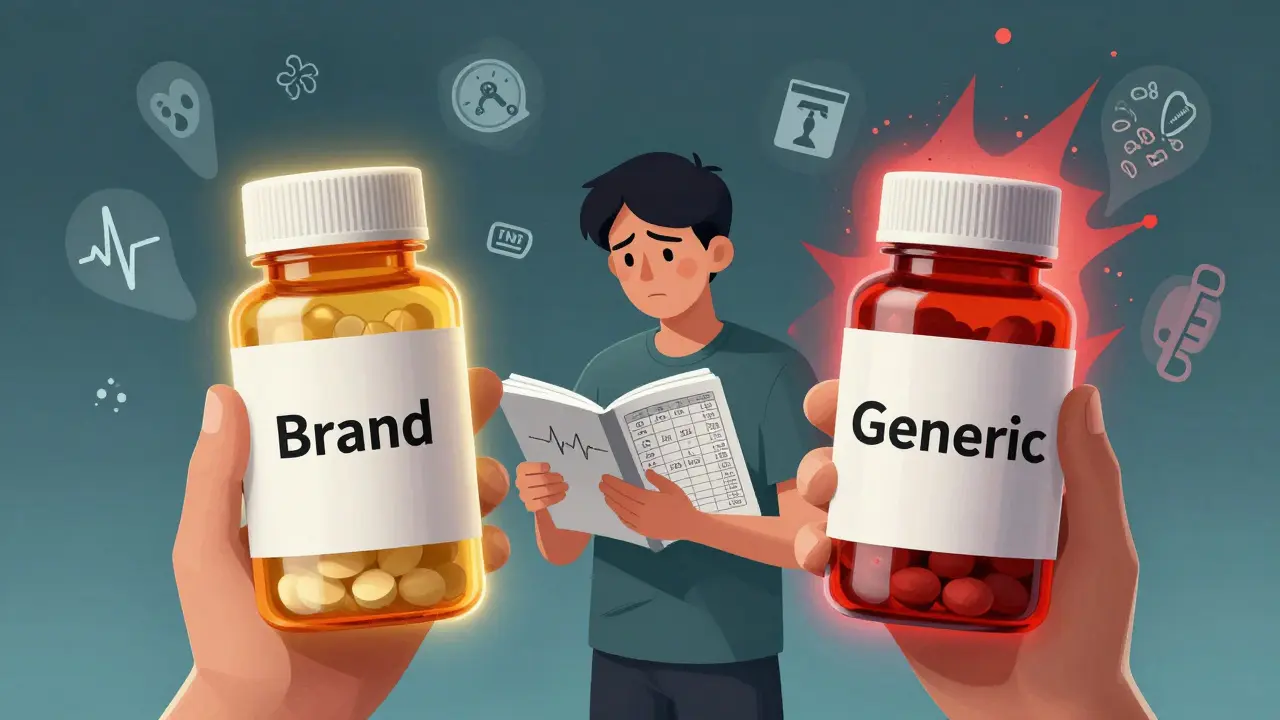
Switching from a brand-name medication to a generic version sounds simple: cheaper, same active ingredient, same results. But for some people, that switch isn’t harmless-it can mean a return of symptoms, new side effects, or even dangerous health shifts. If you’ve noticed changes after your pharmacy switched your prescription, you’re not imagining it. And you don’t have to accept it without a fight. Talking to your doctor about staying on a brand medication isn’t about being difficult-it’s about being informed and proactive.
Why Some People Need to Stay on Brand Medication
Not all medications are created equal when it comes to switching. The FDA says generics must be bioequivalent to brand-name drugs, meaning they deliver the same active ingredient at the same rate and amount. That’s true for most drugs. But there’s a catch: the acceptable range for bioequivalence is 80% to 125% of the brand’s effect. For many drugs, that’s fine. For others, it’s not.Drugs with a narrow therapeutic index-like warfarin, levothyroxine, and certain anti-seizure medications-are especially sensitive. Even small changes in blood levels can cause big problems. A study in Neurology found that patients with epilepsy who switched from brand-name Keppra to a generic had a 23% higher chance of having a seizure. Another study in the American Journal of Managed Care showed that switching between different generic versions of warfarin led to a 17% spike in emergency room visits due to unstable blood clotting levels.
It’s not just about the active ingredient. Generics can use different fillers, dyes, or preservatives. If you’re allergic to lactose, gluten, or a specific dye like FD&C Red No. 40, that’s not in the brand-name version, it can trigger reactions. About 7% of patients report allergic or intolerant reactions to these inactive ingredients in generics, according to the Journal of Allergy and Clinical Immunology.
How to Prepare Before Your Appointment
Your doctor can’t help you if they don’t know what happened. Don’t just say, “I don’t like the generic.” Be specific.- Write down exactly what changed after the switch: fatigue, headaches, mood swings, seizures, heart palpitations, or digestive issues.
- Include dates-when you switched, when symptoms started, and when they improved after going back to the brand.
- Bring lab results if you have them. For example, if you’re on warfarin, show your INR levels before and after the switch. If you’re on levothyroxine, bring your TSH numbers.
- Keep a symptom journal. Rate severity on a scale of 1 to 10. Note if symptoms happened after taking the pill or if they got worse over time.
- If you still have the original brand bottle, bring it. Or take a photo of the label. It helps your doctor see what you were on.
You don’t need to be an expert. You just need to be honest and detailed. The more concrete your evidence, the more likely your doctor will take your concerns seriously.
What to Say to Your Doctor
Use clear, direct language. Avoid vague statements like “I feel worse.” Instead, say:- “I was stable on brand-name [medication] for two years. After switching to the generic, I had [symptom] within [timeframe]. When I went back to the brand, it went away.”
- “My INR dropped from 2.8 to 1.9 after the switch. That’s below my target range. I’ve had two episodes of bruising since then.”
- “I have a known allergy to [ingredient]. I read the generic label and it contains that. The brand doesn’t.”
Use the SBAR method-it’s a proven framework doctors use to communicate clearly:
- Situation: “I’m here because I had a bad reaction after switching to the generic version of my medication.”
- Background: “I’ve been on brand-name [medication] for [X years]. I was stable. The pharmacy switched me without warning.”
- Assessment: “I believe the change in formulation caused [symptoms]. My lab results support this.”
- Recommendation: “I’d like to stay on the brand-name version. Can we request an exception with my insurance?”
Studies show that using SBAR increases successful outcomes in patient-provider discussions by 78%. It turns emotion into evidence.
Insurance and Prior Authorization
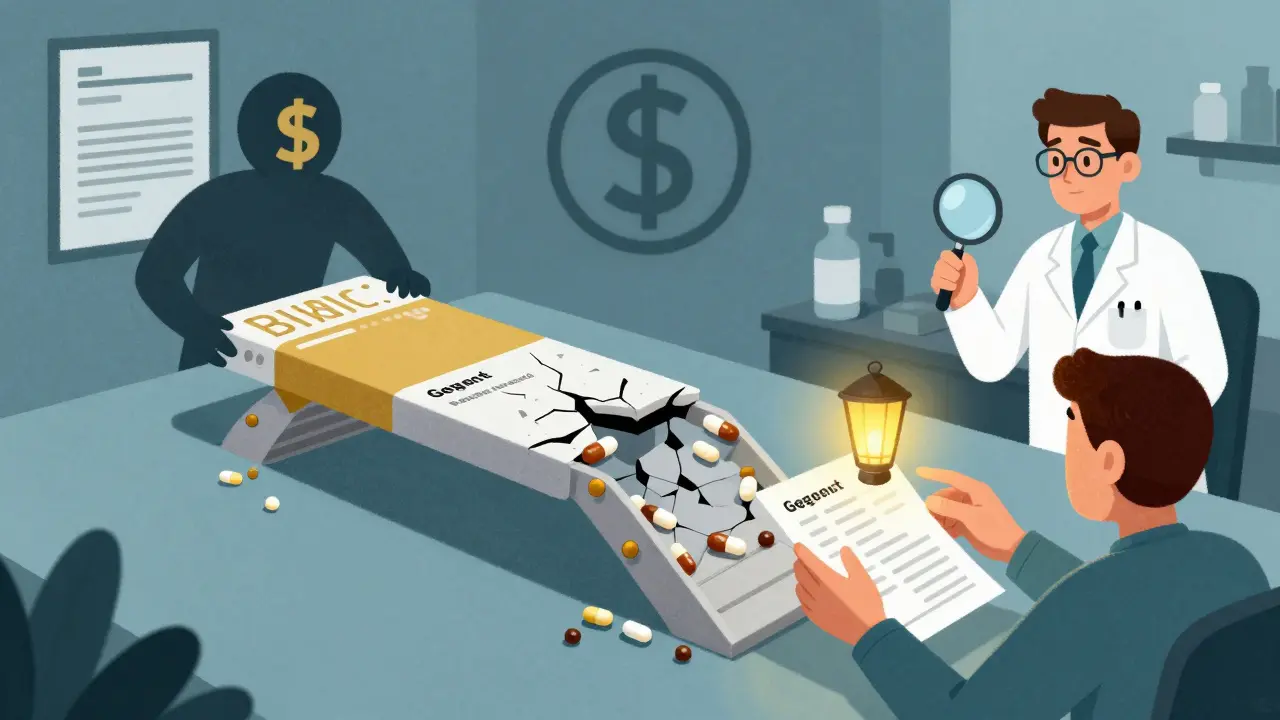
Most insurance plans push for generics. They save money. But they’re required by law to allow exceptions for medical necessity.Your doctor will need to file a prior authorization. This is paperwork that explains why the brand is necessary. Many doctors hate this-it can take 15 to 30 minutes per patient. But if you come prepared, it’s easier for them.
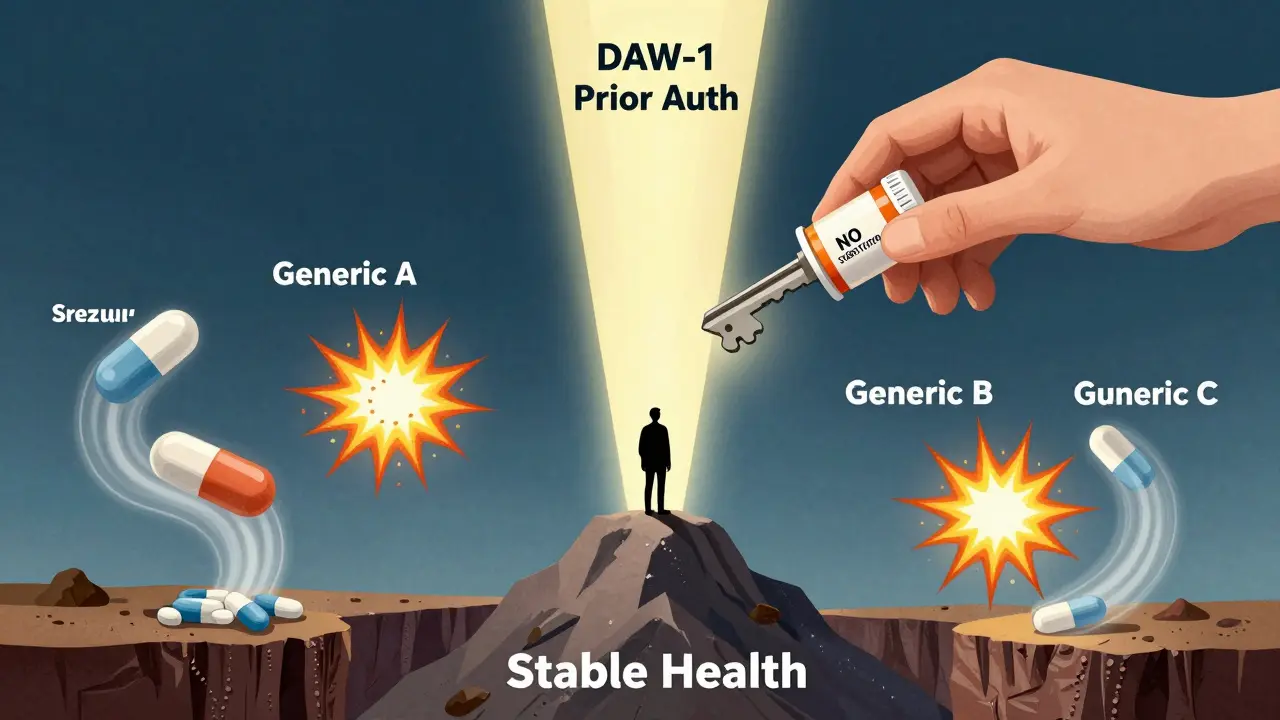
Ask your doctor to write “Dispense as Written” (DAW-1) on the prescription. That code tells the pharmacy: do not substitute. Without it, they can legally switch you.
Also, ask your doctor to reference:
- Your lab results
- Previous pharmacy records showing adverse reactions
- Guidelines from the FDA’s Orange Book, which lists therapeutic equivalence ratings
Medicare Part D and most commercial plans approve 57-72% of brand-name requests when supported with solid documentation. Don’t assume it’s denied-appeal if needed. The average time to appeal successfully is under 3 hours total.
What If Your Doctor Refuses?
Some doctors will say, “Generics are just as good.” That’s true for most drugs. But it’s not true for all. If your doctor dismisses your concerns:- Ask: “Can you refer me to a specialist who handles patients with this condition?”
- Ask: “Is there a clinical guideline that supports switching me, or is this just policy?”
- Ask: “Can we try a different generic manufacturer? Sometimes the fillers vary between companies.”
Some patients find that switching to a different generic-say, from one manufacturer to another-works better. It’s worth asking.
If your doctor still won’t help, consider seeing a pharmacist. Many pharmacists are trained in therapeutic substitution and can help you build a case. You can also contact your state’s pharmacy board or patient advocacy groups for support.
What You Can Do Right Now
You don’t need to wait for your next appointment. Start today:- Check your current prescription bottle. Look for the manufacturer name. Write it down.
- Go to the FDA’s Drugs@FDA database. Search your medication. Look for the ANDA number for your brand and any generics. Compare inactive ingredients.
- Check your pharmacy’s website. Some list the manufacturer of the generic they dispense.
- Call your pharmacy and ask: “Was I switched from a brand to a generic? If so, which one?”
- Start a simple log: Date | Medication | Symptoms | Severity
These steps take less than 20 minutes. But they give you real power.
Final Thought: Your Experience Matters
The system is designed to save money. But your health isn’t a cost center. If you’ve tried generics and had a negative outcome, your experience is valid. You’re not being difficult. You’re being smart.Doctors aren’t against you. They’re caught between policy and patient care. Give them the facts. Give them the evidence. And don’t be afraid to ask for what you need.
You’ve managed your condition this long. You deserve to keep it stable-no matter what’s on the label.
Can my pharmacist switch my medication without telling me?
In most states, yes. Forty-seven states allow pharmacists to substitute generics without notifying you, as long as the prescription doesn’t say "Dispense as Written" (DAW-1). Only 12 states require patient consent. Always check your prescription label and ask your pharmacist if a switch happened.
Are brand-name medications safer than generics?
Not inherently. Both must meet the same FDA standards for quality, purity, and strength. But safety can depend on your individual biology. If you’re sensitive to certain inactive ingredients-like lactose, dyes, or gluten-then the brand version may be safer for you. The issue isn’t safety overall-it’s individual tolerance.
What if I can’t afford the brand-name drug?
Many pharmaceutical companies offer patient assistance programs that provide brand-name drugs for free or at a low cost if you qualify based on income. You can also ask your doctor about co-pay cards or nonprofit foundations like the Patient Access Network Foundation. Some pharmacies offer discount programs too. Don’t assume you can’t afford it-there are options.
Do biosimilars count as generics?
No. Biosimilars are not generics. They’re similar to biologic drugs (like insulin or rheumatoid arthritis treatments), but they’re made from living cells, not chemicals. They’re not required to be identical-just very similar (90%+). Many patients and doctors prefer to stick with the original biologic because small differences can affect outcomes. Always check if your prescription is for a biologic or a traditional chemical drug.
How do I know if my medication has a narrow therapeutic index?
Common examples include warfarin, levothyroxine, phenytoin, carbamazepine, and lithium. You can check the FDA’s Orange Book online or ask your pharmacist. If your medication requires regular blood tests to monitor levels (like INR or TSH), it’s likely in this category. These are the drugs where switching generics carries the highest risk.




13 Comments
I switched from brand Keppra to a generic last year and my seizures doubled. I didn’t even realize it was the med until I read this post. I kept thinking I was just getting worse. My neurologist laughed at first, said generics are all the same. Then I brought my seizure log, my EEGs, and the pharmacy receipt showing the switch. He wrote DAW-1 the next day. I’m not ‘difficult’-I’m alive.
/p>Don’t let anyone tell you your body is wrong. If you feel it, document it. Bring photos of the bottles. Write down the exact time symptoms started. I used a Google Sheet. My doctor now calls me his ‘epilepsy whisperer.’
You’re not annoying. You’re the reason this system gets fixed.
generic = same shit different bag. why are we even pretending this isn’t corporate greed? they dont care if you have a seizure as long as they save 3 bucks per script. i hate how they act like its some noble cost-saving move when its just insurance companies forcing doctors to play russian roulette with your brain.
/p>DAW-1 is your best friend. Always ask for it. And if your pharmacy says they can't honor it, ask for the pharmacist on duty. They’re trained to handle this. I’ve had 12 patients get their brand meds approved just by having the right paperwork. It’s not magic. It’s procedure.
/p>my mom had a stroke after switching to generic warfarin. they said it was ‘coincidental.’ i had to dig up her INR logs from 2018 to 2022. the drop was 0.9 points after the switch. she’s still on brand. they didn’t believe us until we showed the data. now my whole family does this. you’re not crazy. you’re just the first one who kept records.
/p>It is a fascinating phenomenon, the degree to which pharmaceutical policy prioritizes fiscal efficiency over individual physiological variance. One might posit that the FDA’s 80–125% bioequivalence range, while statistically valid for population-level outcomes, fails to account for the nonlinear, idiosyncratic nature of human pharmacokinetics. In essence, we are applying a Gaussian model to a system that is demonstrably non-Gaussian.
/p>Furthermore, the inert ingredients-those ‘fillers’ dismissed as trivial-are often the very catalysts for adverse events in individuals with underlying immune sensitivities. The absence of rigorous labeling standards for excipients across generic manufacturers is, frankly, a regulatory blind spot. One must wonder: if the active ingredient is so precisely controlled, why are the excipients not subject to identical scrutiny?
I’m from India, and here generics are the norm. But I’ve seen people with thyroid issues crash after switching brands. My cousin’s TSH went from 2.1 to 8.7 in two weeks. We switched back and she’s fine. The science is real. You’re not alone. Also, in India, we have a thing called ‘same drug, different factory’-one brand makes the original, another makes the copy. Sometimes the copy is better. Ask your pharmacist which factory it’s from. It matters.
/p>people who complain about generics are the same people who think organic kale is a cure for cancer. you want brand name? pay for it. insurance exists to keep costs down. if you can’t afford it, get on assistance. stop making everyone else pay for your personal preference. this isn’t a luxury item. it’s a pill.
/p>I’ve been on levothyroxine for 11 years. I’ve tried 5 different generics. One made me cry for no reason. Another gave me heart palpitations. One made me feel like I was underwater. I kept a journal. I cried in my doctor’s office. She said, ‘You’re too sensitive.’ I said, ‘No, my TSH is 10.2. You’re not listening.’ I’m still on brand. I’m not ‘difficult.’ I’m just not dead. And I’m tired of being told my pain is a cost problem.
/p>so you’re telling me the FDA says generics are ‘equivalent’ but then gives them a 45% window of variation? that’s like saying ‘a 5’ is equivalent to a ‘7’ because they’re both numbers. genius. also, i love how they act like patients are just being dramatic when we say ‘it feels different.’ because clearly, our bodies are just making up symptoms to be inconvenient. 🙃
/p>Bring your lab results. Write down the dates. Say DAW-1. That’s it. No drama. No guilt. Just facts. Doctors respond to data. If you have the numbers, they can’t ignore you. I’ve seen it a hundred times. You don’t need to be loud. You just need to be precise.
/p>my pharmacist switched me without telling me. i found out when i saw a different logo on the bottle. i called them out. they said ‘oh we do that all the time.’ i said ‘well i’m not your experiment.’ they gave me the brand next time. just ask. it’s your right.
/p>There is a deeper philosophical tension here between systemic efficiency and individual sovereignty. The medical-industrial complex, driven by algorithmic cost-cutting, reduces human beings to statistical aggregates. Yet, biology does not conform to averages. Each body is a unique ecosystem. To impose uniformity on a system that is inherently non-uniform is not just impractical-it is ethically questionable. Perhaps the real question is not whether generics work, but whether we have the moral courage to accept that some lives cannot be optimized by a spreadsheet.
/p>As an Indian citizen who has studied pharmacology at IIT, I must say: the U.S. system is absurd. In India, we have strict batch-tracking for generics. Every pill is traceable. The FDA’s 80–125% range is a joke. 🤦♂️ If you’re in the U.S., demand better. You have the resources. Use them. Also, always check the manufacturer code on the pill bottle. Some Indian-made generics are better than American ones. I’ve seen it. 💪
/p>