
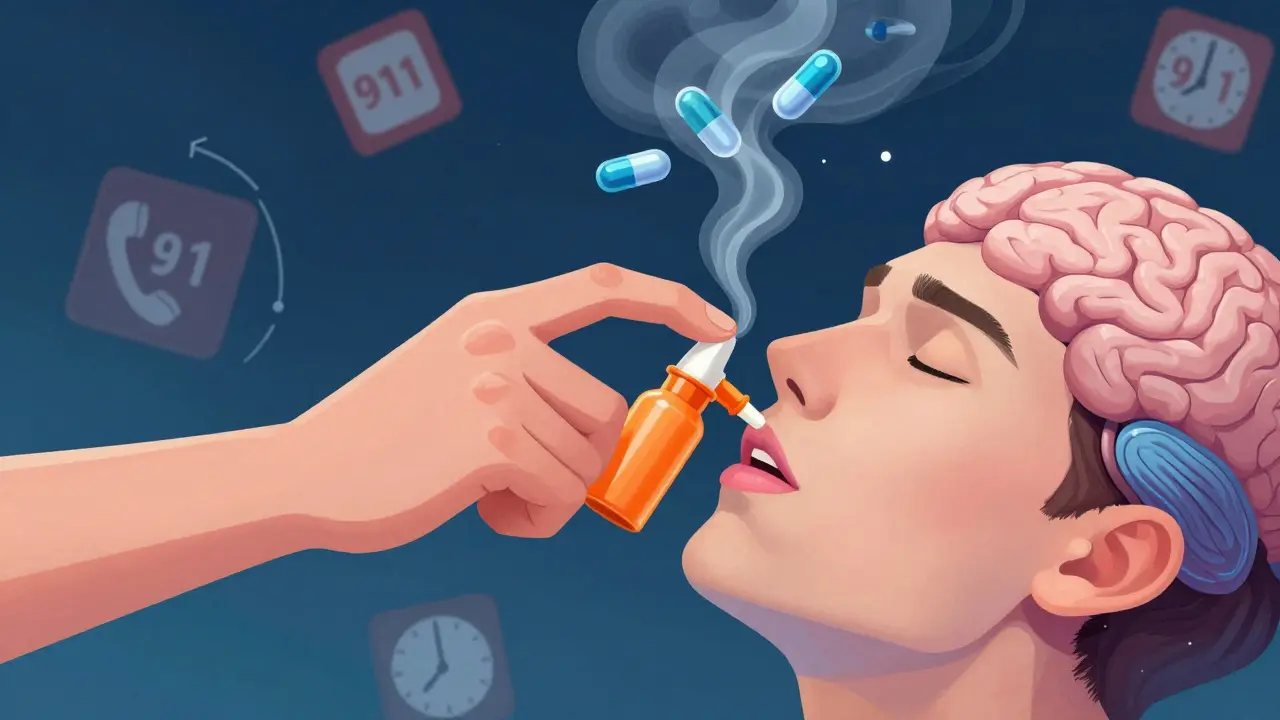
When someone overdoses on opioids, every second counts. Their breathing slows, then stops. Their skin turns blue. They don’t respond to shaking or shouting. This isn’t a scare tactic-it’s real, and it’s happening right now, in homes, alleys, and public spaces. But there’s a tool that can bring someone back: naloxone nasal spray. It’s simple, fast, and works even if you’ve never used it before. You don’t need to be a doctor. You just need to know what to do.
What Naloxone Nasal Spray Does
Naloxone nasal spray, sold under the brand name NARCAN, is a medication that blocks opioids from binding to brain receptors. It doesn’t cure addiction. It doesn’t work on alcohol, benzodiazepines, or cocaine. But if someone has taken heroin, fentanyl, oxycodone, or any other opioid, naloxone can reverse the overdose in minutes. The FDA approved it for over-the-counter sale in March 2023, and by August 2023, it was widely available in pharmacies, gas stations, and community centers across the U.S. A single spray delivers 4 mg of naloxone-enough to wake someone up from a fentanyl overdose, even if they’ve taken a lethal dose.
It’s not magic. Naloxone wears off in 30 to 90 minutes. Opioids like fentanyl can stay in the body for hours. That’s why someone who gets revived with naloxone still needs emergency help. But those few minutes matter. They’re the difference between life and death.
Recognizing an Opioid Overdose
You don’t need a medical degree to spot an overdose. Look for these signs:
- Slow, shallow, or stopped breathing (fewer than 12 breaths per minute)
- No chest movement for 15 seconds
- Unresponsive to loud voices or sternum rub (press your knuckles hard into the center of their chest for 5-10 seconds)
- Pinpoint pupils (very small, dark circles in the center of the eyes)
- Blue, gray, or pale skin, especially around the lips or fingernails
If you see two or more of these, assume it’s an opioid overdose. Don’t wait for all of them. Don’t worry if you’re not sure. Naloxone is safe-even if opioids aren’t involved, it won’t hurt someone who hasn’t taken them.
Step-by-Step: How to Use Naloxone Nasal Spray
Here’s exactly what to do, in order. Do this quickly, but calmly. Panic wastes time. Practice makes it easier.
- Call 911 immediately. Before you do anything else, call emergency services. Tell them it’s a suspected opioid overdose. Even if you’re not sure, call. Paramedics need to know what they’re walking into.
- Position the person on their back. Gently lay them flat. Tilt their head back slightly to open the airway. This helps them breathe better once naloxone starts working.
- Remove the spray from its package. Don’t pull the red cap off yet. Just take it out of the box. The device is ready to use-no assembly needed. If you accidentally press the plunger before use, you’ve wasted the dose. Be careful.
- Insert the nozzle into one nostril. Hold the device with your thumb on the plunger and your fingers on either side of the nozzle. Gently slide the nozzle into one nostril until your fingers touch the bottom of the person’s nose. Don’t force it. You’re not trying to go deep-just enough to seal the spray in.
- Press the plunger firmly. Push down all the way until you hear a click. Hold it there for 2-3 seconds. You’re delivering the full 4 mg dose. Studies show 18% of first-time users don’t press hard enough, which means they give only half the dose.
- Remove the spray and check for response. Watch their chest. Are they breathing? Is color returning to their lips? Give it 2-3 minutes. If they start breathing normally, they’re waking up. Keep monitoring.
- If no response, give a second dose. If they’re still not breathing after 3 minutes, use a new spray in the other nostril. Fentanyl overdoses often need two or more doses. The CDC says 32% of fentanyl cases require multiple sprays. Don’t wait. Don’t hesitate. Give it.
- Place them in the recovery position. If they start breathing but stay unconscious, roll them onto their side. Bend the top knee and arm to keep them stable. This keeps their airway open and prevents choking if they vomit.
- Stay with them for at least 4 hours. Naloxone wears off faster than most opioids. Someone might seem fine after 10 minutes, then slip back into overdose. Keep watching them. If they stop breathing again, give another dose. Emergency services may take 10-15 minutes to arrive. Your presence saves their life.
What to Expect After Administering Naloxone
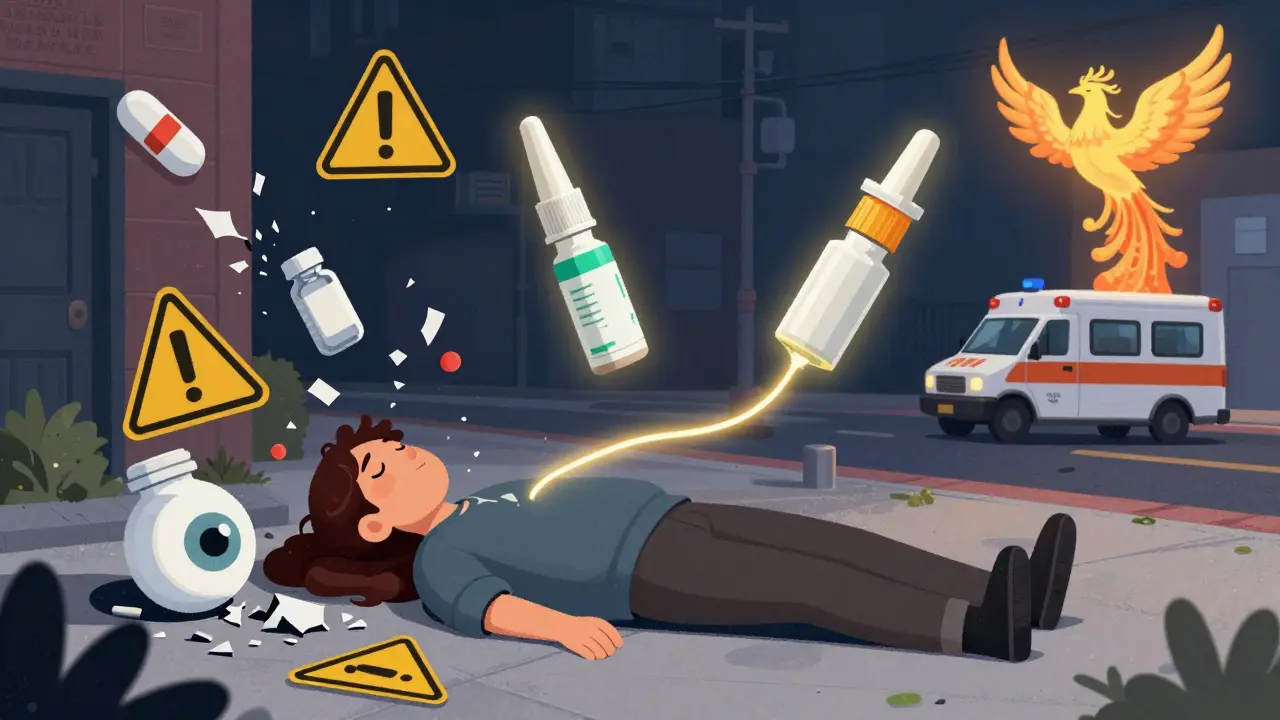
When naloxone works, the person wakes up fast. Sometimes, they wake up angry. They may feel sick, shaky, or in pain. That’s because the opioid is being ripped from their brain receptors. It’s not the naloxone hurting them-it’s the sudden absence of the drug they’re dependent on.
Some people panic. They might try to run, fight, or refuse help. Don’t take it personally. Stay calm. Keep talking to them. Say, “You’re safe. Help is coming.”
Don’t assume they’re out of danger. Fentanyl is 50 to 100 times stronger than heroin. Even if they wake up, the drug is still in their system. That’s why monitoring for 4 hours is non-negotiable.
Common Mistakes and How to Avoid Them
Most failures aren’t because naloxone doesn’t work. They’re because people make simple mistakes.
- Mistake: Waiting to call 911. Solution: Call first. Always.
- Mistake: Not pressing the plunger fully. Solution: Practice with a training device. Many pharmacies give them out for free.
- Mistake: Assuming one dose is enough. Solution: Always have two sprays ready. Keep extras in your car, bag, or home.
- Mistake: Giving naloxone to someone who didn’t take opioids. Solution: It’s safe. If you’re unsure, give it anyway.
- Mistake: Leaving after giving the dose. Solution: Stay. Monitor. Don’t assume they’re fine.
Where to Get Naloxone Nasal Spray
You don’t need a prescription. You can buy it at any pharmacy-Walgreens, CVS, Walmart, Rite Aid-without showing ID. Two sprays usually cost $40-$50 without insurance. Some community health centers, needle exchange programs, and local governments give them out for free. In Melbourne, Australia, naloxone is available through the National Drug Strategy and can be obtained from participating pharmacies under the Pharmacist Supply Scheme.
Keep one in your car. One in your bag. One at home. If you know someone who uses opioids-or even if you just live in a community where overdoses happen-having naloxone nearby is like carrying a fire extinguisher. You hope you never need it. But if you do, you’ll be glad it’s there.
Training and Support
Watching a 3-minute video on YouTube can make you 87% likely to use naloxone correctly. But hands-on training with a practice device? That raises it to 98%. Many organizations offer free training: local health departments, harm reduction groups, even some libraries.
The National Overdose Response Service (1-800-222-4357) can walk you through what to do over the phone. They handled over 28,000 calls in 2022 and got 97% of callers through the steps correctly.
And if you’re ever unsure? Ask. There’s no shame in learning. People have saved lives because they didn’t wait to feel ‘ready.’ They acted.
Why This Matters
In 2022, over 81,000 people in the U.S. died from opioid overdoses. Fentanyl was involved in nearly 90% of those deaths. That’s more than car crashes or gun violence. But naloxone has already saved over 27,000 lives in the U.S. since 2020. And that number could rise to 30,000 more per year if everyone who might need it had access.
This isn’t about judgment. It’s about survival. You don’t have to understand addiction to save a life. You just have to know how to use a nasal spray.


11 Comments
Naloxone is a game-changer. I’ve seen it work firsthand. One guy went blue in a parking lot, we sprayed him, and he sat up coughing like he’d been punched. No doctor needed. Just guts and a spray bottle.
/p>Keep one in your glovebox. You never know when you’ll need it.
I work in a community center and we hand these out like candy. People think it’s too complicated, but once they hold one, they get it. It’s not magic, but it’s close enough.
/p>My favorite part? The guy who said, ‘I didn’t know I could save someone’s life with this.’ He now carries two in his backpack. That’s the ripple effect.
Just got my first NARCAN from CVS. $42. No ID. No judgment. Just a little plastic box that could save someone’s life.
/p>Put one in my purse. One in my car. One in my brother’s coat pocket. He’s been clean 18 months, but I’m not taking chances. 🙏
So let me get this straight. We’re handing out life-saving nasal sprays like gum at a movie theater, but we still can’t get clean needles into the hands of people who need them? Interesting priorities.
/p>Also, why is this only available in the U.S.? Europe’s still acting like this is a moral issue, not a medical one.
While I appreciate the sentiment, this guide is dangerously oversimplified. Naloxone is not a panacea. The FDA’s approval was politically motivated, not scientifically rigorous. The claim that it reverses fentanyl overdoses is misleading-fentanyl analogues often require multiple doses, and many are resistant.
/p>Furthermore, the normalization of naloxone distribution inadvertently encourages risky behavior among substance users, creating a false sense of security. We must address root causes, not symptom mitigation.
And the assertion that it’s safe for non-opioid users? That’s medically inaccurate. In rare cases, it can precipitate acute withdrawal syndrome with cardiovascular complications, especially in chronic users.
Finally, the recommendation to monitor for four hours is not evidence-based. The half-life of fentanyl metabolites can extend beyond 12 hours in some cases. This guide, while well-intentioned, is a public health liability.
How utterly gauche. To reduce the profound tragedy of opioid dependency to a checklist of nasal sprays and step-by-step instructions is to commodify suffering. This is not empowerment-it is performative benevolence dressed in the cheap polyester of public health propaganda.
/p>One does not save a life by handing out a spray; one saves a life by restoring dignity. By offering housing. By providing therapy. By ceasing to treat addicts as disposable statistics.
And yet, here we are, celebrating the latest pharmacological Band-Aid as if it were a moral victory. How quaint. How tragically American.
Perhaps we should be mourning the erosion of communal care, not applauding the convenience of a $50 nasal spray purchased next to the energy drinks.
I’m from India, and I’ve seen people die because no one knew what to do. We don’t have naloxone here. Not legally. Not easily.
/p>But I watched my cousin’s friend overdose in a back alley. Someone tried mouth-to-mouth for 15 minutes. No one called 911. No one had a clue.
This guide? It’s a lifeline. I’m printing it. Sharing it with my community. Maybe one day, India will catch up.
Thank you for writing this. Not just for Americans-for all of us who still believe saving a life is worth the effort.
They say naloxone saves lives, but what they don’t tell you is that it’s a tool of the pharmaceutical industry. The same companies that profit from opioids now profit from the antidote. It’s a closed loop.
/p>And why is it sold in gas stations? To normalize addiction. To make it seem like it’s just another consumer product.
They want you to think you’re a hero for using it. But you’re just a pawn in their game.
Who funded this guide? Who owns the patents? Look deeper. Always look deeper.
Used this on my cousin last year. Fentanyl. One spray. He woke up screaming, ‘What the f*** did you do?!’ Then he hugged me. Cried. Said he’d never do it again.
/p>He’s been sober 11 months now.
It’s not about politics. It’s about family. Keep the spray. Don’t overthink it.
Call 911 first
/p>Position on back
Insert nozzle
Press plunger
Wait 3 minutes
Second spray if no response
Recovery position
Stay for 4 hours
That’s it. No fluff. No theory. Just do it.
They’re putting naloxone in gas stations next to cigarettes and energy drinks. That’s not an accident. That’s a deliberate strategy to normalize addiction. The government knows most users are young. They want you to think it’s safe. It’s not. It’s a trap.
/p>And why are they pushing this now? Right after the opioid lawsuits settled? Coincidence? I don’t think so.
They’re not saving lives. They’re managing populations. The real solution? Criminalize the manufacturers. Not the users. Not the spray. The people who flooded the streets with fentanyl.
And who’s funding these ‘free training’ programs? Check the donors. I dare you.