

When you take a pill, you expect every tablet to be exactly the same. That’s how small-molecule drugs work-they’re made in a lab using precise chemical reactions, and each dose is identical. But if you’re on a biologic drug, that expectation doesn’t hold. Even two bottles from the same manufacturer, made weeks apart, contain millions of slightly different versions of the same protein. This isn’t a mistake. It’s lot-to-lot variability-a natural, unavoidable part of how biologics and biosimilars are made.
Why Biologics Are Never Exactly the Same
Biologics aren’t chemically synthesized like aspirin or metformin. They’re grown inside living cells-usually Chinese hamster ovary cells or yeast cultures. These cells act like tiny factories, producing complex proteins like antibodies, hormones, or enzymes. But living systems aren’t machines. They’re messy. Tiny changes in temperature, nutrient levels, or even the cell’s own internal chemistry can alter how the protein folds, how sugars attach to it, or how it behaves in the body. These changes are called post-translational modifications. The most common? Glycosylation-the addition of sugar molecules to the protein. A single antibody can have dozens of different glycosylation patterns. Some versions might bind more tightly to immune cells. Others might clear from the bloodstream faster. None of this is random noise. It’s part of the biological process. The U.S. Food and Drug Administration (FDA) calls this "inherent variation." And they’re clear: it’s not a flaw. It’s the rule. Even the original brand-name biologic-say, Humira or Enbrel-has lot-to-lot differences. That’s why biosimilars don’t need to be identical. They just need to be highly similar with no clinically meaningful differences in safety or effectiveness.Biosimilars vs. Generics: A Fundamental Difference
You’ve probably heard that biosimilars are "like generics" for biologics. That’s misleading. Generics are exact copies. If you take a generic version of lisinopril, you’re getting the same molecule, in the same form, with the same salt, in the same dose. It’s chemistry. It’s predictable. Biosimilars? They’re more like twins than clones. They start from the same blueprint, but their final form isn’t identical. One batch might have 12% more of a certain sugar group. Another might have a slightly different shape in one part of the protein. The key is whether those differences affect how the drug works in your body. That’s why the approval process is so different. Generics go through an Abbreviated New Drug Application (ANDA). They show bioequivalence-your blood levels of the drug are within 80-125% of the brand. Done. Biosimilars go through the 351(k) pathway. They need to prove similarity at the molecular level using hundreds of analytical tests. Then they need functional assays to show they bind to the same targets. Then they need pharmacokinetic studies. And sometimes, clinical trials. All to prove that even with natural variation, the biosimilar performs just like the original. As of May 2024, the FDA has approved 53 biosimilars in the U.S. Twelve of those are designated as "interchangeable," meaning a pharmacist can swap them for the brand without consulting the doctor. That’s a big deal. But it’s not automatic. Interchangeability requires an extra layer of proof: switching studies. Patients are moved back and forth between the brand and the biosimilar multiple times to show no drop in effectiveness or rise in side effects.How Manufacturers Control the Chaos
If variation is inevitable, how do companies make sure every batch is safe? They don’t eliminate it. They control it. Every biologic manufacturer has a "control strategy"-a set of tightly defined parameters for every step of production. Temperature ranges. Fermentation times. Purification filters. Cell line stability. Each of these factors is monitored and adjusted to keep variation within a narrow, safe window. Think of it like baking sourdough. No two loaves are identical. But a skilled baker knows how to adjust hydration, proofing time, and oven heat so every loaf still rises properly and tastes great. Same here. The manufacturer doesn’t aim for perfection. They aim for consistency within acceptable limits. The FDA reviews these control strategies before approving any biosimilar. They look at the pattern of variation-not just the average, but the range, the trends, and how it compares to the reference product. If the biosimilar’s variation overlaps with the reference product’s variation, that’s a good sign. Advanced tools like mass spectrometry and high-throughput analytics now let scientists detect differences at the molecular level that were invisible a decade ago. That’s why newer biosimilars are more precisely matched to their reference products than earlier ones.
What This Means for Labs and Clinicians
Lot-to-lot variability doesn’t just affect patients on biologics. It affects everyone who relies on lab tests. Many diagnostic tests use biologic reagents-antibodies, enzymes, or proteins that detect markers in blood or urine. If the reagent lot changes, the test result can shift. A 2022 survey found that 78% of lab directors consider reagent lot-to-lot variation a "significant challenge." Here’s why it’s tricky: quality control samples don’t always behave like real patient samples. A reagent lot might pass QC tests but still give different results for actual patients. In one documented case, switching reagent lots caused HbA1c results to rise by 0.5%-enough to push a patient from "well-controlled" to "poorly controlled" diabetes without any real change in their health. That’s why labs don’t just swap reagents. They verify. They test 20 or more patient samples with the new lot and compare results to the old lot. They need statistical power-80% to 95% confidence-to catch even small shifts. It’s time-consuming. Smaller labs spend 15-20% of their technical staff’s time each quarter just verifying new lots. Clinicians need to know this, too. If a patient’s lab values suddenly shift without clinical change, check the reagent lot. It might not be the patient. It might be the test.Why This Matters for Patient Trust
When patients hear that a biosimilar isn’t "exactly the same," they worry. Is it weaker? Riskier? Less effective? The data says no. Studies of biosimilars for rheumatoid arthritis, psoriasis, and cancer have shown no difference in outcomes compared to the original biologic. In fact, over 32% of all biologic prescriptions in the U.S. are now filled with biosimilars. That’s not because they’re cheaper (though they are). It’s because doctors and patients trust them. The real issue isn’t the science. It’s the messaging. If we keep calling biosimilars "generic biologics," we set up patients for disappointment. They expect perfection. They get variation. And that can erode trust. The better message? "This medicine is made the same way as the original, using living cells. Like the original, it has natural, small differences between batches. But those differences have been studied, measured, and proven not to affect safety or how well it works."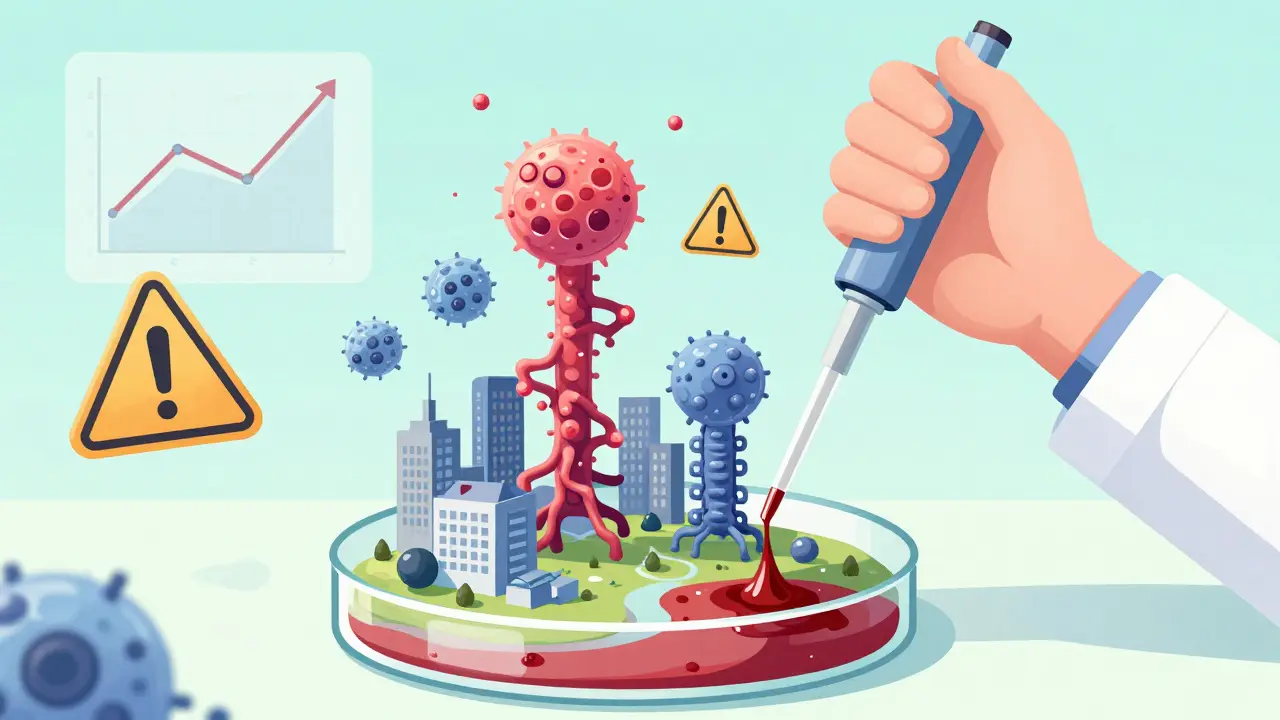
The Future: More Complexity, More Control
The next wave of biologics-antibody-drug conjugates, cell therapies, gene therapies-is even more complex. They’re not just proteins. They’re living cells carrying genes, or tiny drug-loaded antibodies targeting tumors. These therapies will have even greater lot-to-lot variability. But the tools are getting better. AI is helping predict how small changes in manufacturing affect final product quality. Real-time monitoring during production is becoming standard. Regulatory agencies are adapting too. By 2026, experts predict 70% of new biosimilar applications will include interchangeability data-up from 45% in 2023. The goal isn’t to eliminate variation. It’s to understand it, manage it, and prove that even with millions of slightly different molecules, the medicine still works the same way for every patient.Frequently Asked Questions
Are biosimilars less safe because of lot-to-lot variability?
No. Every batch of a biologic or biosimilar is tested to ensure it stays within strict, predefined limits of variation. The FDA requires manufacturers to prove that even with natural differences between lots, the product remains safe and effective. Clinical studies and post-market monitoring have shown no increased risk with biosimilars compared to their reference products.
Can I switch between a biosimilar and the original biologic safely?
If your biosimilar has the "interchangeable" designation from the FDA, then yes. These products have been tested in switching studies where patients moved back and forth between the biosimilar and the original. No drop in effectiveness or increase in side effects was found. For non-interchangeable biosimilars, switching should be done under a doctor’s supervision, but many providers do so safely in practice.
Why do some labs have trouble with biosimilar reagents?
Many lab tests use biologic reagents-like antibodies-that are sensitive to small changes in protein structure. Even minor shifts in glycosylation or folding can affect how well the reagent binds to its target. Labs must verify each new reagent lot with patient samples, not just controls, because QC materials don’t always mimic real patient results. This is a known challenge, and labs have protocols to manage it.
Does lot-to-lot variability mean biosimilars are inferior?
No. It means they’re biologics. All biologics-brand-name and biosimilar-have natural variation. The difference isn’t in the product quality. It’s in the manufacturing origin. Biosimilars are held to the same high standards for consistency and safety. The variation is not a sign of inferiority; it’s a sign of complexity-and it’s managed just as rigorously.
How do I know if my medication is a biosimilar?
Check the label or ask your pharmacist. Biosimilars have distinct nonproprietary names that include a four-letter suffix (like adalimumab-atto for Humira’s biosimilar). The FDA’s website also lists all approved biosimilars and their interchangeability status. If you’re unsure, your doctor or pharmacist can confirm what you’re taking.



12 Comments
Let’s be real-this whole ‘inherent variation’ narrative is just corporate doublespeak for ‘we can’t control our shit, but we’ll charge you $20K/year anyway.’ You call it ‘biological complexity’? I call it sloppy manufacturing wrapped in a lab coat. The FDA’s ‘no clinically meaningful differences’ is a euphemism for ‘we haven’t caught it yet.’ And don’t get me started on interchangeable biosimilars-those are just pharmacy shortcuts disguised as science.
/p>i read this whole thing and honestly… my brain hurt but in a good way? like i never thought about how my insulin might be slightly different every time i fill the prescription. that’s wild. and kinda scary? but also… kinda beautiful? nature’s messy but it works. thanks for explaining it like i’m not a phd.
/p>The notion that variation implies inferiority is a deeply human fallacy. We crave uniformity because it gives us the illusion of control, yet biology thrives in ambiguity. The protein’s glycosylation patterns are not defects-they are signatures of life. To demand molecular perfection from a living system is to misunderstand the very essence of what a biologic is. Perhaps the real innovation isn’t in controlling variation, but in learning to trust its consistency.
/p>Oh wow a 78% survey says labs have problems? Shocking. Next you'll tell me water is wet and the sky is blue. Also, I'm sure those 'clinical trials' were conducted by the same people who wrote the manual for the machine that made the drug. What a surprise, it works perfectly in the lab. In the real world? Not so much. Pass the placebo.
/p>I’ve been on Humira for 8 years. Switched to a biosimilar last year. My flare came back 3 weeks later. My doctor said ‘it’s just variation’ and gave me more steroids. I’m not a lab rat. I’m not a data point. And no, I don’t care if your ‘control strategy’ says it’s ‘within acceptable limits.’ My body knows the difference. This isn’t science. It’s corporate gambling with people’s lives.
/p>labs are fucked. reagent lots change and no one tells you. my hba1c jumped 0.7 without me changing anything. doctor blamed me. turned out it was the new antibody batch. i called the lab. they said ‘oh yeah we had to revalidate.’ no apology. no notice. just me paying for their mess.
/p>It’s fascinating how the modern pharmaceutical industry has weaponized complexity to obscure regulatory arbitrage. The FDA’s 351(k) pathway isn’t a rigorous standard-it’s a negotiated concession to biotech capital. The term ‘biosimilar’ itself is a semantic sleight of hand, designed to imply equivalence while legally permitting heterogeneity. One must ask: if the variation is truly inconsequential, why not call it a generic? The answer lies not in science, but in patent economics.
/p>This article is dangerously misleading. The United States of America leads the world in biopharmaceutical innovation. To suggest that variation is acceptable without absolute, unyielding standards is to undermine decades of rigorous scientific achievement. Our regulatory framework is the gold standard for a reason. Any suggestion that biosimilars are somehow equivalent without perfect molecular identity is an affront to American medical integrity.
/p>THIS. THIS IS SO IMPORTANT. 🙏 I’ve been on a biosimilar for my RA and honestly? I felt like a guinea pig at first. But my pain’s been stable, my doctor’s been transparent, and I’ve saved $15K a year. This isn’t compromise-it’s progress. We need to stop scaring patients with jargon and start celebrating access. You’re not losing quality-you’re gaining life. 💪❤️
/p>Lot-to-lot variability is not a flaw. It is a necessary consequence of manufacturing living systems. The regulatory process is designed to ensure that all variation remains within statistically validated, clinically insignificant boundaries. To suggest otherwise is to misunderstand the fundamental nature of biologics. The science is sound. The data is robust. Trust the process.
/p>As someone who works in biologics QA, I can say this: we spend more time measuring variation than we do making the drug. Every batch is tracked down to the molecular level. We’ve got AI models predicting glycosylation shifts before they happen. The truth? The biosimilar I helped approve is actually more consistent than the original brand from 2012. It’s not magic-it’s better tech. And yeah, I’ve seen patients cry when they find out they’re saving $10K a year. That’s the real win.
/p>People like you think this is all fine because you don’t have to live with the consequences. My sister died because her biosimilar didn’t work. They said it was ‘within acceptable variation.’ She was 29. Your ‘control strategy’ didn’t control anything. You’re not saving money-you’re sacrificing lives. And you call yourself a scientist? Pathetic.
/p>