
Medication Risk Calculator
Orthostatic Hypotension Risk Assessment
Determine if your medications put you at risk for dizziness when standing. Based on data from the article.
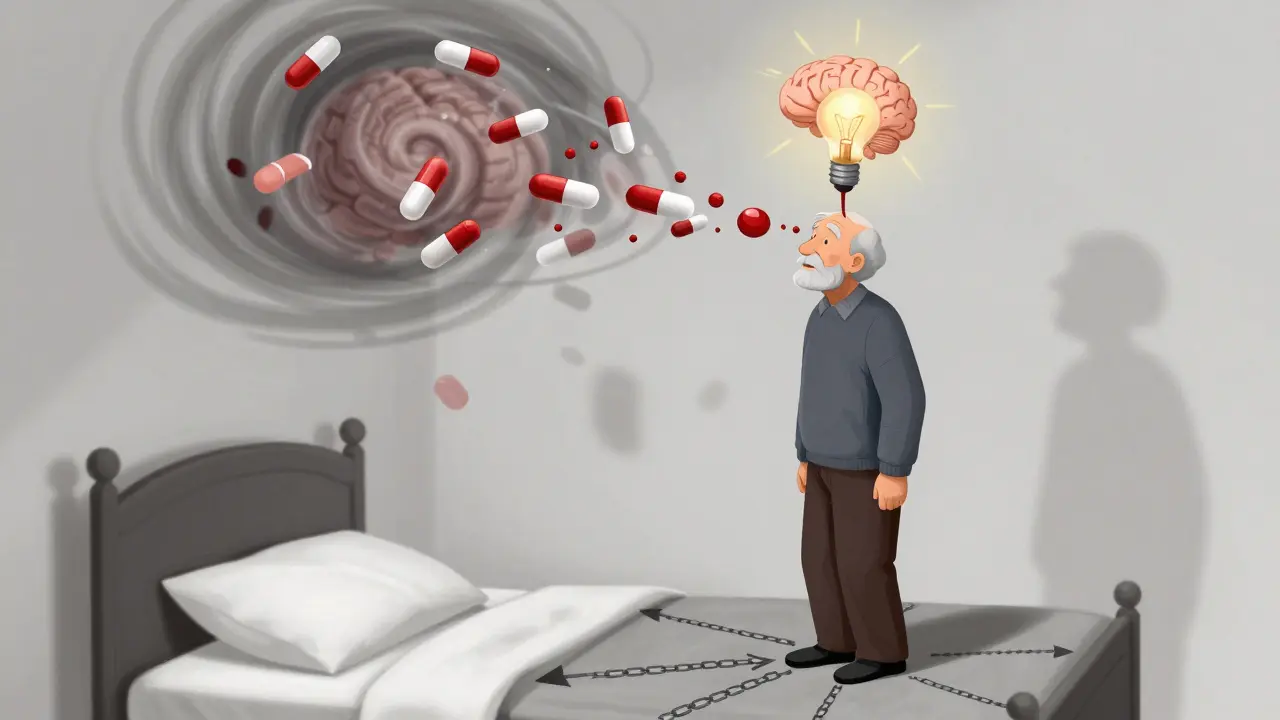
Standing up too fast and feeling like the room is spinning? That dizzy spell isn’t just bad luck-it could be your medications. Orthostatic hypotension is the medical term for the sudden drop in blood pressure that happens when you stand up, and it’s one of the most common, yet often ignored, side effects of everyday drugs. It’s not just an annoyance. It’s a real risk for falls, injuries, and even long-term health problems-especially if you’re over 65 or taking multiple medications.
What Exactly Is Orthostatic Hypotension?
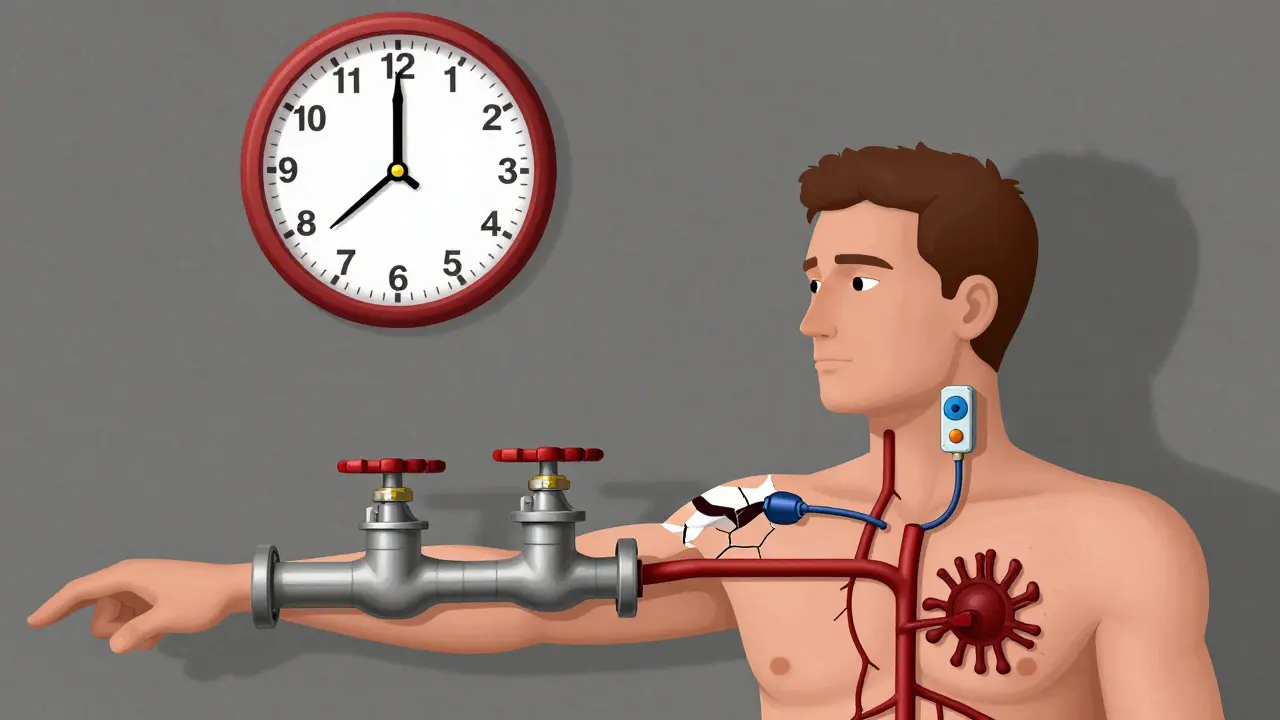
When you stand, gravity pulls blood down into your legs. A healthy body responds by tightening blood vessels and increasing heart rate to keep blood flowing to the brain. But when this system fails, blood pressure drops too much, and your brain gets less oxygen. That’s orthostatic hypotension. The clinical definition is simple: a drop of 20 mm Hg in systolic pressure or 10 mm Hg in diastolic pressure within three minutes of standing. You don’t need fancy equipment to notice it-symptoms like lightheadedness, blurred vision, or feeling faint are your body’s warning signs.Here’s the catch: up to 40% of people with this condition don’t even realize they have it. They just think they’re clumsy or getting older. But when someone over 70 falls because of this, the consequences can be serious-fractures, brain injuries, hospital stays. And it’s not rare. About 5% to 30% of older adults experience it, depending on how many meds they’re on. And nearly one in three of those cases? Directly tied to the drugs they’re taking.
Which Medications Cause Dizziness on Standing?
Not all drugs cause this-but some are notorious. The big offenders fall into a few key categories:- Antihypertensives (blood pressure pills): These are supposed to lower BP, but sometimes they lower it too much. Diuretics like hydrochlorothiazide and ACE inhibitors like lisinopril are common culprits. One patient’s story from Cleveland Clinic’s forums: after removing HCTZ, their recurrent falls stopped within 72 hours.
- Alpha-blockers: Used for prostate issues and high blood pressure, these drugs (like doxazosin and terazosin) relax blood vessels. But they can overdo it. Studies show they increase OH risk by nearly 3 times.
- Tricyclic antidepressants (TCAs): Drugs like amitriptyline and nortriptyline affect nerve signals that control blood pressure. People on these have over 3 times higher risk of OH than those not taking them.
- Antipsychotics: Especially older ones like chlorpromazine and clozapine. Clozapine alone causes OH in 35-45% of users. Even newer ones like quetiapine can trigger it-Reddit user AnxiousSenior89 reported fainting twice after starting it.
- Opioids: Morphine, oxycodone, hydrocodone. About 15-25% of elderly patients on opioids develop OH. The risk spikes if they’re also taking benzodiazepines or drinking alcohol.
- Levodopa: Used for Parkinson’s, it causes OH in 30-50% of patients. That’s why many Parkinson’s patients fall-not because of their movement disorder, but because their blood pressure crashes when they stand.
And here’s the kicker: the more drugs you take, the higher your risk. People on four or more medications have over 5 times the risk compared to those on one or two. Polypharmacy isn’t just a buzzword-it’s a silent danger.
Why Does This Happen? The Science Behind the Dizziness
Your body’s natural response to standing is a well-oiled machine: baroreceptors in your neck and chest sense the drop in pressure, signal your brain, and your heart pumps faster while your blood vessels tighten. Medications disrupt this chain in different ways.- Alpha-blockers prevent blood vessels from tightening.
- Diuretics drain fluid, reducing blood volume so there’s less to pump.
- Antidepressants and antipsychotics interfere with nerve signals that control blood pressure.
- Opioids depress the brain’s ability to respond to low BP.
Age makes it worse. As we get older, baroreceptors become less sensitive. Blood vessels stiffen. The heart doesn’t respond as quickly. Combine that with meds that already slow the system down, and you’ve got a perfect storm. That’s why someone in their 70s on three meds has a much higher risk than a healthy 40-year-old on one.
How Is It Diagnosed? It’s Simpler Than You Think
Your doctor doesn’t need a CT scan or blood test. Just two measurements:- Take your blood pressure while lying down for five minutes.
- Stand up. Measure again at one, two, and three minutes.
If the systolic number drops 20 or more, or diastolic drops 10 or more, you’ve got orthostatic hypotension. And if you feel dizzy at the same time? That’s confirmation. Many doctors skip this simple step-especially if they’re focused on treating the original condition (like depression or high BP) and not the side effect. But if you’re falling, fainting, or feeling lightheaded after standing, this test should be routine.
And don’t assume it’s just “getting older.” A 2022 Mayo Clinic study found that 55% of patients had symptoms for over two months before their doctor linked them to meds. That’s two months of unnecessary risk.
What Can You Do About It?
The good news? Medication-induced orthostatic hypotension is often reversible. You don’t have to live with it.Step 1: Review Your Meds
Talk to your doctor or pharmacist. Ask: “Could any of these be causing my dizziness?” Sometimes, switching to a safer alternative helps. For example:- Instead of a TCA for depression, try an SSRI like sertraline-much lower OH risk.
- For prostate issues, consider tamsulosin instead of doxazosin. It’s less likely to drop blood pressure.
- For pain, avoid long-term opioids if possible. Try physical therapy or non-opioid options.
Don’t stop meds on your own. But do ask for a full review. Stanford Healthcare found that 65-80% of patients saw symptom relief after adjusting their drug list.
Step 2: Non-Drug Fixes Work Better Than You Think
- Stand up slowly. Sit on the edge of the bed for 30 seconds before standing. Use a handrail.
- Drink more water. Aim for 2-2.5 liters a day. Dehydration makes OH worse.
- Wear compression stockings. They help push blood back up from your legs. Studies show they reduce symptoms in over half of users.
- Elevate the head of your bed. Just 6-8 inches. It helps your body retain fluid overnight and reduces morning BP drops.
- Avoid heat. Hot showers, saunas, and hot weather dilate blood vessels and make OH worse.
Step 3: When Medication Is Still Needed
Sometimes, you can’t stop the drug-like levodopa for Parkinson’s or an antipsychotic for severe psychosis. In those cases, doctors may prescribe midodrine, a drug that tightens blood vessels. It’s not perfect-it can raise BP too much when lying down-but it helps 65% of patients. The American Heart Association now recommends it as a first-line option when lifestyle changes aren’t enough.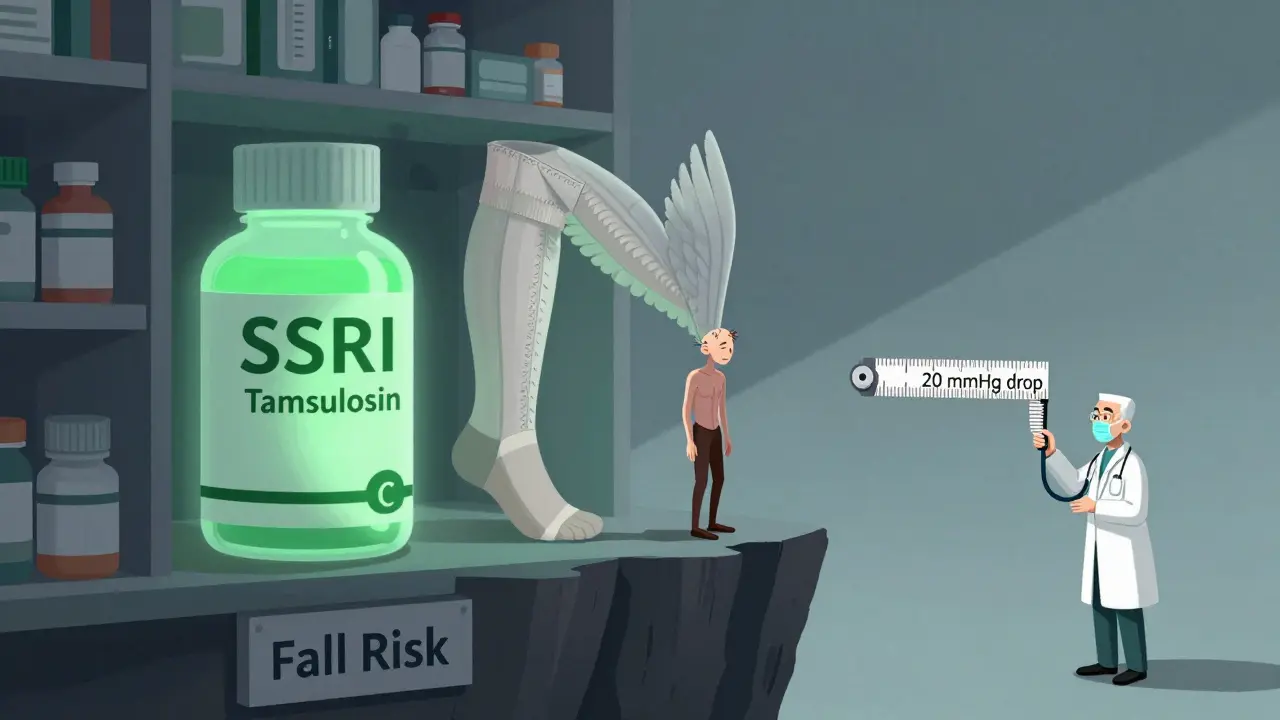
Who’s at Highest Risk?
It’s not just seniors. But certain people are far more vulnerable:- Age 70+: 3.2 times higher risk than younger adults.
- On 4+ medications: 5.7 times higher risk.
- Diabetes or Parkinson’s: These conditions damage nerves that control blood pressure.
- History of falls: Even one fall in the past year increases your risk of another.
If you fit any of these, ask your doctor for a simple orthostatic BP check at your next visit. It takes two minutes. It could save your life.
Why This Matters More Than Ever
By 2040, over 80 million Americans will be over 65. That’s a huge increase in people at risk for medication-induced OH. Right now, OH-related falls cost Medicare $31 billion a year-and 30-40% of those are linked to drugs. That’s billions in avoidable costs. And behind every number is a person who fell, got hurt, and might have been protected with a simple med review.Doctors are starting to catch on. The American Geriatrics Society now lists 12 high-risk meds in their Beers Criteria. Most geriatric clinics screen for OH now. But it still slips through. You can’t wait for your doctor to catch it. Be your own advocate. If you feel dizzy when standing, say something. Ask: “Could this be my meds?”
It’s not about stopping treatment. It’s about making it safer. You don’t have to choose between managing your condition and staying upright. With the right changes, you can do both.


9 Comments
I've been dizzy since I started my blood pressure meds. Thought I was just getting old. Turns out my doctor never checked my orthostatic BP. Now I'm on a different pill and no more falling. Why do docs skip this? It's 2 minutes.
My mom fell and broke her hip last year. They said 'just age.' No, it was the hydrochlorothiazide. I wish I'd known sooner./p>
They're all just pushing pills. Big Pharma doesn't want you to know this. The real cause? The government's hidden salt mandate. They force it into everything so you need more meds. Then they sell you the pills to fix the side effects. It's a cycle. I stopped all meds and went salt-free. No more dizziness. They don't tell you this because they profit off your dizziness./p>
You people are too soft. America's got the best healthcare in the world. If you're dizzy, you're probably just lazy. I'm 72 and I still lift weights. No meds. No dizziness. Stop whining. Get up fast. Your body adapts.
Also, if you're on more than two meds, you're probably just a pill-popping idiot. I've been on three since '08 and never once felt faint. You're weak. Build up your legs. Or move to Canada./p>
Ive been reading this and i think its all a bit overblown tbh. The real issue is the american medical system. They dont test for OH because theyre too busy billing for CT scans. I was misdiagnosed for 18 months. My GP just wrote it off as 'senior moments'.
Also, why is everyone so obsessed with meds? I think the real problem is the sugar in our food. It messes with autonomic function. Nobody talks about that. Probably because the FDA is in bed with Big Sugar./p>
I'm on sertraline now instead of amitriptyline and the difference is night and day. No more blacking out when I get up.
Also drinking 3L of water a day and wearing socks helped. Not magic. Just basic. Why do we make this so complicated?/p>
The baroreflex arc is compromised in polypharmacy due to downregulation of alpha-2 adrenergic receptors in the nucleus tractus solitarius. The clinical implication is that non-pharmacologic interventions must be prioritized before considering pharmacologic reversal agents like midodrine.
Furthermore, the 2022 Mayo data shows a 55% delay in diagnosis, which is unacceptable given the sensitivity of orthostatic BP measurement. This is a systems failure, not a patient failure./p>
I used to work in a nursing home. Saw this every day. Old folks falling. Family blaming them. Doctors blaming age. But it was always the meds. One guy was on 9 drugs. 9.
They didn't even check his BP standing. Just gave him more painkillers. I quit that job. Too much BS./p>
This is one of the most important pieces of health information I've read in years. Thank you for breaking it down so clearly.
Many people don't realize that dizziness isn't normal. It's a warning sign. And it's often reversible. That's hope.
Please share this with someone over 65. It could literally save their life./p>
The pathophysiology of medication-induced orthostatic hypotension is multifactorial and primarily involves dysregulation of the autonomic nervous system. The integration of non-pharmacological interventions such as volume expansion, compression therapy, and postural modification demonstrates a 62% reduction in symptomatic episodes in prospective cohort studies.
It is imperative that clinicians adopt a proactive screening protocol for patients on polypharmacy, particularly those with concomitant conditions such as diabetes or Parkinson's disease. The cost-benefit ratio of a simple orthostatic BP measurement is overwhelmingly favorable./p>