
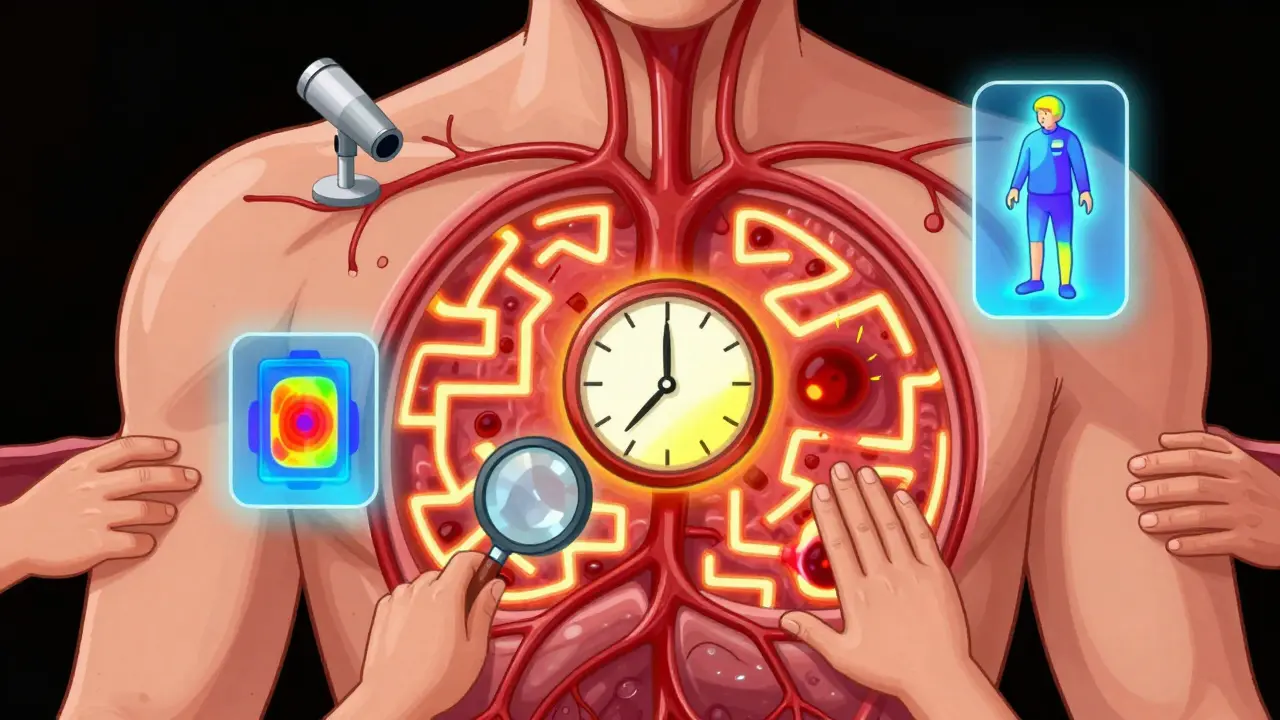
When melanoma is caught early, your chances of survival are nearly certain. More than 99% of people diagnosed with localized melanoma live at least five years after diagnosis. But if it spreads? That number drops to just 32%. This isn’t a distant threat-it’s a real, ticking clock. Melanoma doesn’t always look like a classic dark mole. It can be a new spot, a changing freckle, or even a scar that won’t heal. The difference between life and death often comes down to one thing: early detection.
How Melanoma Is Found Before It Spreads
For decades, the only tool doctors had was their eyes. A visual exam, sometimes with a handheld magnifier called a dermoscope. But studies show primary care providers miss up to 40% of melanomas this way. That’s why newer tools are changing the game.
One of the most promising advances is AI-powered skin analysis. Systems like SegFusion, developed at Northeastern University, combine image segmentation and deep learning to isolate suspicious skin lesions and analyze them with 99% accuracy. It doesn’t just guess-it shows doctors exactly where the abnormal cells are, using color overlays and heat maps. This isn’t science fiction. It’s already being tested in clinics across the U.S. and Europe.
Then there’s the wearable patch from Wake Forest University. It’s thin, battery-free, and sticks to your skin like a Band-Aid. It measures tiny changes in electrical resistance between healthy tissue and cancerous cells. In early tests with 10 volunteers, it clearly distinguished melanoma from benign moles. Imagine checking your skin at home every week without a doctor’s visit. That’s the goal.
The EU’s iToBoS project takes it further. A full-body scanner that takes six minutes to map every inch of your skin. It doesn’t just take pictures-it uses explainable AI to highlight which spots are most dangerous, then explains why. Dermatologists in pilot programs say it’s like having a second pair of expert eyes. But it’s not perfect. Some systems still flag harmless spots as risky. That’s why specificity matters. A device with 95% sensitivity but only 30% specificity might catch almost all melanomas-but also send half the healthy population for unnecessary biopsies.
The Tools You Can Use Today
You don’t need to wait for a scanner to protect yourself. Here’s what’s already available:
- Dermoscope: Used by dermatologists to see beneath the skin’s surface. It’s not foolproof, but it’s better than the naked eye.
- DermaSensor: An FDA-approved device for primary care doctors. It shines near-infrared light on a mole and measures how it scatters. In trials, it boosted diagnostic confidence by 87% among non-specialists. But its specificity is low-meaning it often says “maybe” when it’s nothing. Still, for clinics without dermatologists, it’s a game-changer.
- Self-checks: The ABCDE rule still works: Asymmetry, Border irregularity, Color variation, Diameter over 6mm, Evolving size or shape. If something changes, get it checked. Don’t wait.
But here’s the catch: most AI tools were trained on light-skinned patients. A 2025 JAMA Dermatology study found these systems perform 12-15% worse on darker skin tones. That’s not a bug-it’s a flaw in the data. If you have brown or black skin, your risk isn’t lower. Melanoma just shows up differently-in places like your palms, soles, or under nails. Be extra vigilant.
What Happens If It’s Already Spread?
If melanoma has moved beyond the skin-into lymph nodes or organs-your treatment options change. Surgery alone won’t cut it. That’s where immunotherapy comes in.
Before 2011, metastatic melanoma meant a death sentence. Median survival? Less than a year. Then came ipilimumab, the first immunotherapy to show real results. It didn’t attack the cancer directly. It woke up your own immune system to do the job.
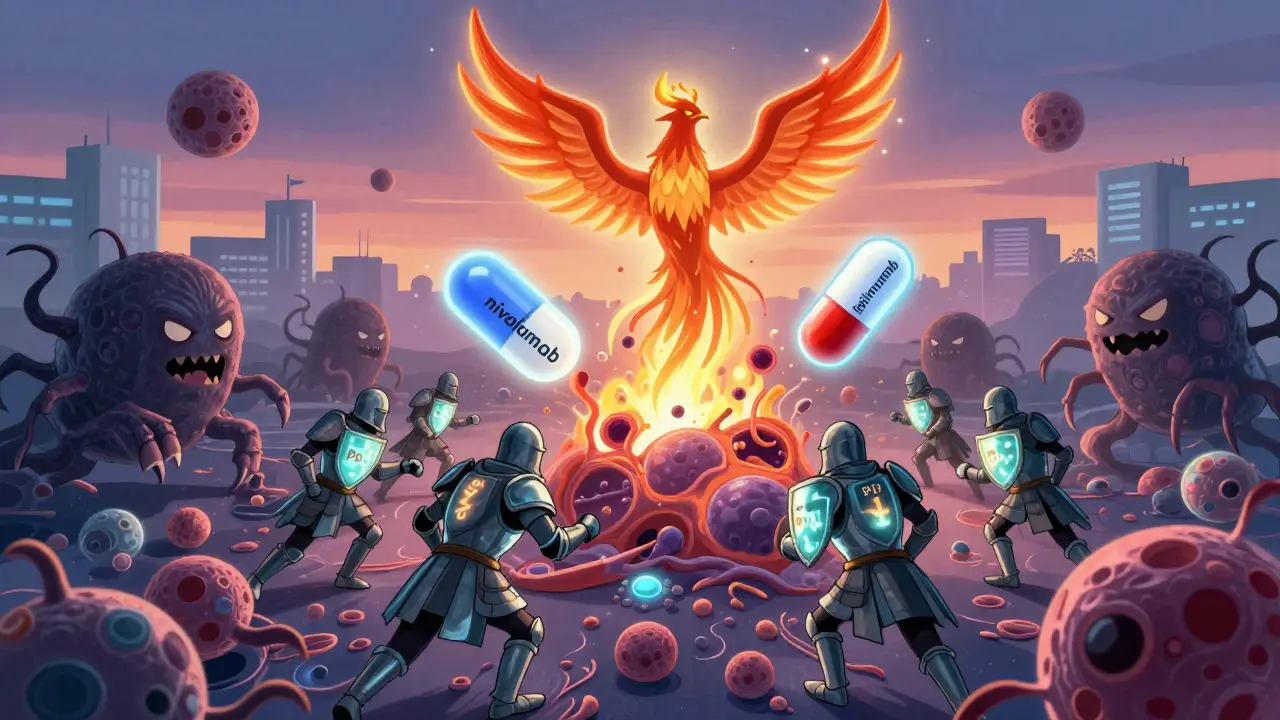
Today, the standard is combination therapy. Two drugs, often a PD-1 blocker (like pembrolizumab or nivolumab) and a CTLA-4 blocker (like ipilimumab). Together, they can shrink tumors in over half of patients. Some see complete remission. And for a growing number, the cancer never comes back.
Newer drugs are even more promising. Regeneron’s fianlimab, paired with a PD-1 inhibitor, is showing higher response rates in early trials. And IMA203, a cell therapy targeting a protein called PRAME, achieved a 56% complete response rate in a Phase 1b trial. These aren’t lab curiosities-they’re in Phase 3 trials right now, with results expected by 2027.
Immunotherapy isn’t magic. Side effects can be serious-fatigue, rashes, colitis, even thyroid issues. But for many, it’s the only path to long-term survival. And unlike chemotherapy, it doesn’t destroy healthy cells. It teaches your body to recognize and kill cancer cells. That’s why survival curves for melanoma patients on immunotherapy now stretch out for years, not months.
The Real Challenges
Not every clinic has the latest tools. Not every patient can afford them. And not every system works the same way.
AI tools need time to integrate. Dermatology practices report 15-20 hours of training per provider to use full AI platforms. DermaSensor? Just 2-3 hours. But if the device doesn’t plug into your electronic health record? That’s a dealbreaker. Clinics are tired of juggling five different screens just to check one mole.
Then there’s the cost. The global melanoma diagnostics market hit $2.87 billion in 2024-and it’s growing fast. But who pays? In the U.S., insurance reimbursement for AI tools is still patchy. Google Health pulled its AI skin analyzer in late 2024 because insurers wouldn’t cover it. That’s a warning sign: even the best tech can fail if the system doesn’t support it.
And then there’s overdiagnosis. Some experts warn that finding tiny, harmless melanomas that would never harm you might lead to unnecessary surgeries, scars, and anxiety. The goal isn’t to find every mole-it’s to find the ones that matter.
What’s Next?
The future isn’t just about better cameras or smarter algorithms. It’s about combining data.
Imagine a single scan that combines:
- AI imaging of your skin
- Electrical readings from a wearable patch
- Your genetic profile (like HLA-A*02:01 status)
- Your blood pressure, oxygen levels, and even gut microbiome
That’s the direction researchers are heading. Northeastern’s team is already testing if adding patient health records improves accuracy. If it works, we could move from reactive detection to predictive prevention.
By 2030, AI-assisted screening could be standard in every dermatology clinic. But until then, the best tool you have is still you. Know your skin. Check it monthly. Don’t ignore changes. And if you’re told a spot is fine but it keeps bothering you? Get a second opinion.
Melanoma doesn’t care how smart your phone is. It only cares if you notice it early enough.
Can melanoma be detected without a biopsy?
Some AI tools and devices like DermaSensor can strongly suggest melanoma without a biopsy by analyzing skin patterns, light scattering, or electrical properties. But a biopsy remains the only way to confirm a diagnosis. No non-invasive tool is 100% accurate yet. Even the best AI systems still flag some benign moles as suspicious, so a tissue sample is required for certainty.
Is immunotherapy better than chemotherapy for melanoma?
For advanced melanoma, immunotherapy is now the first-line treatment-and it’s far more effective than chemotherapy. Chemo kills fast-growing cells, which means it damages healthy tissue too, causing severe side effects. Immunotherapy trains your immune system to target cancer cells specifically. Response rates are higher, survival times are longer, and many patients live for years instead of months. Chemotherapy is rarely used today unless immunotherapy fails.
Do AI skin scanners work on dark skin?
Many early AI systems were trained mostly on light skin, so they perform worse on darker skin tones-up to 15% less accurate. This is a known problem, and researchers are fixing it by including more diverse data. Newer tools like SegFusion and iToBoS are being retrained with multi-ethnic datasets. But if you have darker skin, don’t rely on AI alone. Always get suspicious spots checked by a dermatologist familiar with melanoma in pigmented skin.
How long does immunotherapy last?
Treatment usually lasts 6 months to 2 years, depending on the drugs and how well you respond. Some patients stop after a year if their cancer shrinks significantly. Others continue longer if the treatment is working. The goal is to keep the immune system active against any remaining cancer cells. Many patients who complete treatment never see melanoma return-even after 5 or 10 years.
Can I use an AI app on my phone to check for melanoma?
There are apps that claim to analyze moles, but none are FDA-approved for diagnosis. They can help you track changes over time, but they can’t replace a doctor. Many apps misclassify lesions, especially if lighting is poor or the image is blurry. The American Academy of Dermatology warns against using them as a diagnostic tool. Use them for awareness, not decision-making.
What’s the survival rate if melanoma spreads to the lymph nodes?
If melanoma spreads to nearby lymph nodes (Stage III), the 5-year survival rate drops to about 70%. But it’s not the same for everyone. New immunotherapies have improved outcomes significantly. Some patients with Stage III melanoma now have survival rates approaching 80% or higher, especially if they respond well to treatment. Early detection and treatment make all the difference-even after spread.




10 Comments
Okay but let’s be real-most of us aren’t dermatologists. I check my moles like I check my phone battery: when I remember to. That wearable patch from Wake Forest? I’d wear it like a charm. Imagine just gluing something to your arm and getting alerts like a fitness tracker. No more ‘maybe it’s just a scar’ panic. I’d sleep better.
/p>Let’s not pretend these AI tools are revolutionary. They’re just glorified pattern-matchers trained on datasets that barely include people who aren’t pale and Scottish. And yet, here we are, treating them like oracle machines. If you have darker skin, you’re still playing Russian roulette with your health. The ‘99% accuracy’ claim is marketing spin wrapped in a lab coat.
/p>The fundamental flaw in this entire narrative is the assumption that technology alone can solve a biological problem. Melanoma isn’t a software bug to be patched-it’s a biological process that evolves, adapts, and exploits systemic blind spots. AI models trained on skewed data don’t ‘improve’ outcomes-they amplify inequality. And the fact that insurers refuse to reimburse these tools? That’s not a technical failure. It’s a moral one. We prioritize cost over life. Again.
/p>Y’all, I just got my first skin scan at my local clinic-no dermatologist, just a tablet and some weird light. It said ‘monitor’ for a spot I’d been ignoring. I went back two weeks later and they biopsied it. Turned out it was pre-cancerous. I’m alive because I listened. Don’t wait. Check your feet. Check your scalp. Check your nails. You think melanoma only hides in moles? Nah. It hides in plain sight.
/p>It is imperative to emphasize that while technological advancements in melanoma detection are commendable, they must be contextualized within the broader framework of equitable healthcare access. The disparity in diagnostic efficacy across skin phototypes is not merely an algorithmic limitation but a reflection of historical underrepresentation in clinical research. It is incumbent upon policymakers and institutions to mandate inclusive dataset curation and subsidize diagnostic tools for underserved populations.
/p>So we’re trusting algorithms built by Silicon Valley to save our lives? Meanwhile, real doctors are being pushed out because insurance won’t pay for their expertise. We’re outsourcing health to apps while the system crumbles. This isn’t innovation-it’s lazy capitalism. And don’t even get me started on how they’re training AI on white skin and then selling it to everyone. That’s not science. That’s negligence dressed up as progress.
/p>Wait… did you know the iToBoS scanner is secretly linked to a government surveillance program? I read it on a forum. They’re not just mapping skin-they’re mapping your DNA, your location, your habits. And the ‘explainable AI’? It’s just a fancy word for ‘we’re watching you’. If you get a false positive, they’ll tag you. Next thing you know, your insurance premiums spike. This isn’t medicine. It’s control. And they’re selling it as salvation.
/p>I’ve been thinking a lot about how we’ve turned something deeply personal-like the shape of a mole or the texture of a spot-into a data point. We’re so obsessed with quantifying risk that we forget the anxiety that comes with every new freckle. I used to check my skin every week, terrified. Then I realized: I wasn’t protecting myself-I was punishing myself with vigilance. The truth is, we’ll never have perfect tools. But we can learn to trust our instincts. If something feels off, it probably is. And sometimes, that’s enough.
/p>When I first heard about immunotherapy, I cried. Not because I was scared-but because I finally felt hope. My cousin had Stage IV melanoma. They told her she had six months. Two years later, she’s hiking in the Himalayas. No chemo. No hair loss. Just her body, learning to fight. It’s not perfect-side effects are brutal-but it’s a revolution. And for the first time, I believe survival isn’t luck. It’s science. And science is finally listening.
/p>I’m just saying… if you’re going to spend $200 on a skin scanner, why not just go to the doctor? I went to a clinic last year, got a biopsy, paid $50 out of pocket. They found a melanoma I didn’t even know about. No app. No patch. Just a guy with a magnifying glass and a sharp knife. Sometimes the old way is the best way. Stop chasing gadgets. Just get checked.
/p>