

Every time you pick up a prescription, there’s a small sticker on the bottle. Maybe it says take with food, or do not operate heavy machinery, or refrigerate. You glance at it, maybe read it once, and toss it aside. But those stickers aren’t just busywork-they’re your last line of defense against dangerous mistakes.
What Those Little Stickers Are Really For
Those colorful warning labels aren’t random. They’re legally required safety messages approved by the FDA. Every prescription container in the U.S. must carry warnings that prevent injury. The FDA says these labels exist to stop medication errors-mistakes that send over 1.3 million people to the ER every year. That’s more than car accidents. And nearly 7,000 of those cases turn deadly.These aren’t just suggestions. They’re based on real, documented risks. A drug might cause liver damage if mixed with alcohol. It might not work if taken with grapefruit. It might make you so dizzy you can’t stand up. The sticker is the final check before you walk out the door with your medicine. If the pharmacist missed something, the label catches it.
Black Box Warnings: The Red Flag You Can’t Ignore
Not all warnings are created equal. The most serious ones come in a black box-a bold, bordered warning printed on the drug’s official prescribing guide and sometimes copied onto the patient label. These are reserved for drugs that can cause death or serious injury. About 40% of new drugs approved between 2013 and 2017 carried one. Think: blood thinners that can cause uncontrolled bleeding, antidepressants linked to suicidal thoughts in young adults, or diabetes drugs that might trigger heart failure.These aren’t hidden. They’re front and center because the risk is real. If your prescription has a black box warning, don’t skip reading the full Patient Prescribing Information sheet. Don’t assume your doctor already covered it. Ask: What exactly could go wrong? What signs should I watch for? This isn’t fear-mongering-it’s survival.
Color Matters: Red Means Danger, Yellow Means Caution
You’ve probably noticed that some labels are red, others yellow, blue, or white. That’s not random design. A 2017 study found that 42% of patients automatically link color to severity. Red means stop. Yellow means be careful. Blue or white? Often ignored as just "information."Here’s the problem: not all pharmacies use the same colors. Some use red for everything. Others use it only for life-threatening risks. That inconsistency makes it harder to trust. But if you see a red sticker, treat it like a fire alarm. Don’t wait to ask questions. Call your pharmacist right away.
Text Warnings That Confuse More Than Help
Even simple phrases can trip people up. Take "Do not chew or crush, swallow whole". In a study, nearly 30% of patients thought it meant "don’t swallow it"-or worse, "chew it up so it dissolves faster." Another common one: "For external use only." Nearly 91% of people misunderstood it, even though it’s written at a first-grade reading level. Some thought it meant the medicine was radioactive. Others thought it was for use on the skin only-even if the pill was meant to be swallowed.Why does this happen? Because labels are written for doctors, not patients. They use medical jargon like contraindication or adverse reaction. The average patient spends just 7 to 12 seconds looking at their label. That’s not enough time to decode confusing language.
What You Should Do When You Get a New Prescription
Don’t just take the bottle and go. Follow these three steps:- Check the pill itself. Does the shape, color, and imprint match what’s on the label? If it looks different from your last refill, ask. Pills can change manufacturers without you knowing.
- Look for color codes. Red? That’s urgent. Yellow? Proceed with care. White? Still important, but less critical.
- Ask for the "teach-back" method. Say: "Can you please explain this to me like I’m 12?" Then repeat back what you heard. Studies show this improves understanding by nearly 50%.
Don’t be shy. Pharmacists are trained to explain this stuff. They’ve seen people misunderstand warnings hundreds of times. They’ve heard the stories-like the man who took his blood pressure pill with grapefruit juice and ended up in the ER. Or the woman who ignored "avoid sunlight" and got a severe burn from her new acne medication.

Why People Ignore Warnings (And How to Stop It)
A Healthline survey found that 64% of people have ignored at least one warning. The top three? Take with food (42% ignored), avoid sunlight (37%), and do not drink alcohol (31%).Why? Three reasons:
- They think it’s not a big deal. "I’ve taken this before without food. Nothing happened."
- They forget. Life gets busy. You’re rushing to work. You’re tired. You’re overwhelmed.
- They don’t trust the label. "The doctor didn’t mention this. Why should I believe a sticker?"
Here’s the fix: write it down. Stick a note on your mirror. Set a phone reminder. Put the warning in your phone’s notes app. Don’t rely on memory. Medication errors happen when people assume they know what’s safe.
The Future Is Changing-And It’s Better
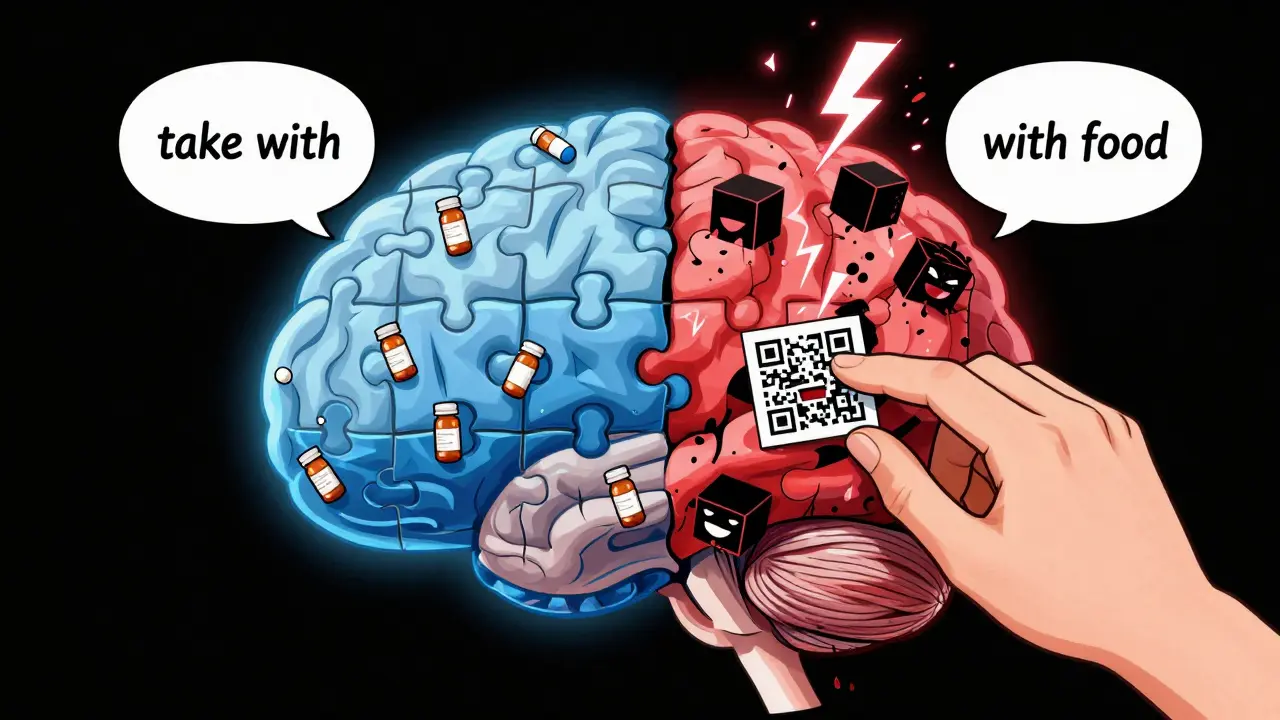
The FDA is finally catching up. In 2023, they approved a new set of standardized icons-simple pictures that mean the same thing across all pharmacies. One icon for do not crush, another for take with food, a third for avoid alcohol. In testing, these cut misinterpretation from 31% down to just 8%.By June 2025, 20 high-risk drugs will come with a new "Facts Label"-short, plain-language summaries printed right on the bottle. No more tiny print. No more jargon. Just: "This can cause dizziness. Don’t drive."
Some pharmacies are testing QR codes on labels. Scan it, and a 60-second video explains the warning in simple terms. Mayo Clinic trials showed comprehension jumped by over 50%.
What You Can Do Today
You don’t have to wait for the system to fix itself. Here’s your action plan:- Always read the sticker. Even if you’ve taken the drug before.
- Ask your pharmacist: "Is there anything I absolutely must avoid?"
- Keep a list of your meds and their warnings in your phone or wallet.
- If you’re confused, don’t guess. Call the pharmacy. It’s their job to help.
- Don’t throw away the Patient Prescribing Information sheet. Even if it’s long, scan it for the bolded warnings.
Medication isn’t like a vitamin you can take anytime. It’s a powerful tool-and like any tool, it can hurt you if used wrong. Those little stickers? They’re not clutter. They’re your safety net.
What does "take with food" actually mean?
"Take with food" means eat something-any food-within 30 minutes before or after taking the pill. It’s not just about eating a full meal. A banana, a slice of toast, or even a handful of nuts will do. This helps your body absorb the medicine properly and reduces stomach upset. Skipping food can make the drug less effective-or worse, cause nausea, vomiting, or ulcers.
Why do some pills say "do not crush"?
Some pills are designed to release medicine slowly over hours. Crushing them releases all the drug at once, which can cause an overdose. Others have coatings that protect your stomach or prevent the medicine from breaking down too early. Crushing can destroy that protection. If you have trouble swallowing pills, ask your doctor or pharmacist for a liquid form or a different pill that’s safe to crush.
Can I ignore a warning if I’ve taken the drug before without problems?
No. Your body changes. So do your other medications. A warning might have been added after your last refill. You might now be taking something new that interacts dangerously with your prescription. Or your liver or kidneys may not process the drug the same way. Never assume safety based on past use. Always check the current label.
What should I do if I accidentally break a warning?
If you took a drug with grapefruit juice when it said "avoid grapefruit," or drank alcohol while on a sedative, call your pharmacist or doctor immediately. Don’t wait for symptoms. Some reactions happen fast. Others build up over days. Even if you feel fine, the damage might already be starting. It’s better to be safe than sorry.
Are warning labels the same everywhere in the U.S.?
The required warnings are the same, but how they’re presented isn’t. Some pharmacies use color codes, others don’t. Some print warnings on the bottle, others put them on separate stickers. The FDA is working to standardize this, but it’s still inconsistent. Always read every label carefully, no matter where you fill your prescription.

16 Comments
These stickers are the last thing standing between you and a hospital bed. I used to ignore them too-until I took my dad’s blood pressure med with grapefruit juice and ended up in the ER for three days. Turns out, the label wasn’t being dramatic. It was just doing its job.
/p>Now I read every single one like it’s a warning from my future self. No exceptions. Not even for aspirin.
Medicine isn’t candy. It’s a scalpel. And these little labels? They’re the hand holding the handle.
I love how this post breaks it down without fearmongering. Seriously, pharmacists are the unsung heroes of healthcare. I always ask mine to explain the stickers like I’m five. They don’t mind-I’ve never been turned away.
/p>Also, the teach-back method? Game changer. My grandma started using it after her stroke, and now she’s the one reminding *me* to read labels. We’ve both slept better since.
It’s astonishing how the average American treats pharmaceutical warnings like spam emails. You wouldn’t ignore a ‘do not touch’ sign on a live wire, yet you’ll swallow a pill with alcohol because ‘I’ve done it before.’
/p>There’s a reason the FDA mandates these. It’s not bureaucracy-it’s damage control for a population that treats medical advice like a suggestion box. The black box warnings? Those aren’t suggestions. They’re obituaries waiting to happen.
And don’t get me started on the ‘take with food’ myth. It’s not ‘if you feel like it.’ It’s ‘or your liver will thank you with a biopsy.’
So you’re telling me I’m supposed to believe a sticker more than my doctor? That’s rich. My doc told me I could have wine with my statin. The label says no. Who’s lying?
/p>And why do I need a QR code to understand ‘don’t crush’? If you can’t write it in plain English, maybe your job is the problem, not the patient.
Also, color-coded labels? That’s not safety. That’s marketing. Red means ‘pay attention’? What if my pharmacy uses green? Am I supposed to guess?
This whole thing feels like overcorrection for people who can’t read past the first paragraph.
I used to think the ‘take with food’ thing was just a hassle-until I started getting stomach cramps every time I took my thyroid med on an empty stomach. Turns out, it wasn’t just ‘a little upset.’ It was my body screaming.
/p>Now I keep a little note on my fridge: ‘Meds = food first.’ Simple. No jargon. No guessing.
And yeah, I’ve called the pharmacy at 9 p.m. because I didn’t understand a label. They didn’t judge. They just explained. That’s why I trust them more than Google.
Everyone says ‘read the label’ like it’s magic. But what if you’re blind? Or dyslexic? Or don’t speak English? Who’s making these labels accessible? No one. The system is broken, and you’re just yelling at the people drowning in it.
/p>As someone from India where pill labels are often handwritten and in multiple languages, I can say this: clarity saves lives. Here, we rely on pharmacists to explain everything. No QR codes, no color codes-just trust and conversation.
/p>But your system’s push toward standardization is admirable. Even small improvements like plain language summaries can bridge gaps. The teach-back method? Brilliant. It’s how we teach in rural clinics-repeat, confirm, understand.
OMG YES. I took my antidepressant with grapefruit juice for SIX MONTHS because my pharmacist didn’t explain it clearly. I had panic attacks I couldn’t explain. Turns out, the interaction spiked my serotonin levels dangerously.
/p>I cried in the pharmacy last week when they handed me a new label with a simple icon: 🍊🚫. That’s it. No jargon. Just a picture. I felt seen for the first time.
They didn’t just give me medicine. They gave me peace.
The pharmacokinetic implications of concurrent ingestion of CYP3A4 substrates with furanocoumarin-containing citrus species are non-trivial. The bioavailability modulation induced by grapefruit juice can lead to supratherapeutic plasma concentrations, particularly in drugs with low first-pass metabolism. The clinical significance is amplified in polypharmacy regimens, especially among geriatric populations with reduced hepatic clearance.
/p>Moreover, the adherence paradox-where patient autonomy is prioritized over pharmacovigilance-exacerbates iatrogenic risk profiles. Standardized visual lexicons mitigate cognitive load and enhance translational comprehension across literacy strata.
People are so lazy these days. You think the government should print warnings in giant neon letters? No. You should read. You should care. You should be responsible.
/p>I’ve been on 12 different meds in the last 5 years. I’ve never once ignored a label. I write them on my calendar. I set alarms. I print the sheets. I don’t need a QR code. I need people to stop being idiots.
And why do we even need color codes? If you can’t read, maybe you shouldn’t be taking pills.
While the intent of standardized pharmaceutical labeling is commendable from a public health perspective, one must acknowledge the ontological asymmetry between regulatory intent and patient reception. In Canada, we’ve observed that linguistic simplification, while improving comprehension metrics, may inadvertently diminish the perceived gravity of warnings.
/p>Thus, the balance between accessibility and gravitas remains an unresolved epistemological challenge in health communication policy.
THIS IS WHY AMERICA IS FALLING APART. 🤬
/p>You people can’t even read a sticker? You need a VIDEO? A QR CODE? A 60-SECOND EXPLANATION?!
Back in my day, we read the label, we listened to the doctor, and we didn’t whine about it. Now we’ve got millennials thinking a banana counts as ‘food’ for meds? 🍌💊
And don’t get me started on the ‘teach-back’ thing. That’s not empowerment-that’s infantilization. Get a brain. Read the damn thing.
Also, why are we letting foreigners tell us how to do healthcare? 🇮🇳 🇨🇦 🇬🇧 - We’re the United States. We invented pills. We can read.
I used to roll my eyes at those stickers-until I started taking my new migraine med and got a rash that looked like I’d been slapped with a nettle bush. Turns out, the label said ‘avoid sunlight’ and I thought it meant ‘don’t go to the beach.’
/p>Turns out, it meant ‘don’t walk to your car in the morning.’ I was sunburned from the inside out.
Now I have a sticky note on my mirror: ‘STICKERS ARE NOT SUGGESTIONS.’ I even made a playlist called ‘Medication Warnings That Saved My Life’-yes, it’s real. And yes, I cry every time I hear ‘Take With Food’ by The Weeknd.
Black box = red flag. Color codes = unreliable. QR codes = overkill. Teach-back = unnecessary. Just read the label. It’s not hard. If you can’t, don’t take the drug. Simple.
/p>Interesting piece. I've found that in the UK, many pharmacies now include a QR code linked to a BNF summary-clear, concise, and referenced. It’s been well received, particularly among elderly patients. That said, I agree with the point about consistency. We still see regional variation in label design, which can cause confusion.
/p>Perhaps a national standard, co-designed with patients, would yield better outcomes than top-down mandates.
Jim, your doctor didn’t tell you about grapefruit because they assumed you’d read the label. That’s their job too. Not to repeat everything. The label is the safety net. If you don’t check it, you’re not blaming the system-you’re blaming yourself.
/p>And yes, I’ve had pharmacists say, ‘Your doctor might’ve missed this.’ That’s not a failure. That’s teamwork.