
Theophylline Interaction Checker
Check Your Medications
Enter medications you're taking that might interact with theophylline. We'll calculate the combined clearance reduction and provide recommendations.
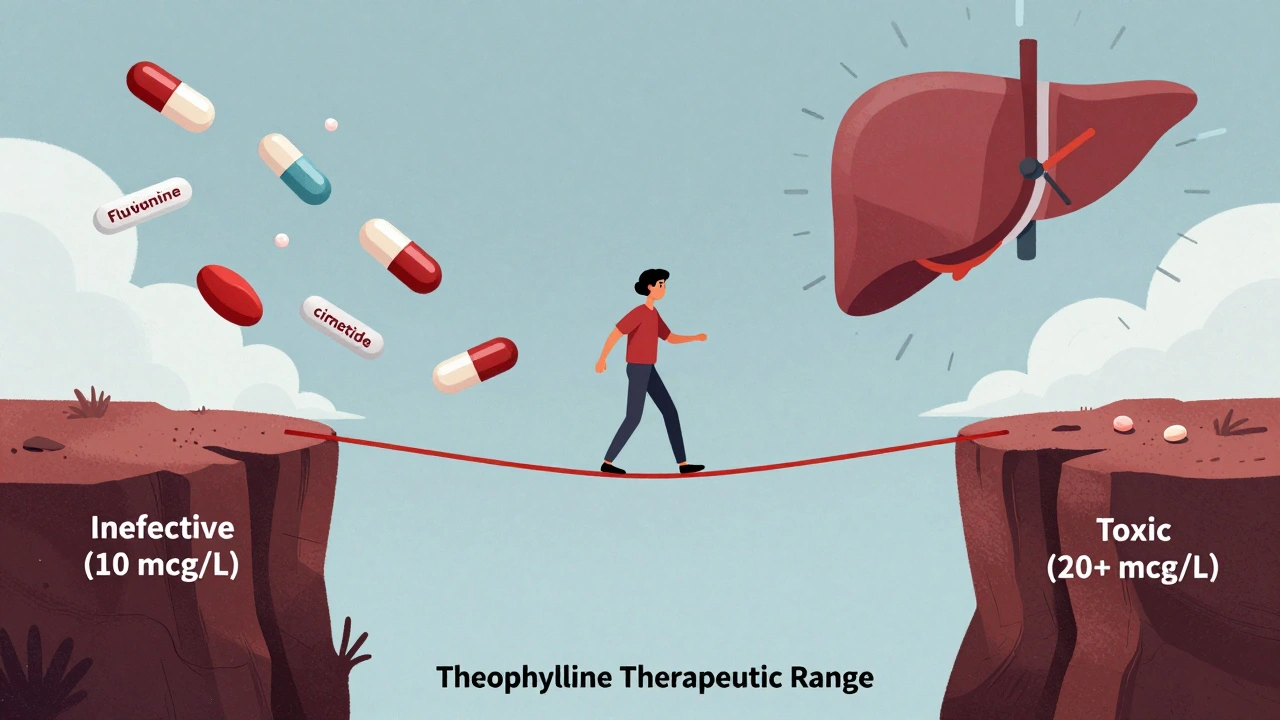
When a doctor prescribes theophylline, they’re not just giving a pill-they’re managing a tightrope walk. The drug works for asthma and COPD, but the difference between healing and hospitalization is often just a few points on a blood test. Theophylline clearance is the key. If your body slows down how fast it breaks down this drug, levels can spike into the danger zone. And it’s not rare. About 35% of theophylline-related emergency visits in the U.S. happen because another medication interfered with its metabolism.
Why Theophylline Is So Fragile
Theophylline isn’t like most asthma meds. It doesn’t just relax your airways-it’s processed by your liver in a very specific way. Around 90% of it gets broken down by an enzyme called CYP1A2. That’s the same enzyme that handles caffeine, antidepressants, and some antibiotics. The problem? The therapeutic range is tiny: 10 to 20 micrograms per milliliter in your blood. Go above 20, and you risk seizures, irregular heartbeat, or even death. Go below 10, and it stops working.
What makes this worse is that theophylline doesn’t clear out at a steady rate. At therapeutic doses, its metabolism becomes non-linear. That means a small increase in blood levels doesn’t just mean a small rise in toxicity-it can mean a huge, unpredictable jump. One extra pill, or one new medication, and your levels can double overnight.
Medications That Slow Down Theophylline Clearance
Not all drugs are equal when it comes to interfering with theophylline. Some barely touch it. Others slam the brakes hard. Here are the big offenders, ranked by how much they reduce clearance:
- Fluvoxamine (an antidepressant): Reduces clearance by 40-50%. This is the most dangerous combo. The European Respiratory Society says to avoid it entirely. A patient on stable theophylline who starts fluvoxamine can go from 15 mcg/mL to over 30 mcg/mL in under a week.
- Cimetidine (an old-school heartburn drug): Slows clearance by 25-30%. Still used in some places, especially in older patients. A 2022 study found it was involved in nearly 29% of all theophylline toxicity cases in hospitals.
- Allopurinol (for gout): Lowers clearance by about 20%. Even though it’s not a direct CYP1A2 blocker, it messes with the same metabolic pathway. Many doctors don’t realize this interaction until a patient gets sick after starting allopurinol.
- Erythromycin and clarithromycin (antibiotics): Cut clearance by 15-25%. These are common prescriptions, especially for respiratory infections. If someone’s on theophylline and gets pneumonia, switching from azithromycin to clarithromycin could be deadly.
- Furosemide (a water pill): Mixed evidence. Some studies show a 10-15% drop in clearance, others show nothing. But in patients with heart failure or kidney issues, even a small reduction can tip the balance.
These aren’t hypothetical risks. In a 2021 study of over 1,200 elderly patients on theophylline, nearly 3 out of 10 were taking at least one of these drugs-and only 37% had their dose adjusted. That’s a recipe for disaster.
What Happens When Clearance Drops
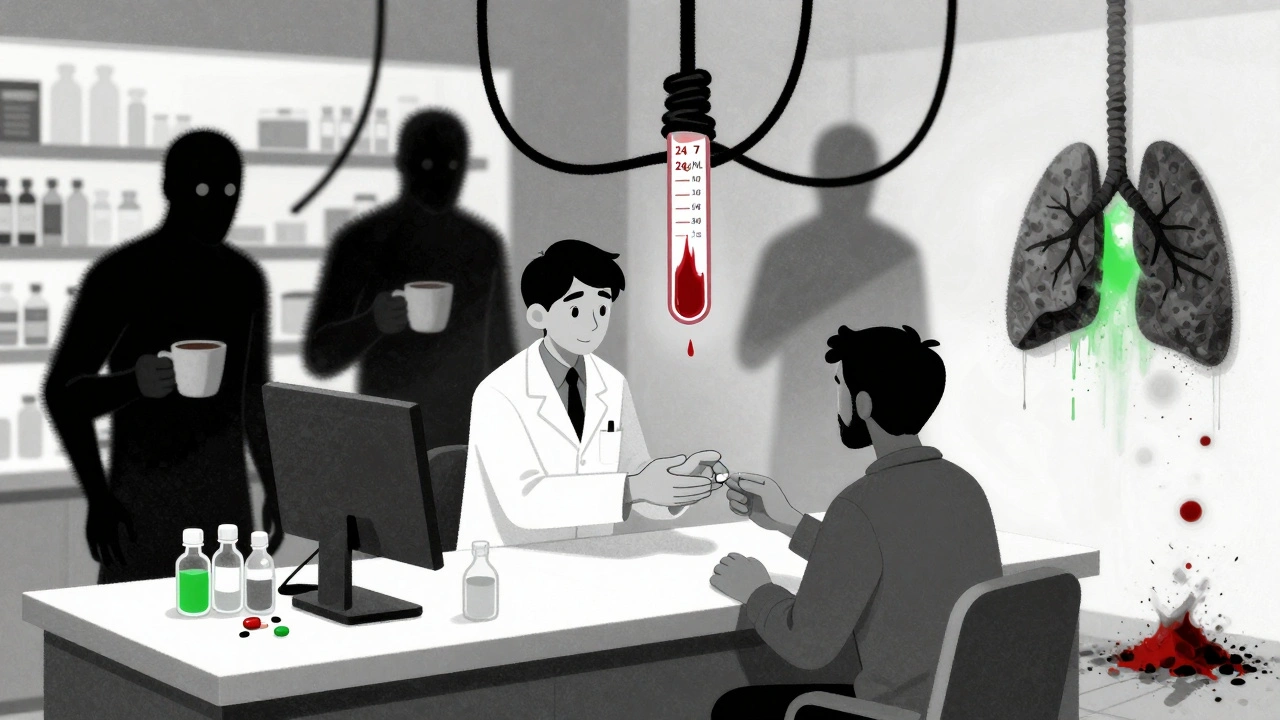
Imagine you’ve been on theophylline for months. Your levels are steady at 14 mcg/mL-safe, effective. Then you start cimetidine for heartburn. Three days later, you feel nauseous. Your hands shake. Your heart races. You go to the ER. Your blood test shows 24.7 mcg/mL. That’s toxic.
This isn’t a rare story. Pharmacists in Australia and the U.S. report similar cases every month. One patient in Melbourne went from 15.2 to 24.7 mcg/mL after starting cimetidine. No dose change. No warning. Just a sudden spike. He spent three days in the hospital. His doctor didn’t know the interaction existed.
The symptoms aren’t subtle. Nausea, vomiting, tremors, palpitations, confusion. In severe cases, seizures and cardiac arrest. And because theophylline is often used in older adults with multiple conditions, they’re more likely to be on other meds that interfere. Heart failure, gout, acid reflux, depression-these are common. And all of them might require drugs that block theophylline clearance.

What Clinicians Should Do
There’s no room for guesswork. Here’s what actually works in practice:
- Check every new prescription. Before adding any new drug to a patient on theophylline, ask: Does it inhibit CYP1A2? If yes, assume interaction until proven otherwise.
- Reduce the dose upfront. When starting fluvoxamine or cimetidine, cut the theophylline dose by 40-50% immediately. Don’t wait for symptoms. Don’t wait for blood tests. Start low.
- Test serum levels within 48-72 hours. The American Association for Clinical Chemistry says this is non-negotiable. Levels need to be checked after starting or stopping any interacting drug.
- Consider alternatives. If a patient needs an antidepressant, pick one that doesn’t touch CYP1A2-like sertraline or citalopram. For heartburn, use pantoprazole instead of cimetidine. For antibiotics, choose azithromycin over clarithromycin.
- Watch for smoking cessation. This is often forgotten. Smoking induces CYP1A2. When a patient quits, their clearance drops by 30-50% in two weeks. That’s like adding a powerful inhibitor without even realizing it.
Many clinics still don’t have alerts in their electronic systems for theophylline interactions. A 2023 survey of 412 pulmonologists found that 62% said their EHR didn’t warn them about these risks. That’s not just a gap-it’s a liability.
The Bigger Picture: Why Theophylline Still Exists
You might wonder: Why even use this drug anymore? Newer inhalers like salmeterol and tiotropium are safer, more targeted, and don’t need blood tests. The answer? Cost and access.
Global sales of theophylline were still $187 million in 2022. In parts of Asia and Africa, it’s the only affordable long-term option for COPD. In the U.S., it’s mostly used for severe, refractory asthma or nocturnal symptoms that don’t respond to other treatments. But here’s the catch: the patients who still need it are often the ones most vulnerable to interactions-older, with multiple chronic conditions, on multiple medications.
And the risk is rising. Even as overall use declines, the proportion of toxicity cases caused by drug interactions is increasing. In 2022, 41.7% of theophylline-related ER visits in the U.S. were due to interactions-a 5.3% jump from the year before. That means the remaining users are at higher risk than ever.
What Patients Should Know
If you’re on theophylline, here’s what you need to do:
- Keep a list of every medication you take-prescription, over-the-counter, herbal. Bring it to every appointment.
- Ask your pharmacist: “Could this new medicine affect my theophylline?”
- Know the warning signs: nausea, shaking, fast heartbeat, confusion. If you feel this way after starting a new drug, go to urgent care immediately.
- Don’t stop or change your dose without talking to your doctor-even if you feel fine.
- If you quit smoking, tell your doctor. Your theophylline dose may need to go down.
There’s no shame in using theophylline. But there’s huge risk in assuming it’s safe just because you’ve been on it for years. The drug doesn’t change. Your body doesn’t change. But your other medications? They do.
Final Thoughts
Theophylline is a relic with real teeth. It’s not the first-line choice anymore, but it’s still in use-and when it interacts with common drugs, the results can be fatal. The problem isn’t the drug. It’s the lack of awareness. Doctors, pharmacists, and patients all need to treat this interaction like a live wire. One wrong step, and it’s dangerous.
There’s no excuse for missing this. The data is clear. The guidelines exist. The tools are available. What’s missing is consistent attention. Every time a new medication is added to a patient on theophylline, someone should pause. Check. Adjust. Test. Because the difference between safety and crisis is often just one pill-and one missed question.
Can I take ibuprofen with theophylline?
Yes, ibuprofen does not significantly affect theophylline clearance. It doesn’t inhibit CYP1A2 or other key enzymes involved in theophylline metabolism. Most studies show no clinically meaningful interaction. However, always inform your doctor if you start taking any new pain reliever, especially if you have kidney issues or are elderly.
How long does it take for theophylline levels to change after starting a new drug?
Serum levels can rise significantly within 48 to 72 hours after starting a CYP1A2 inhibitor like cimetidine or fluvoxamine. The liver’s enzyme inhibition happens quickly, and because theophylline has a half-life of about 8 hours in healthy adults, it builds up fast when clearance drops. That’s why guidelines recommend checking blood levels within 3 days of starting a new interacting medication.
Does coffee affect theophylline?
Yes, but indirectly. Caffeine is metabolized by the same enzyme (CYP1A2) as theophylline. Heavy coffee drinking can induce CYP1A2, lowering theophylline levels. Conversely, if you suddenly cut back on coffee, your clearance may drop by 20-30%, raising theophylline levels. Patients on theophylline should maintain consistent caffeine intake and report any major changes to their doctor.
Is theophylline still used in 2025?
Yes, but much less often. In the U.S., its use has dropped by 62% since 2000. It’s now mostly reserved for patients who don’t respond to inhaled bronchodilators, those with severe nocturnal asthma, or in regions where newer drugs are too expensive. Global use is higher in Asia and Africa, where cost remains a barrier to newer therapies. Even so, its narrow safety window means it’s only used when benefits clearly outweigh risks.
What should I do if I experience side effects from theophylline?
Stop taking the medication and seek medical help immediately. Symptoms like vomiting, rapid heartbeat, tremors, or confusion are signs of toxicity. Do not wait to see if it gets better. Go to an emergency department or call emergency services. Bring your medication list with you. Blood tests will confirm if your theophylline level is too high, and treatment can begin right away.
Can I switch to a different asthma medication to avoid these interactions?
Absolutely. Inhaled bronchodilators like salmeterol, formoterol, or tiotropium are safer, more effective, and don’t require blood monitoring. Oral theophylline is rarely needed today unless other options have failed or aren’t accessible. Talk to your pulmonologist about switching-especially if you’re on multiple medications that could interact. Newer drugs have fewer systemic side effects and far lower interaction risks.
Managing theophylline isn’t just about dosing-it’s about understanding your whole medication picture. The drug hasn’t changed. The risks haven’t changed. But awareness has. And that’s what saves lives.




14 Comments
This is wild... theophylline is basically a ticking time bomb in a pill, and nobody talks about it? I mean, we're talking about a drug that can turn your heart into a disco ball if you so much as sneeze near a cimetidine bottle. 😱 It's like your body's a chemistry lab and the pharmacist forgot to label the beakers. We need a warning label that screams 'DO NOT MIX WITH LIFE'./p>
Ugh. Another post about how doctors are clueless. Honestly, if you're on theophylline in 2025, you're just asking for trouble. Why not just switch to something that doesn't require a PhD in pharmacology to manage? It's not rocket science./p>
I work in ER and I've seen this 7 times this year alone. One guy came in with a theophylline level of 42 after starting fluvoxamine for depression. He had a seizure in the waiting room. His doctor didn't even know the interaction existed. This isn't rare. It's systemic. And the worst part? The patients are the ones who pay the price. We need mandatory CYP1A2 checks in EHRs. Like, yesterday./p>
I'm sorry, but this is just... irresponsible. How can we still be using a drug with a therapeutic window narrower than a catwalk? And yet, here we are - prescribing it to elderly patients who are also on cimetidine, allopurinol, and furosemide like it's a multivitamin. Someone's got to take responsibility. And it's not the patient. It's the system. And the system is broken./p>
I'm from Nigeria and we still use theophylline because it's cheap. But I've seen people die from this. Last month, my uncle took cimetidine for heartburn and ended up in ICU. The doctor didn't even know it could interact. We need more education - not just in the US, but everywhere. This isn't a 'first-world problem'. It's a global silent killer./p>
Okay, so theophylline is basically the crypto of respiratory meds - outdated, volatile, and only for people who think they can ‘HODL’ their way out of toxicity. I’m not even mad. I’m impressed. Like, who still uses this? Who signed off on this? Was there a meeting? ‘Hey guys, let’s keep this 1950s relic in play because it’s 12 cents a pill.’ Meanwhile, my cousin’s 78-year-old grandma is on 4 meds that each say 'DO NOT MIX' on the bottle. And she’s still breathing? I’m just saying - the universe is either testing us or it’s drunk./p>
Coffee. Caffeine. CYP1A2. Same enzyme. So if you drink 5 coffees a day and quit cold turkey? Boom. Toxicity. And no one tells you. Why? Because doctors assume you’re a ‘responsible adult’. But we all know most people don’t even read the side effects. This isn’t medicine. It’s Russian roulette with a nebulizer./p>
I just want to say thank you for writing this. As someone who’s watched my dad nearly die from this interaction, I can’t tell you how relieved I am that someone finally put this out there. It’s not just about the drug - it’s about how we treat elderly patients like they’re just a list of symptoms. We forget they’re people with lives, habits, coffee routines, and grandkids. This isn’t just pharmacology. It’s humanity. 🫂/p>
I'm a pharmacist and I can't tell you how many times I've caught this. I had a patient last week who was on theophylline and started clarithromycin for a sinus infection. I called the prescriber immediately. They were shocked. Said they 'didn't know'. I said, 'Neither did the last 3 patients who ended up in ICU.' We need better alerts. And we need to stop assuming everyone knows this stuff./p>
Let’s be real - theophylline is the last dinosaur of respiratory meds. It’s like using a rotary phone to order a pizza. Sure, it works... if you’re okay with waiting 20 minutes while the operator yells at you for not having a phone book. And now we’re surprised when the line gets crossed? We’ve got inhalers that cost less than a latte and don’t require a blood test. Why are we still clinging to this? Because inertia. And greed. And laziness. And the fact that nobody wants to admit we’re still playing medical whack-a-mole in the 21st century./p>
I got on theophylline after my asthma got worse post-COVID. My doc said 'it's fine, you've been on it before.' I didn't even know I was on it before. Turns out I was, 10 years ago. I started taking melatonin for sleep. Two weeks later I was shaking like a leaf. ER said my level was 28. They said 'oh, melatonin might inhibit CYP1A2.' I said 'wait, what?' No one told me. No one warned me. I'm just lucky I didn't seize. This is terrifying./p>
This is just another piece of the Great Pharma Cover-Up. They keep theophylline around because it’s cheap and they make more money off the blood tests, ER visits, and hospitalizations. Look at the stats - toxicity cases are rising because they WANT you to get sick. Then you need more meds. More tests. More doctors. More $$$ for the system. The real danger isn’t the drug. It’s the machine that keeps it alive. Wake up. The system is designed to fail you./p>
I really appreciate how thorough this is. I work with older patients in community clinics, and this is exactly the kind of thing we need to be talking about every day. Theophylline isn’t evil - it’s just misunderstood. We just need to treat it like the precision tool it is. Check levels. Adjust doses. Ask about new meds. Talk to the pharmacist. It’s not hard. It’s just not routine. Let’s make it routine./p>
My grandma’s on theophylline. I printed out this whole post and gave it to her doctor. She’s 82, on 7 meds, and doesn’t even know what CYP1A2 is. But she knows I care. And now so does her doc. Sometimes the best medicine isn’t a pill - it’s someone who asks the right questions./p>