
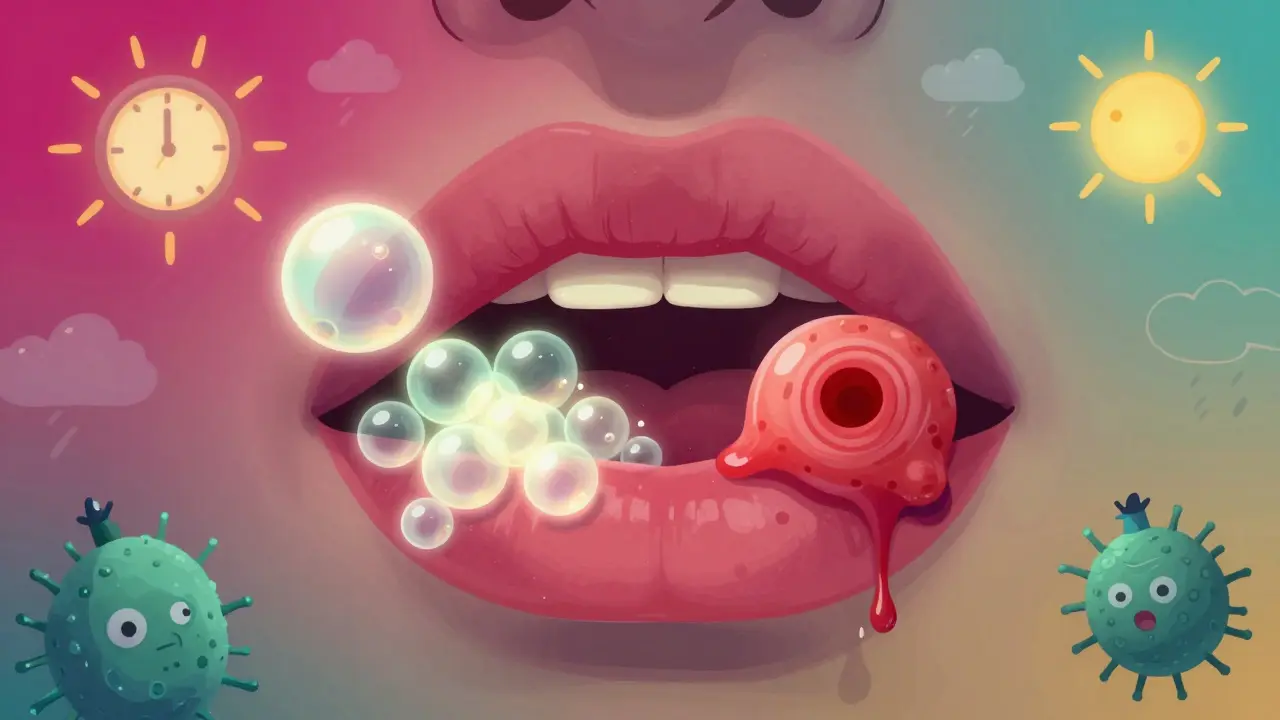
Why It Matters If You Mistake a Cold Sore for a Pimple
You wake up, look in the mirror, and see a small red bump near your lip. You think it’s a pimple. You grab your acne spot treatment, dab on some benzoyl peroxide, and wait. But instead of fading, it gets worse. It swells, it tingles, then it bursts into a cluster of tiny blisters. Now you’re confused-and maybe even worried. What you thought was a simple zit was actually a cold sore. And by treating it like a pimple, you might have made it worse.
Cold sores and pimples look similar at first glance. Both can show up on or around the lips. Both can be red, swollen, and painful. But they’re completely different conditions with totally different causes, treatments, and risks. Mixing them up isn’t just annoying-it can spread infection, delay healing, or even make your skin worse.
What Causes Cold Sores?
Cold sores are caused by the herpes simplex virus type 1 (HSV-1). This isn’t something you catch once and forget. Once you’re infected, the virus stays in your body for life. It hides in nerve cells and wakes up when your defenses are low. About 67% of people under 50 worldwide carry HSV-1, according to the World Health Organization. In the U.S., 50-80% of adults have been exposed by age 20.
Outbreaks don’t happen randomly. They’re triggered by things like sunburn, stress, hormonal shifts, illness, or fatigue. If you’ve ever gotten a cold sore after a long flight, during exam week, or right after a beach day, that’s why.
Cold sores don’t start as a bump. They start with a warning. You’ll feel it first: a tingling, burning, or itching sensation right where the sore will appear-usually along the edge of your lip, where the skin meets the mucous membrane. That’s the prodrome phase. It can last 12 to 48 hours before you even see anything.
What Causes Pimples?
Pimples are a type of acne. They happen when hair follicles get clogged with oil, dead skin cells, and bacteria-mainly Cutibacterium acnes. Your face has lots of these follicles, especially around the nose, chin, and yes, even the lip area. That’s why pimples can pop up right on the lip surface, not just next to it.
Unlike cold sores, pimples aren’t contagious. You can’t catch one from kissing someone or sharing a towel. They’re a result of your skin’s own biology: overactive oil glands, hormonal changes (especially during puberty, periods, or pregnancy), or even certain skincare products that block pores.
A pimple doesn’t come with a warning. No tingling. No burning. Just a red bump that gets tender to the touch. Sometimes it develops a white or yellow head-that’s pus, not fluid like in a cold sore.
How They Look Different (Even When They’re Both Small)
Here’s the easiest way to tell them apart: look at the structure.
- Cold sores appear as a cluster of tiny, fluid-filled blisters-usually 2 to 5 grouped together. They’re not a single bump. The fluid starts clear, then gets cloudy as the sore matures. After they break, they form a yellow or brown crust.
- Pimples are single, raised bumps. They might be red and inflamed, or they might have a whitehead or blackhead in the center. There’s no clustering. No blistering. Just one irritated pore.
Location matters too. Cold sores almost always show up on the vermillion border-the thin line where your lip ends and your face begins. Pimples can show up anywhere on the face, including the center of the lip, the chin, or the forehead. If you’ve got a bump right on the edge of your lip, especially if it’s part of a group, it’s far more likely to be a cold sore.
Sensation: The Real Clue
The biggest giveaway? How it feels before it shows up.
Cold sores come with a signature pre-symptom: tingling, burning, or itching. This happens hours, sometimes a full day, before the blister appears. If you’ve ever felt that weird sensation and knew what was coming, you’ve experienced the prodrome phase. That’s your body’s early warning system.
Pimples? No such thing. They just appear. You might feel tenderness when you touch it, but there’s no creeping sensation beforehand. If you wake up with a bump and no warning, it’s probably a pimple.
Treatment: What Works and What Doesn’t
This is where things get dangerous if you’re wrong.
Cold sores need antivirals. Prescription creams like acyclovir (Zovirax), valacyclovir (Valtrex), or penciclovir (Denavir) are the gold standard. These don’t cure the virus, but they slow it down. If you start applying them during the tingling phase-before the blister forms-you can cut the outbreak short by 1 to 2 days. Over-the-counter docosanol (Abreva) helps too, but it takes 4 to 5 days of daily use to reduce symptoms by half.
Pimples need acne treatments. Benzoyl peroxide (2.5%-10%) kills bacteria and dries out the pimple. Salicylic acid (0.5%-2%) unclogs pores. Both work best when used consistently, not just when a pimple appears. You won’t see results overnight, but in 4 to 6 weeks, breakouts become less frequent and less severe.
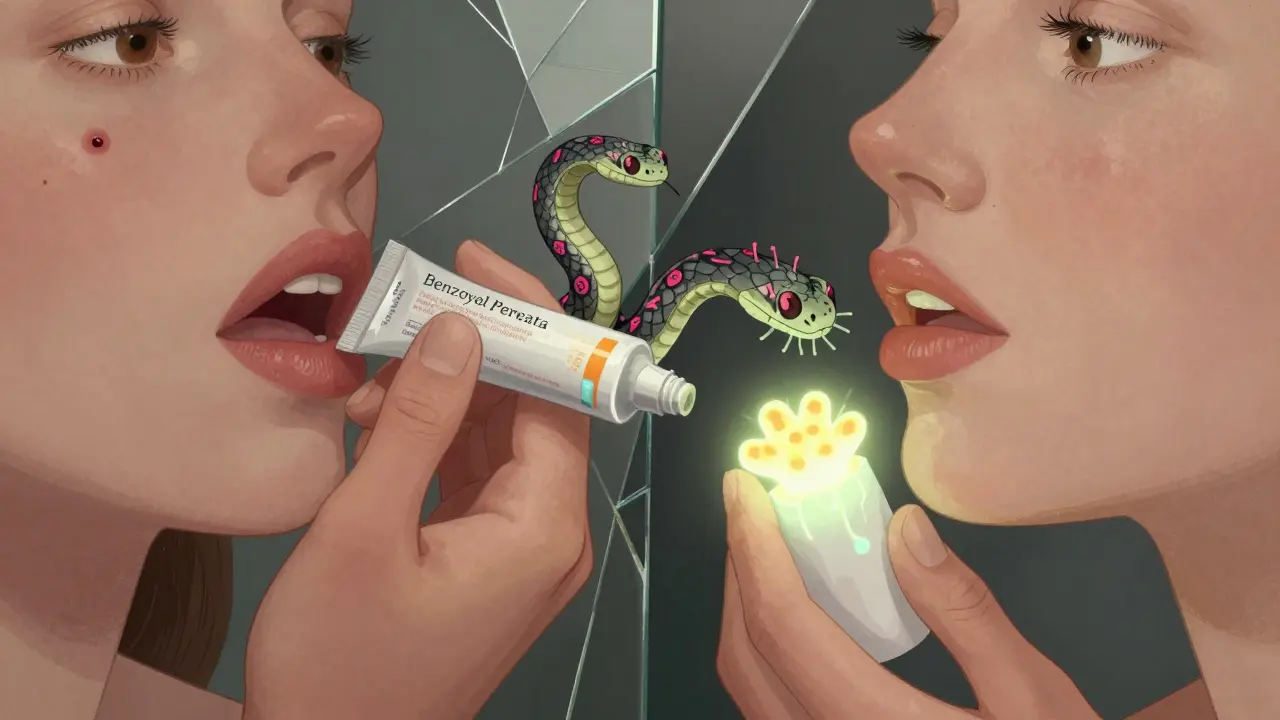
Here’s the critical part: don’t use acne products on cold sores. Benzoyl peroxide, alcohol-based spot treatments, or even toothpaste (yes, people still try this) can rupture the blisters. That releases more virus into your skin and increases the chance of spreading it to other areas-or to other people.
How to Prevent Spreading (Especially With Cold Sores)
Cold sores are contagious. You can spread HSV-1 through kissing, sharing lip balm, utensils, or towels-even if you don’t have visible sores. Studies show transmission happens in 30-50% of close contacts during an active outbreak.
Here’s how to stop it:
- Avoid touching the sore. If you do, wash your hands immediately.
- Use separate lip balms, towels, and makeup brushes during an outbreak.
- Never kiss someone or share drinks when you feel tingling or have a visible sore.
- Use sunscreen on your lips daily. UV exposure triggers outbreaks in 32% of cases.
Pimples don’t spread, so none of this applies. But if you’re popping them, you’re risking scarring and infection. Don’t pick.
When to See a Doctor
Most cold sores and pimples clear up on their own. But call a dermatologist if:
- Your cold sore lasts longer than two weeks.
- You get frequent outbreaks (more than 5 times a year).
- The sore spreads to your eyes, nose, or fingers.
- You have a weakened immune system from illness or medication.
- Your pimple is huge, painful, and doesn’t improve after 4 weeks of treatment.
- You’re getting cystic acne-deep, hard lumps under the skin.
Doctors can prescribe stronger antivirals for frequent cold sores or oral antibiotics and hormonal treatments for stubborn acne.
What’s New in Treatment
Science is moving fast. In 2023, the FDA approved pritelivir, a new antiviral that reduces viral shedding by 70% in clinical trials. That could mean fewer outbreaks and less spreading in the future.
For acne, newer treatments focus on the skin’s microbiome. Instead of wiping out all bacteria, they target only the harmful ones-like C. acnes-while protecting good bacteria. These are gentler on the skin and less likely to cause dryness or irritation.
And yes, some dermatologists now use laser therapy to reduce cold sore frequency. It’s not a cure, but it can help people who get outbreaks triggered by sun exposure or stress.
Real-Life Mistakes (And How to Avoid Them)
People make the same errors over and over:
- Applying toothpaste to a cold sore (it burns, dries out skin, and delays healing).
- Using alcohol wipes on a pimple (over-dries skin, triggers more oil production).
- Sharing lip balm during an outbreak (41% of partners get infected this way).
- Waiting to treat a cold sore until it’s fully formed (miss the golden 24-hour window).
The best thing you can do? Learn your body. If you’ve had a cold sore before, pay attention to that tingling. Keep antiviral cream on hand. If you’re prone to pimples, stick to non-comedogenic products and wash your face twice a day-not more, not less.
Bottom Line
Cold sores and pimples aren’t the same. One is viral. One is bacterial. One spreads. One doesn’t. One needs antivirals. One needs acne treatments.
Get it wrong, and you risk making things worse. Get it right, and you heal faster, avoid spreading infection, and save yourself months of frustration.
If you’re unsure, take a photo. Compare it to reliable sources. Or better yet-see a dermatologist. It’s not just about looks. It’s about your skin’s health.



8 Comments
Bro, I once put toothpaste on a cold sore and thought I was a genius. Turned out I just made it worse and looked like I got sucker-punched by a clown. Don't be me. Get the antiviral cream before it turns into a full-blown disaster. Seriously, stop treating your face like a science experiment./p>
I used to mistake cold sores for pimples all the time until I started paying attention to that tingling feeling. Now I keep acyclovir in my bag like a lifeline. Also, sunscreen on the lips isn't just for beach days-it’s a daily armor. If you get outbreaks often, talk to a derm. It’s not just ‘bad luck,’ it’s manageable./p>
The article presents a clinically accurate distinction between HSV-1 lesions and inflammatory acne, though it lacks statistical granularity regarding recurrence rates across age cohorts. Furthermore, the assertion that benzoyl peroxide exacerbates viral lesions is supported by dermatological literature, yet the omission of comparative efficacy data between docosanol and prescription antivirals constitutes a methodological gap./p>
Wow, someone actually wrote a useful post without yelling about ‘detoxing’ or ‘miracle cures.’ Respect. I used to pop every bump like it owed me money. Then I learned the hard way that your lip isn’t a zit factory. Now I just whisper ‘not today, Satan’ and reach for Zovirax. Small victories./p>
AMERICA NEEDS TO STOP LETTING VIRUSES WIN! GET YOUR ANTIVIRALS AND USE SUNSCREEN LIKE A REAL CITIZEN! NO MORE TOOTHPASTE ON YOUR LIPS! THIS ISN'T A DRAMA, IT'S A PUBLIC HEALTH ISSUE! #STOPTHESORES #AMERICAHEALS/p>
The ontological distinction between a viral exanthem and a sebaceous follicular occlusion reveals a profound epistemological dissonance in contemporary dermatological discourse. One is an invader, the other an internal dysregulation-yet both are pathologized through the same visual lens, perpetuating a Cartesian fallacy of bodily autonomy. The true cure lies not in topical agents, but in the reintegration of the self with its microbial symbionts./p>
Okay but have you ever heard that cold sores are actually caused by 5G towers? I read it on a forum. The government puts the virus in lip balm to track us. And acne? That’s just your body reacting to fluoride in the water. They don’t want you to know this. I’ve been using apple cider vinegar and moonlight for 3 years-no more outbreaks. Also, I think the WHO is lying about the 67% stat. They’re funded by Big Pharma./p>
You guys are doing great just by paying attention. Seriously. Most people don’t even notice when their skin changes. If you caught that tingling before the sore showed up? That’s intuition. That’s your body talking. Keep the antiviral cream handy, use sunscreen, and don’t beat yourself up if you messed up before. Healing isn’t perfect. It’s just persistent. You’ve got this./p>