
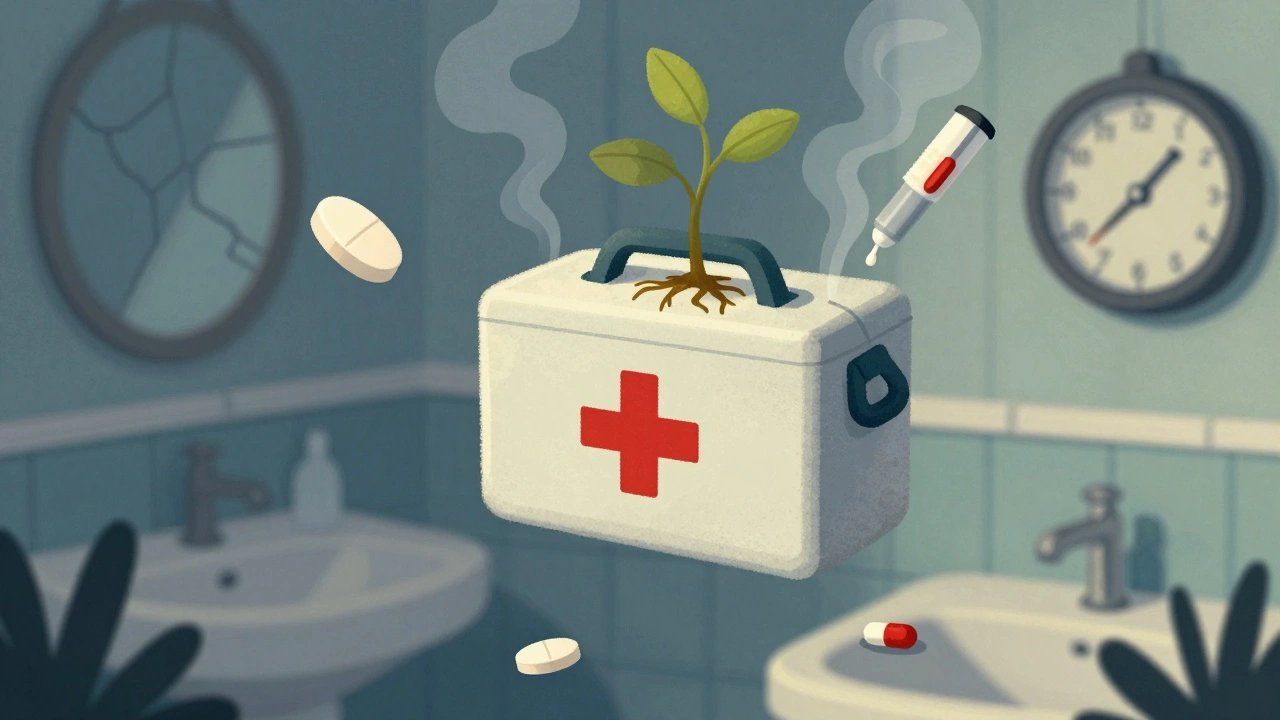
Most people keep a first-aid kit at home, but how many of them actually check the expiration dates? If you haven’t looked at yours in over a year, you might be holding onto pills, creams, or injectables that no longer work - or worse, could harm you. In an emergency, you don’t want to find out your ibuprofen is weak or your EpiPen failed because it expired six months ago. The truth is, not all expired medications are dangerous, but some are life-threatening. Knowing which ones to toss and which ones you can stretch a little is critical.
Not All Expired Medications Are the Same
Expiration dates aren’t just marketing tricks. They’re based on real testing by manufacturers and approved by the FDA to guarantee the medicine works as intended. But here’s the twist: some drugs last far longer than their labels say, while others degrade fast - even before the date on the bottle.
For example, solid pills like ibuprofen, acetaminophen, and aspirin are surprisingly stable. A U.S. Department of Defense study found that 80% of these medications still had at least 90% of their original potency up to 15 years after expiration - if they were kept in their original containers, away from heat and moisture. That’s not a suggestion to hoard medicine, but it does mean you’re probably not in immediate danger if you use a 1-year-old bottle of Tylenol for a headache.
But liquid medications? That’s a different story. Eye drops, antibiotic suspensions, and epinephrine auto-injectors start breaking down within months of expiration. Epinephrine, the life-saving drug in EpiPens, loses 20-30% of its potency within six months after the expiration date. In a severe allergic reaction, that drop in strength could mean the difference between recovery and a trip to the ER - or worse. The same goes for nitroglycerine tablets used for chest pain. These degrade quickly once the bottle is opened, and even if the date hasn’t passed, they’re often ineffective after 3-6 months.
What You Must Replace Immediately
There are five types of OTC first-aid medications you should never use past their expiration date:
- Epinephrine auto-injectors (EpiPen, Auvi-Q) - Loss of potency can be fatal during anaphylaxis.
- Nitroglycerine tablets - Used for heart attacks; they lose effectiveness fast once exposed to air.
- Liquid antibiotics - Like amoxicillin suspension. If it’s expired, it won’t kill the bacteria - and might make them stronger.
- Eye drops and ear drops - These are sterile. Once expired, they can grow bacteria and cause serious infections.
- Insulin - Even though it’s prescription, it’s often kept in home first-aid kits for diabetics. Expired insulin can lead to dangerous blood sugar spikes.
If you’re using any of these and they’re expired, replace them now. Don’t wait. Don’t hope. Don’t think, “It might still work.” In emergencies, sub-potent medicine isn’t better than nothing - it’s dangerous.
What You Can Stretch (With Caution)
For non-emergency meds like pain relievers and antihistamines, you have a bit more wiggle room - but only if they’re stored right.
- Acetaminophen and ibuprofen: Can be used up to 6 months past expiration if the tablets look normal - no cracks, discoloration, or strange smell.
- Diphenhydramine (Benadryl): Loses about 15% potency after expiration but still works for mild allergies. Don’t rely on it for severe reactions.
- Hydrocortisone cream: Avoid using past expiration. A 2023 FDA lab study found 47% of expired creams had bacterial contamination. A rash you’re trying to treat could turn into an infection.
- Antiseptics: Hydrogen peroxide loses its fizz and disinfecting power within 30 days of opening, no matter the expiration date. Isopropyl alcohol (70%) stays good for up to two years if sealed.
Always check the physical condition of the medicine. If it’s changed color, smells odd, or has particles in it - toss it. That’s not a sign it’s just old. That’s a sign it’s unsafe.
Storage Matters More Than You Think
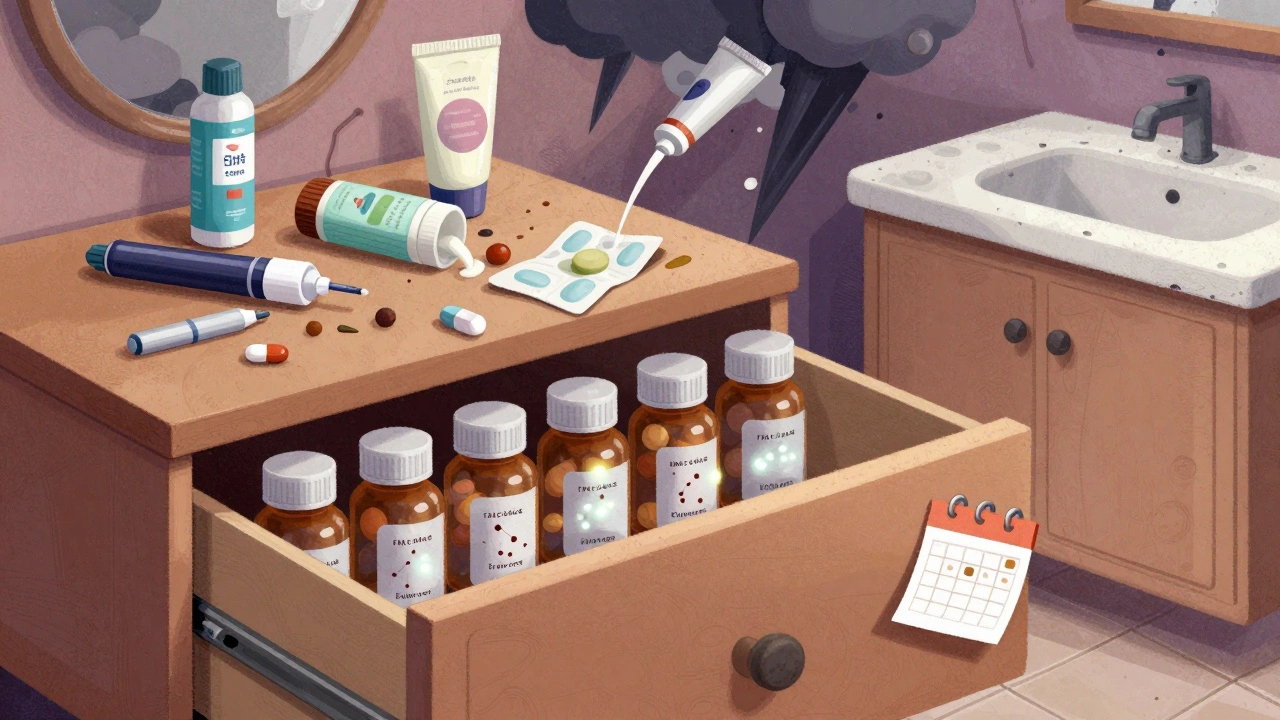
Where you store your first-aid kit makes a huge difference. The bathroom is the worst place. Humidity, steam, and heat from showers destroy medicine. A 2022 Johns Hopkins study showed medications stored in bathroom cabinets lost potency 40% faster than those kept in a cool, dry bedroom drawer.
Keep your first-aid kit:
- In its original container
- At room temperature (20-25°C / 68-77°F)
- Away from direct sunlight
- In a place with low humidity (below 60%)
Don’t transfer pills to pill organizers unless you’re using them daily. Once you move them out of the original bottle, they’re exposed to air and moisture. The University of Michigan found that pills in organizers lose half their shelf life - so a 3-year expiration becomes 18 months.
How to Check and Maintain Your Kit
Here’s a simple routine that takes 5 minutes twice a year:
- Look: Check for discoloration, crumbling pills, cloudy liquids, or weird smells.
- Check dates: Write the expiration date on a sticky note and put it on the front of the kit. It’s easier to see than digging through bottles.
- Replace emergency meds early: Don’t wait until the day it expires. Swap out EpiPens, nitroglycerine, and inhalers 30 days before the date.
- Dispose properly: Don’t flush pills or throw them in the trash. Take them to a pharmacy drop box or a National Prescription Drug Take Back Day event. In Australia, pharmacies like Chemist Warehouse and TerryWhite Chemmart offer free disposal.
- Restock: After you use something, replace it immediately. Don’t wait until the next emergency.
The American Red Cross recommends a full kit review every 12 months. That includes checking bandages, gauze, and tape too. Adhesive bandages lose 40% of their stickiness after 18 months. Sterile gauze can become contaminated even if unopened after two years.
What Happens If You Use Expired Medicine?
Most solid medications won’t make you sick - they’ll just not work. But that’s the problem. If you take an expired antibiotic and it doesn’t fully kill the infection, the bacteria can survive and become resistant. That’s how superbugs form.
There are real cases of people getting worse after using expired meds. A 2021 report from the Institute for Safe Medication Practices linked expired topical antibiotics to 127 documented skin infections. One Reddit user shared how their child’s minor scrape turned into a staph infection because they used an old antibiotic ointment.
And then there’s the epinephrine story. A 2022 Healthline thread collected 43 accounts of people who used expired EpiPens during allergic reactions. Half got partial relief. Some needed a second dose. One woman had to be rushed to the hospital after her expired pen didn’t stop her throat swelling.
What’s Changing in 2025?
Regulations are catching up. As of December 2025, all OTC manufacturers in the U.S. must submit full stability data to the FDA - meaning expiration dates will be more accurate and consistent. Some companies are already using smart packaging: QR codes that tell you the actual potency based on how you stored the medicine, or labels that change color if the product got too hot.
Smart first-aid kits are also on the rise. Devices like those from First Aid Only now sync with your phone and send alerts 60 days before any item expires. In professional settings, OSHA now fines employers $15,625 per violation if expired meds are found in workplace kits.
But you don’t need tech to stay safe. Just make checking your first-aid kit part of your routine - like changing your smoke detector batteries. Do it every spring and fall. Write it on your calendar. Set a reminder on your phone.
Final Rule: When in Doubt, Toss It
Medicine isn’t like milk. You can’t smell it and know it’s bad. But you can be smart about it. If it’s something you’d use in an emergency - epinephrine, insulin, eye drops - replace it on time. If it’s a pain reliever you use for a headache, and it’s 6 months past expiration, and it looks and smells fine? It’s probably okay.
But never gamble with your health. If you’re unsure, go to a pharmacy. Pharmacists will check it for you and often give you a free replacement if it’s expired. It’s not worth risking an infection, a bad reaction, or a failed emergency dose.
Your first-aid kit is your first line of defense. Make sure it’s ready to work when you need it most.
Can I still use expired ibuprofen or acetaminophen?
Yes, if they’re solid tablets, stored properly, and show no signs of damage - like discoloration, crumbling, or odd smells. Studies show many retain 90%+ potency up to 6 months past expiration. But don’t use them for serious pain or if you’re treating a child. When in doubt, replace them.
What happens if I use an expired EpiPen?
It might not work fully. Epinephrine loses potency quickly after expiration - up to 30% within six months. In a severe allergic reaction, this could mean the difference between stopping the reaction and needing emergency care. If you have no other option, use it anyway - but call emergency services immediately after. Never delay treatment because you’re waiting for an unexpired one.
Should I throw away expired antiseptic wipes?
Yes, especially if they’re dry or smell off. Alcohol-based wipes lose effectiveness once the liquid evaporates. Even if the expiration date hasn’t passed, if the wipes aren’t moist, they won’t disinfect. Replace them every 12-18 months, regardless of the date.
Can I store first-aid meds in the car?
No. Cars get extremely hot in summer and freezing in winter. Heat and cold destroy medicine. Epinephrine, insulin, and antibiotics can become useless or unsafe. Keep your kit in a cool, dry place like a bedroom drawer - not the glovebox.
How do I dispose of expired medications safely?
Never flush them or throw them in the trash. Take them to a pharmacy that offers a take-back program. In Australia, Chemist Warehouse, TerryWhite Chemmart, and many public hospitals accept expired meds. You can also check for National Prescription Drug Take Back Day events - they happen twice a year and are free and anonymous.
Do bandages and gauze expire?
Yes. Sterile gauze can become contaminated after 24 months, even if unopened. Adhesive bandages lose stickiness after 18 months and may not stay on properly. Check for brittleness, discoloration, or odor. Replace them annually to ensure they work when needed.
What to Do Next
Right now, grab your first-aid kit. Lay it out on the table. Check every item. Write down the expiration dates. Toss anything that’s expired - especially epinephrine, eye drops, or antibiotics. Replace what you used. Restock the basics: bandages, antiseptic, pain relievers. Set a reminder on your phone for next spring.
Don’t wait for an emergency to realize your kit is outdated. A few minutes today could save you from a dangerous mistake tomorrow.

13 Comments
So let me get this straight-you’re telling me I can keep my 12-year-old ibuprofen because it "looks fine" but I need to replace my EpiPen the second it hits 11:59 PM on the expiry date? Sounds like the FDA and Big Pharma are running a scam where the only thing that expires is my trust in the system.
Also, why does everything in this post sound like a pharmaceutical sales pitch disguised as public service?/p>
This is one of the most practical guides I’ve read in a while. I used to toss expired meds without thinking, but now I’m checking my kit every season. The bit about bathroom storage was eye-opening-I had mine in the cabinet above the sink for years. No more.
Also, replacing bandages annually? I never thought about stickiness degrading. Small things matter./p>
The pharmacokinetic stability of solid oral dosage forms under ambient storage conditions is a well-documented phenomenon, particularly for non-hygroscopic molecules like ibuprofen and acetaminophen. The FDA’s Shelf Life Extension Program demonstrated that many pharmaceuticals retain >90% potency well beyond labeled expiration dates, provided they’re protected from UV, moisture, and thermal degradation. However, the risk-benefit calculus changes dramatically with biologics-epinephrine’s degradation pathway is autocatalytic, and nitroglycerin’s volatility is governed by Henry’s Law in relation to headspace oxygen. Bottom line: don’t gamble with life-critical meds, but stop treating all expiration dates as binary fail-safes. The real issue is inconsistent storage protocols, not the dates themselves./p>
I’ve been keeping my first-aid kit in a drawer under my bed since my mom taught me how to do it when I was 12. Never thought about humidity until this post. I used to think "if it’s not expired, it’s fine"-but now I see how dangerous that mindset is. Especially with eye drops. My cousin got a corneal ulcer from an old bottle. Never again.
Thanks for the reminder. I’m checking mine tonight./p>
i just checked my kit and my benadryl is 8 months past exp. it looks fine so im gonna keep using it for my allergies. i dont need a whole new bottle for a little sneezing. also why is everyone so scared of expired stuff? its not like its poison./p>
I appreciate how thorough this is. The storage advice alone is worth the read. I used to keep my kit in the kitchen, near the stove. Now it’s in a cool, dark drawer. Also, I’ve started writing expiration dates on masking tape and sticking it to the front of the box. So simple, but so effective.
And yes-replace EpiPens early. No excuses./p>
You know who benefits from this fear of expired meds? The pharmaceutical companies. They make billions off people replacing perfectly good pills every year. The FDA’s expiration dates are arbitrary. They’re not based on safety-they’re based on profit margins. Why would they want you to keep a 10-year-old bottle of aspirin when they can sell you a new one every 18 months? And don’t get me started on smart packaging-QR codes that track your storage? That’s just another way for them to collect your data. They don’t care if your medicine works-they care if you keep buying.
I’ve been using expired insulin for two years. My glucose levels are better than ever. Coincidence? I think not./p>
The ethical imperative to adhere to manufacturer-determined expiration dates cannot be overstated. To deviate from these parameters is not merely imprudent-it constitutes a violation of the social contract between consumer and purveyor of pharmaceuticals. One does not cavalierly extend the shelf life of life-saving therapeutics based on anecdotal observation or unverified laboratory studies. The consequences of such negligence are not hypothetical-they are documented, fatal, and entirely preventable. One must exercise the utmost diligence. The cost of a replacement EpiPen is negligible compared to the cost of a life.
Moreover, the notion that "it looks fine" is a dangerous fallacy. Human perception is not a reliable indicator of molecular integrity./p>
I used to ignore expiration dates until my kid got a bad cut and I used an old antibiotic ointment. It didn’t help-and the redness got worse. Ended up at urgent care. Lesson learned.
Now I check my kit every January and July. Took me 5 minutes. Saved me a lot of stress. Also, I found out my local pharmacy takes back expired meds for free. Never knew that./p>
Stop being so dramatic. Nobody dies from using expired Tylenol. You’re all acting like expired antiseptic wipes are nuclear waste. If it doesn’t look or smell weird, use it. Your anxiety is worse than the medicine./p>
I found this guide very helpful. I had no idea bandages lose stickiness over time. I replaced mine yesterday. Also, I moved my first-aid kit from the bathroom to the bedroom. It makes sense now why my hydrocortisone cream always felt grainy.
Thank you for the clear advice./p>
I’m so glad someone finally wrote this. I’ve been telling my friends for years that you shouldn’t keep meds in the bathroom. No one listened. Now I’m just sending them this post. The part about pill organizers was a wake-up call-I’ve been using one for months. Guess I’m buying new bottles today./p>
This is exactly the kind of info I need. I’ve been putting off checking my kit for a year. Now I’m doing it right after this. Thanks for the push. Also, I didn’t know about the take-back days. I’ll make sure to go next month./p>