

For many people living with rheumatoid arthritis (RA), the daily pain, stiffness, and swelling aren’t just inconvenient-they’re life-limiting. But over the last 25 years, a new class of drugs has changed the game. Biologic DMARDs aren’t just another pill; they’re precision tools designed to shut down the immune system’s attack on your joints. And for a growing number of patients, they’re making something once thought impossible: disease remission, a real possibility.
What Are Biologic DMARDs, Really?
Biologic disease-modifying antirheumatic drugs (bDMARDs) are made from living cells, not chemicals. Unlike older drugs like methotrexate that broadly suppress the immune system, biologics target specific troublemakers-like TNF-alpha, IL-6, or T-cells-that drive RA inflammation. Think of them as smart missiles instead of carpet bombing.
The first one, etanercept (Enbrel), hit the market in 1998. Since then, we’ve seen a wave of options: adalimumab (Humira), infliximab (Remicade), rituximab (Rituxan), abatacept (Orencia), and tocilizumab (Actemra). Each works differently. Some block signals between immune cells. Others remove specific immune cells entirely. And now, newer JAK inhibitors like tofacitinib (Xeljanz) and upadacitinib (Rinvoq) offer oral alternatives, though they’re technically synthetic, not biologic.
These aren’t first-line treatments. The American College of Rheumatology says methotrexate should come first. It’s cheap, well-studied, and works for many. But if you’ve tried methotrexate for months and still can’t move without pain, or if your X-rays show joint damage creeping in, then it’s time to consider biologics.
How Do Biologics Actually Help You Feel Better?
The goal isn’t just to reduce pain. It’s to stop the disease in its tracks. Clinical trials show that when you combine a biologic with methotrexate, 20-50% of patients reach remission-meaning little to no joint swelling, pain, or fatigue. Compare that to just 5-15% with methotrexate alone.
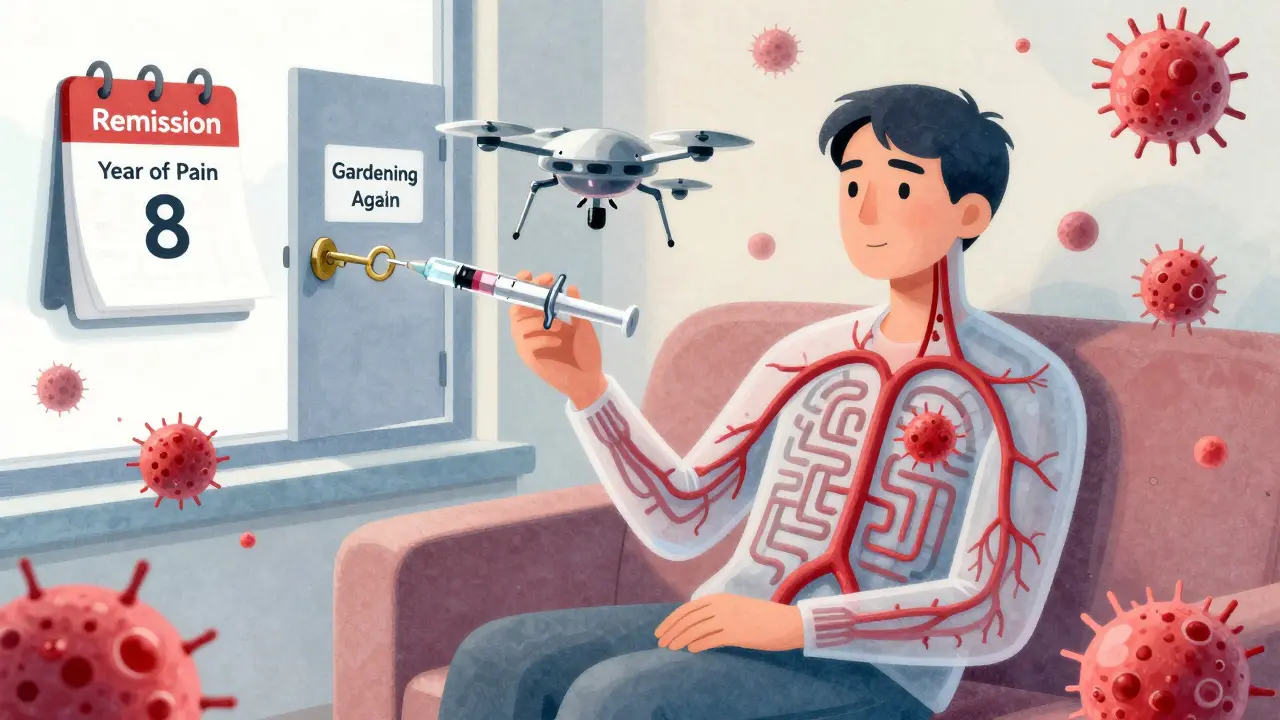
One patient I spoke with in Melbourne, a 52-year-old teacher, had been on six different oral drugs over eight years. Nothing worked. She started adalimumab in early 2023. Within six weeks, her DAS28 score (a standard RA activity measure) dropped from 6.2 (high disease activity) to 1.9 (remission). She stopped using her cane. She started gardening again.
Timing matters. TNF inhibitors like adalimumab often bring relief in days or weeks. Others, like abatacept or rituximab, take longer-sometimes 3-6 months. But if they work, the results can be lasting. A 2022 case study from the Arthritis National Research Foundation followed a patient who achieved remission after just eight weeks on tocilizumab. That’s not rare anymore.
Not All Biologics Are the Same
There’s no one-size-fits-all. Your body’s unique immune profile determines what will work. That’s why some people respond brilliantly to one drug and barely notice a change with another.
Studies show TNF inhibitors-adalimumab, etanercept, and golimumab-are slightly more effective than infliximab in real-world settings. But when you look beyond TNF blockers, non-TNF biologics like tocilizumab (which blocks IL-6) and abatacept (which blocks T-cell activation) often outperform them in specific subgroups.
Here’s the kicker: if you have low levels of B-cells in your joint fluid, rituximab might not help you at all. But tocilizumab? It could be a game-changer. That’s why doctors are starting to use synovial tissue tests and blood biomarkers to guide choices-not just guesswork.
And here’s what most patients don’t know: switching from one biologic to another doesn’t always work. Research from Albany Medical College shows that each new biologic you try after a failure gives you less and less benefit. That’s why getting it right the first time matters more than ever.
Cost, Access, and the Rise of Biosimilars
Let’s be honest: biologics are expensive. In the U.S., the annual cost can hit $70,000. That’s why many patients delay treatment or skip doses. But things are changing.
Biosimilars-near-identical copies of originator biologics-started hitting the market in 2016. Today, they make up 35% of TNF inhibitor prescriptions in the U.S. And they cost 15-30% less. In Australia, where public healthcare covers most of the cost, access is far better than in the U.S., but out-of-pocket expenses still exist for some.
On Reddit, a 2023 thread with over 800 comments showed patients using biosimilars saved an average of $1,200 per month. But some worry about switching. Will it work the same? Studies show biosimilars perform just as well as the originals. The FDA and EMA require them to meet strict standards. If your doctor recommends a biosimilar, it’s not a downgrade-it’s a smart choice.
Side Effects and Risks You Can’t Ignore
Biologics aren’t risk-free. Because they dampen parts of your immune system, you’re more vulnerable to infections. Tuberculosis, pneumonia, and even fungal infections can become serious. That’s why everyone gets a TB test before starting. Some patients develop rashes, headaches, or nausea. Injection site reactions are common-about 45% of adverse event reports mention redness, swelling, or pain where the needle goes in.
But here’s what matters: the risk of serious infection is about 1.4 times higher than with placebo. That sounds scary, but it’s still rare for most healthy people. If you have a history of recurrent infections, cancer, or heart failure, your doctor will weigh this carefully.
One thing patients don’t talk about enough: mental health. RA is exhausting. When pain drops and mobility returns, depression and anxiety often lift too. One study found that patients in remission reported better sleep, less anxiety, and improved work performance within six months. That’s not just physical healing-it’s emotional recovery.

What It Takes to Make Biologics Work for You
Success isn’t just about the drug. It’s about how you use it.
- Stick to the schedule. Missing doses, even occasionally, lowers your chance of remission. Adalimumab works best when given every two weeks, not every three.
- Learn how to inject. Most biologics are self-administered. Training usually takes two sessions. The Arthritis Foundation reports 75% of patients master it after that.
- Track your symptoms. Use apps like ArthritisPower or keep a simple journal. Note joint pain, fatigue, morning stiffness. Share it with your rheumatologist every visit.
- Know the red flags. Fever, chills, unexplained cough, or new skin sores? Call your doctor. Don’t wait.
Insurance approval can take 7-14 days. Some manufacturers offer patient assistance programs that cover 40-100% of costs. Ask your rheumatology nurse. Don’t assume you can’t afford it.
The Future: Personalized RA Care
What’s next? We’re moving toward personalized treatment. Instead of trial and error, doctors may soon use blood tests or joint tissue scans to predict which biologic will work best for you. Early data from Nature Reviews Rheumatology shows synovial biomarkers can predict response with over 80% accuracy.
Longer-acting drugs are coming too. A twice-yearly injection of tocilizumab is already in Phase III trials. That means fewer needles, fewer trips to the clinic.
And while biologics have transformed RA, they’re not a cure. About 30-40% of patients don’t respond to their first biologic. That’s why research into new targets-like GM-CSF and other cytokines-is accelerating. The goal? More options, fewer failures.
Can You Really Achieve Remission?
Yes. Not for everyone. But for far more than before.
Remission doesn’t mean you’re cured. It means your RA is quiet. No joint damage. No pain. No fatigue. You can live without thinking about it.
That’s the promise of biologic DMARDs. They don’t just manage symptoms. They change the trajectory of the disease. And for the first time in history, many people with RA are living full lives-not just surviving it.





14 Comments
Man, I remember when my buddy tried Humira for the first time-thought he was gonna need a rocket scientist to inject it. Turned out, his 82-year-old grandma could do it better than him after two tries. Biologics aren’t magic, but they’re the closest thing we’ve got to a time machine for your joints.
/p>And biosimilars? Total game-changer. My cousin in Edmonton switched to a biosimilar and saved enough to take a real vacation for the first time in a decade. No drama, no side effects. Just… freedom.
You know what’s wild? The way these drugs don’t just numb the pain-they bring back parts of you that you forgot existed. The ability to pick up your kid without wincing. To hold your partner’s hand without thinking about the ache in your knuckles.
/p>It’s not just medicine. It’s memory restoration.
so i tried enbrel and it was like… nothing? then switched to rituximab and boom. 3 weeks later i was walking to the mailbox without a cane. weird how your body just picks one and goes ‘nah, this one’s mine.’
/p>What I love about this post is how it doesn’t sugarcoat the grind. It’s not ‘take this pill and you’ll be fine.’ It’s ‘here’s the science, here’s the struggle, here’s the hope.’
/p>I’m from rural Texas, and my rheum doc told me to try methotrexate first. I did. For 14 months. My hands looked like gnarled oak branches. Then we went biologic. Six weeks later, I painted my kitchen. Not because I had to-but because I wanted to. That’s the quiet miracle these drugs do.
It is a matter of profound scientific advancement that biologic DMARDs have enabled a paradigm shift in the management of rheumatoid arthritis. The precision of immunomodulation, as opposed to broad immunosuppression, represents a triumph of targeted therapeutic design.
/p>One must also acknowledge the socioeconomic disparities in access. In nations with universal healthcare, remission rates are demonstrably higher. This is not merely a medical issue-it is a moral one.
Let’s be real-this whole biologic thing is just Big Pharma’s way of charging $70K a year for a drug that should cost $300. You think your insurance is gonna cover it? Good luck. And don’t get me started on how they patent every tiny variation to keep generics away.
/p>My cousin’s on a biosimilar and she’s fine. But if you’re not rich, you’re playing Russian roulette with your health. That’s not healthcare. That’s extortion.
I’ve been on three different biologics. First one: adalimumab. Worked great for 18 months. Then… nada. Second: tocilizumab. Took 4 months. Felt like a new person. Third: abatacept. Didn’t do squat. It’s like dating. You have to try a few before you find the one that clicks.
/p>And honestly? The hardest part wasn’t the shots. It was the guilt of feeling ‘lucky’ when others can’t even get on the waiting list.
Oh my gosh, I just want to say-this article made me cry, not because I’m sad, but because I finally feel seen. I’ve been living with RA since I was 24, and for years, I thought I’d never walk barefoot on grass again. Then, after starting rituximab, I did. I just stood there, barefoot, in my backyard, and cried because my toes didn’t hurt.
/p>And yes, I track everything-I use ArthritisPower, I journal, I even take pictures of my swollen knuckles (gross, I know). My rheumatologist says I’m her ‘model patient.’ But honestly? I’m just trying to survive. And now? I’m living. Thank you for writing this.
Also, side note: the injection site redness? Yeah, it stings. But I’ve named my pen. It’s ‘Sir Stab-a-Lot.’ I think he likes me.
Just had my 3rd biologic switch. Tofacitinib this time. Took 2 weeks to feel it, but now I can lift my coffee cup without using both hands. Crazy. And yeah, I spell ‘methotrexate’ wrong half the time. Don’t care. It works. And biosimilars? My doc said they’re basically the same. So I’m saving $1,000/month. That’s a new guitar. Or a trip to Alaska. Win-win.
/p>I’ve been on adalimumab for 5 years. Still in remission. No flares. No pain. But I still get paranoid every time I catch a cold. Is it just a bug-or is my immune system finally giving out? I think about that every time I sneeze.
/p>Also, the mental health piece? Huge. When your body stops screaming, your mind finally gets to rest. I started therapy last year. Best decision ever.
While the clinical efficacy of biologic DMARDs is well-documented, it is imperative that patient education and adherence protocols are standardized across healthcare systems. Non-adherence remains a leading cause of therapeutic failure, regardless of drug selection.
/p>Furthermore, the psychological burden of chronic disease must be addressed with equal rigor as the physiological component.
As a mother of two children with juvenile idiopathic arthritis, I’ve watched the transformation biologics have brought-not just in their bodies, but in their spirits. My daughter, once too tired to play with dolls, now climbs trees. My son, who used to cry during soccer practice, just scored his first goal last weekend.
/p>Yes, the cost is staggering. Yes, the needles are scary. But I would do it all again. Because remission isn’t a medical term-it’s a childhood restored.
And to those in countries without access: I see you. I’m fighting for you too.
It is noteworthy that the temporal correlation between the introduction of TNF-alpha inhibitors and the decline in RA-related disability metrics aligns with a statistically significant shift in population-level functional outcomes. This constitutes, by conventional epidemiological standards, a therapeutic revolution.
/p>Moreover, the concept of remission as a clinical endpoint-rather than mere symptom suppression-represents a fundamental redefinition of disease success in rheumatology.
biologics are a scam. just take ibuprofen. you're fine./p>